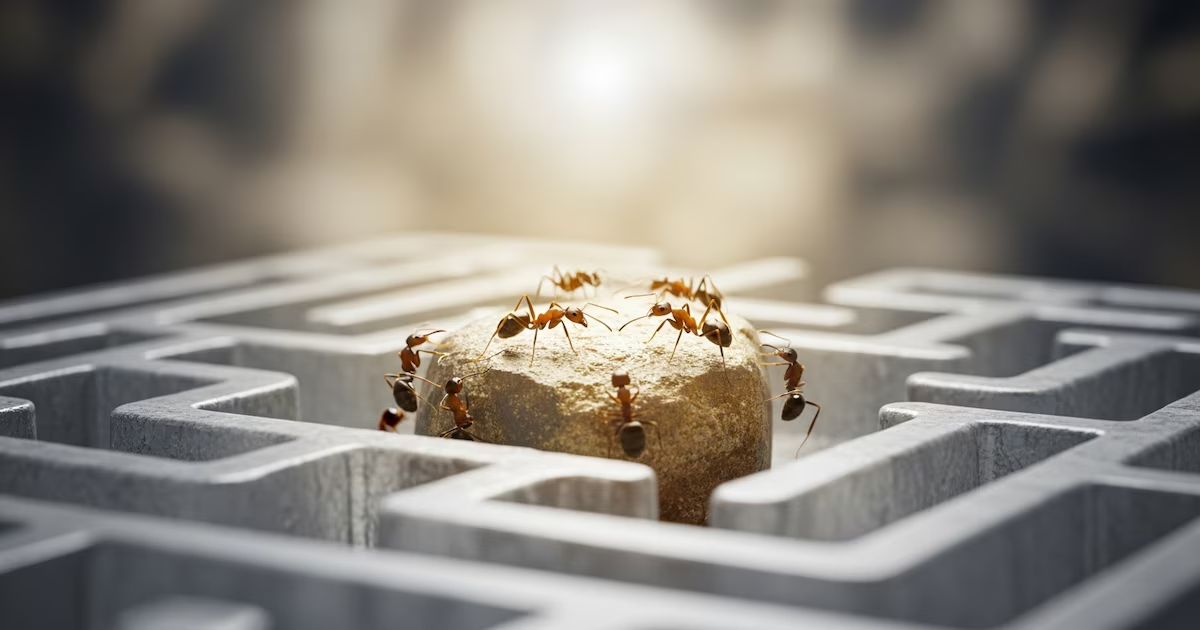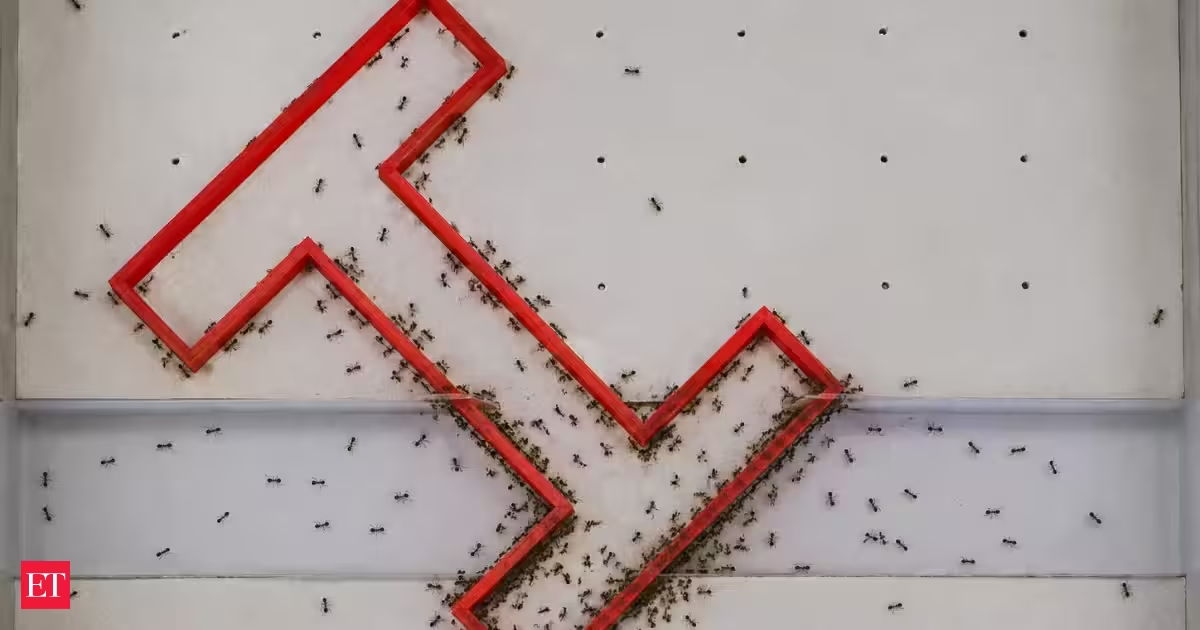
Ants are known for working together in highly organized colonies, and a new study suggests that their teamwork becomes especially valuable when the challenge gets harder. Researchers at the Weizmann Institute of Science found that larger ant groups were better able to solve more complex puzzle-like transport tasks than smaller groups.The work, published in the Journal of the Royal Society Interface, examined how Paratrechina longicornis ants tackled a set of “piano movers’” puzzles designed to test collective problem-solving. The authors say the study highlights the “flexibility and robustness of collective cognition in ant groups.”How the experiment workedThe researchers presented ant groups with a family of puzzles that required a rigid, food-scented load to be moved through slit-like exits. The puzzle set included three single-slit designs, I, T, and H, as well as two more difficult double-slit puzzles, T2 and H2.The team varied both the puzzle geometry and the group size, then tracked how the ants moved the load through the arena. Puzzle difficulty was ranked by the minimal path needed to reach the solution, with the I-puzzle described as the simplest and the H2-puzzle as the hardest.Bigger groups performed more consistentlyOn the easiest puzzle, the I-puzzle, all group sizes performed similarly. But as the tasks became more complex, smaller groups struggled more, showing lower success probabilities and longer cumulative path lengths near the slit.In the T-puzzle, medium-sized groups already outperformed small groups. In the more difficult H-puzzle, the performance gap widened further, and only large groups showed a marked improvement. The study says this pattern shows that “larger groups are more efficient solvers than smaller ones.”Double-slit puzzles raised the difficultyThe double-slit puzzles placed extra demands on the ants because the load had to be moved through a more complicated configuration space. In the T2 puzzle, the ants had to pass through a tight corridor in the puzzle’s geometry, and in the H2 puzzle they also had to avoid a trap that could draw the load into the wrong path.The study found that ants could solve both puzzles, but their paths were much longer than the shortest possible route. Larger groups significantly outperformed smaller ones, especially in the hardest version.Physics models worked only up to a pointTo test whether simple mechanics could explain the ants’ behavior, the researchers compared the ants with simulated solvers based on gravity and noise. That baseline model worked fairly well on the simplest puzzles, but it failed on the more challenging ones.The authors then added ant-inspired features to the simulations, including edge attachment, transient leadership, and slit-directed bias. These improvements made the models more ant-like and helped them better match real ant performance. Still, the study says no single fixed-parameter model could match ant behavior across all puzzles without puzzle-specific tuning.What the findings suggestThe study argues that ants do not need a full geometric understanding of the puzzle to succeed. Instead, the researchers suggest that collective transport benefits from interaction-driven features such as persistence, boundary following, and changing leadership roles.Overall, the findings point to a simple pattern: as task complexity rises, larger ant groups become more effective problem-solvers. The authors say this offers a useful framework for studying collective cognition and for thinking about how biological strategies might inform artificial problem-solving systems.
Scientists gave ants five 'piano movers' puzzles, and larger groups consistently outperformed smaller teams on the toughest challenges
A study reveals that larger ant groups solve complex transport puzzles better. Researchers found that group size significantly impacts success on harder tasks. Smaller ant groups struggled with more intricate puzzle geometries and configurations. Physics models alone could not fully explain the ants' collective problem-solving abilities. This research highlights the flexibility and robustness of ant colony cognition.
536 words~2 min read