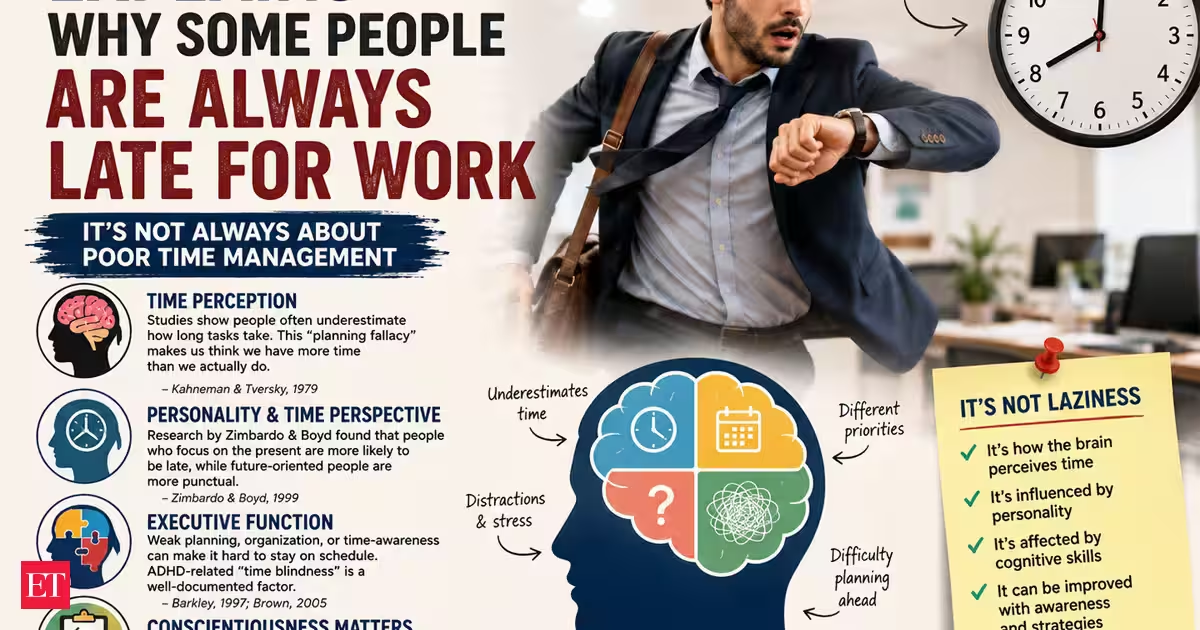
Everyone knows someone who is always rushing into the office a few minutes late. While it is easy to assume these people simply have poor time management skills, psychology suggests the explanation can be far more complex. Researchers have found that chronic lateness may be influenced by how people perceive time, their personality traits, and even the way their brains plan everyday tasks. In many cases, being late is not a sign of laziness or disrespect but the result of deeply rooted cognitive habits. Several studies over the past few decades have helped explain why some people struggle to arrive on time despite their best intentions. Here's what psychology says about the surprising science behind chronic lateness.YOUR BRAIN MAY UNDERESTIMATE HOW LONG TASKS TAKEOne of the best-known explanations comes from the 'Planning Fallacy', a cognitive bias identified by psychologists Daniel Kahneman and Amos Tversky in 1979. Their research found that people consistently underestimate the amount of time needed to complete tasks - even when they have completed similar tasks many times before. This optimistic bias can make someone believe they have 'plenty of time' to finish breakfast, answer one more email, or stop for coffee before work. In reality, these small delays quickly add up, causing them to arrive late. The Planning Fallacy affects students, professionals, and even experienced project managers, making it one of the most common psychological reasons behind chronic lateness.PERSONALITY PLAYS A BIGGER ROLE THAN YOU MIGHT THINKNot everyone experiences time in the same way. According to Philip Zimbardo and John Boyd, creators of the 'Time Perspective Theory', people naturally focus on different aspects of time. Some individuals are future-oriented, meaning they like schedules, deadlines, and planning ahead. Others are more present-oriented, focusing on what is happening right now instead of what comes next. Research published by Zimbardo and Boyd suggests future-oriented people are generally more punctual, while present-focused individuals are more likely to lose track of time. This doesn't mean one personality type is better than another - it simply means their brains prioritize time differently.EXECUTIVE FUNCTION AFFECTS PUNCTUALITYPsychologist Dr. Russell Barkley, known for his research on Attention-Deficit/Hyperactivity Disorder (ADHD) and executive functioning, has shown that skills such as planning, organization, self-monitoring, and estimating time are controlled by the brain's executive functions. When these abilities are weaker, people may struggle to judge how much time has passed or how long a task will actually take. This is especially common among individuals with ADHD, who often experience what experts call 'time blindness'. Importantly, not everyone who is frequently late has ADHD. However, Barkley's research highlights that punctuality depends on cognitive skills - not simply motivation or discipline.CONSCIENTIOUSNESS INFLUENCES EVERYDAY HABITSResearch on the 'Big Five Personality Traits', developed by psychologists Paul Costa Jr. and Robert McCrae, consistently links conscientiousness with punctuality and reliability. People who score high in conscientiousness are generally better at planning ahead, following routines, and meeting deadlines. Those with lower conscientiousness may be more spontaneous and flexible, which can sometimes lead to arriving late. Still, psychologists emphasize that personality is only one part of the picture. Sleep habits, stress, workload, unexpected distractions, and daily routines also influence whether someone arrives on time.Psychology shows that chronic lateness is often about much more than poor time management. Studies by Daniel Kahneman, Amos Tversky, Philip Zimbardo, John Boyd, Russell Barkley, Paul Costa Jr., and Robert McCrae suggest that our perception of time, personality, and brain function all shape punctuality. Understanding these factors can help people develop better habits - and remind us that being late is not always a simple choice.
Psychology explains why some people are always late for work - and why it's not always about poor time management
Psychology reveals chronic lateness stems from time perception and personality traits. Our brains often underestimate task durations, leading to delays. Future-oriented individuals tend to be more punctual than present-focused ones. Executive functions like planning and organization also impact punctuality significantly. Understanding these cognitive habits offers insights into arriving on time.
593 words~3 min read