Story audio is generated using AI
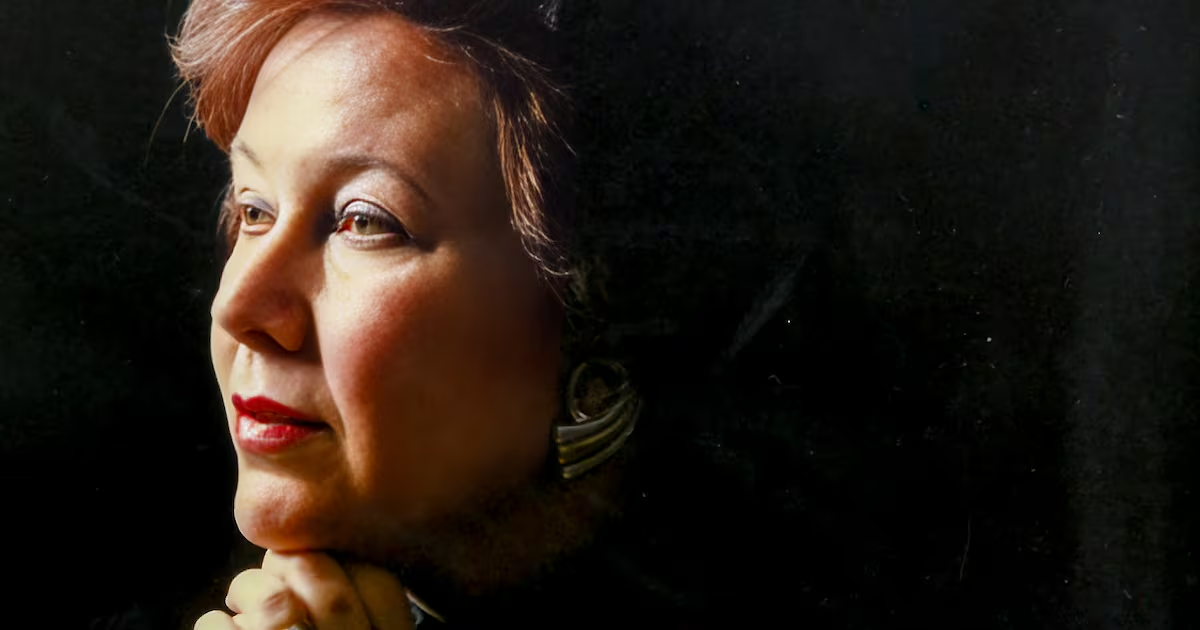
After a lifetime spent working conscientiously and fully engaged in composing contemporary art music that is relevant, aesthetically appealing, mostly accessible but always thought-provoking, I am, ironically, most popularly known now for my role in arranging the South African anthem, rather than for my original creative art music compositions. I find this an interesting and curious phenomenon.In the years leading up to the demise of apartheid and the emergence of democracy in South Africa, there was a kind of frenetic urgency nationwide to give South Africa new national symbols which had meaning and value for everyone in the country.Historical overviewIn February 1995, I received a fax from Dolf Havemann, then acting director-general of South Africa’s department of arts, culture, science & technology, inviting me to an introductory meeting of a newly constituted anthem committee to rearrange the national anthem for a democratic South Africa. The same department had provided financial assistance to me previously for attending overseas music festivals and conferences and thus I was known to them as a composer-musician. I had proved my bona fides with my compositions in Western art music and African genres in local and international spheres. In [former president Nelson] Mandela’s typically generous spirit, it was his wish that the new anthem be as inclusive as possible of all South African creeds and population groups, including Afrikaners. This invitation was a great honour for me and the prospect of meeting the top arts and language practitioners on this platform was truly inspiring. It was the dawn of a new era, one which was going to hopefully herald in peace and prosperity in South Africa.Every country has its national symbols — a flag, a coat of arms and a motto — the purpose being to instil pride in the people of a nation. After the flag, the one that registers most in the minds of its citizens is their national anthem, a patriotic musical composition designed to promote reconciliation and nation-building. The South African national anthem after democracy in 1994 comprised a combination of two separate pieces of pre-existing vocal musics: Nkosi Sikelel’ iAfrika (1897), music and lyrics by Enoch Sontonga (ca 1873–1905) and Die Stem van Suid-Afrika (1921), music by Marthinus Lourens de Villiers (1885–1977), lyrics by Cornelis Jacobus Langenhoven (1873–1932).Die Stem (The Voice) was originally an Afrikaans poem, written in 1918, a deeply patriotic text extolling the beauty of the landscape and one’s self-sacrifice if necessary but from the exclusive viewpoint of the white Afrikaner. It was in 1957, nine years after the Nationalist government came to power under prime minister DF Malan, that it was declared the only official national anthem of South Africa. However, it was first sung in 1928 at the hoisting of the national flag on May 31 and quickly became a popular, iconic symbol of Afrikanerdom. I recall having to learn to sing this anthem in Afrikaans in our English-speaking primary school in the 1960s.‘Sound Me Out: A Lifetime of Music and Memories’ by Jeanne Zaidel-Rudolph. Picture: (Supplied) In 1993, I recall an important proclamation being issued in terms of the provisions of section 248 and read with section 2 of the Republic of South Africa’s constitution; it stipulated that Die Stem and Nkosi Sikelel’ iAfrika would be the country’s national anthems, to be sung consecutively. Though this was democratically appropriate, it would result in an anthem lasting more than five minutes (arguably the longest anthem internationally). It was soon understood to be impractical if both anthems were to be retained in their original forms. It was Mandela’s wish that they be combined and shortened.The words of the first stanza of Nkosi Sikelel’ iAfrika were originally written as a hymn in isiXhosa by Enoch Sontonga at the tender age of 24 in 1897. The music was documented by him in tonic sol-fa in an exercise book, but he died before it was published. Seven additional isiXhosa stanzas were added later by the poet Samuel Mqhayi in 1927. Having been composed as a hymn, it represents a fusion of African and Western cultures. It is an interesting fact that it became a pan-African liberation struggle song and was adopted as a national anthem of five countries, including Zambia (1964–73), Tanzania (from 1961), Namibia (1990 briefly) and Zimbabwe (1980–94) after independence, and then by South Africa after the dismantling of apartheid (from 1997). During apartheid, the song became representative of the struggle against oppression. However, while it was popular among black people, it was banned by the white apartheid authorities, who stringently monitored what was aired on radio and in public.Prof Jeanne Zaidel-Rudolph. Picture: (Supplied) Michael Levy (2009), in his report on the new anthem, states: “The SA Cabinet (1995) established an anthem committee to produce a shortened version in both choral and instrumental settings.”Due to my composing experience and expertise in orchestral arranging, I had the honour of being designated to execute the new composite version by combining the two anthems artistically into one. I considered this somewhat of an irony, given that in my 1974 piano work, Three Dimensions, I parodied Die Stem musically.Members of our committee were asked to put forward ideas for how one could musically combine the two anthems into one composite version, with a stated duration of no longer than two minutes. The two existing anthems had previously been sung successively at formal gatherings, beginning with Die Stem. The lengthy duration was a problem. My suggestion to the committee at the follow-up meeting was to put Nkosi first (since musically and ideologically, it was the most appropriate of the anthems). This was accepted by the committee, as was my recommendation to cut certain repeated lyrics to radically shorten the music. I was tasked by the committee with creating this new composite version based on the musical blueprint that I proposed. I accomplished this digitally in 1995 on behalf of the anthem committee.To cut and paste — to preserveIn order to shorten the combined version considerably, rigorous discussion ensued in the committee meeting about sections such as Woza Moya. Fatima Meer, a Muslim woman, suggested that this section — present in the previous anthem — be omitted, as it referenced the Christian Holy Trinity and was therefore not inclusive of the country’s other faiths, such as Islam, Judaism and Hinduism. These words, which appeared in the original isiZulu chorus (“Descend, oh spirit”) were officially objected to by the Council of Muslim Theologians, and it subsequently made a submission to the committee against their retention. The submission read: “This refrain is a reference to the Christian theological concept of the Holy Trinity. Muslims, who constitute a significant sector of our society, cannot sing this refrain without doing violence to their fundamental creed. By reading the refrain, Muslims argue that they will be defying the very essence of monotheism.”Similarly, the Afrikaans words “Deur ons ver verlate vlaktes met die kreun van ossewa” (“From our plains where creaking wagons cut their trail into the earth”) referenced the Great Trek of 1835, which was the experience of only one sector of the population — the Afrikaners — and thus were not inclusive and were removed. The deletion of these words was supported by members of the committee.There had previously been no original English words in Die Stem. Instead, a literal English translation of the Afrikaans words existed and was frequently sung by Anglophone citizens. However, it did not form part of the official national anthem when it was sung. I personally felt that it was time to include some original English words to be part of the new version and I suggested this to the committee. There is a misconception that the present version with English words is a literal translation of Die Stem, but that is not the case. I wrote English words for the last four lines of the version in use today, which were accepted by the parliamentary cabinet.The anthem committee made several proposals to the cabinet in May 1995. The proposal I put forward was chosen and my blueprint for the new anthem was accepted by the cabinet. This would reflect my preference for placing Nkosi Sikelel’ iAfrika at the beginning of the anthem followed by Die Stem, a suggestion that was ideologically and demographically sound.Tones and traditionsIn writing a new arrangement of the two previous anthems into one composite version, I tried to remain as true as possible to the original musical concepts, with their structures, flavours, sentiments and sensitivities. After a two-bar (music measure) instrumental introduction (using the same melody that was later applied to the words “Thina lusapho lwayo”, I wrote the main body of the anthem. I used the melody as found in its original form, but I enriched the harmonies and piano accompaniment to reflect the richness of South Africa’s diverse peoples.I use a typical music chord progression that is unmistakably African in nature. I applied it to the anthem to infuse the music by moving in parallel harmonies from the main tonal chord to its neighbouring chord (for musicians … Chord I G major, directly to Chord ii A minor), being literally “alongside”. It is a musical metaphor that resounds with the ideals of ubuntu, the African value of “humanness” that epitomises black communities in our country. The concept can best be explained as “I am human through your humanness” — in other words, “my compassion and decency are contingent upon yours, and if your actions are anything less than humane and compassionate, then you betray not just yourself, but also me”. We are a country that embodies diversity, and the anthem is intended to be a blend of the best of African and Western cultures. I consulted Mzilikazi Khumalo, a professor of African languages at the University of the Witwatersrand, about the correct treatment of the languages to avoid any possible misrepresentation of the words due to the drastic “shortening” of the structure.I kept the first two verses in the music key of G major, as it is in a comfortable key range in which the average voice can sing. However, to have continued at that pitch for Die Stem would have rendered it impossibly high for anyone to sing, so it necessitated a change of key. The modulation (change of tonal centre) to the next part is sung on the repetition of the words, “South Africa …” just before the section in Afrikaans, and it flows smoothly from G major into the key of D major for the last two stanzas. It appears to be the only anthem in the world that begins in one key and ends in another. This is referred to musically as being “neomodal”. This was necessary not only to accommodate the average voice range but also to signify the transition from a state of oppression and injustice to one of liberation and hope.In the orchestral version, which the committee commissioned me to arrange, I applied a music technique called “counterpoint”, which layers two or more music melodies vertically on top of one another in a combined form. This creates a pleasant harmony, but still reflects the importance of the two individual voices. I superimposed the two previous anthems musically and created a harmonisation near the end, where I used the Nkosi melody running below the Die Stem melody at the words “Sounds the call to come together …” In this way I effected a “combination of cultures”, figuratively and literally, working together as one.The première performance of the new anthem under the auspices of the Massed Choir Festival was held at the Good Hope Conference Centre at the Foreshore in Cape Town on May 7 1995. This impressive auditorium has a maximum capacity of 7,000 people. I was invited to attend the premier performance, an exciting event during which a massed Cape choir (comprising 17 different choirs) sang the new anthem, accompanied by the Cape Town Symphony Orchestra under the batons of several conductors, including Richard Cock and Mzilikazi Khumalo. My family and I were given front-row seats, and I felt intensely proud to have provided the orchestra with freshly printed score sheets in full orchestration for any performances going forward.According to Levy (2009): “In normal copyright circumstances, rights-holders (composers and arrangers of music) would be entitled to a share proportionate to the creative material they put into the work as it exists in its official version. However, it was immediately apparent that it was undesirable to have a situation in which patriotic South Africans would have to obtain a performing-rights licence every time they wanted to show their love of their country by singing or playing their country’s national anthem!” In this vein, it would be equally undesirable for people to have to obtain a mechanical (recording) rights licence to authorise the making of sound recordings of the work, for example, on CDs or on soundtracks of videos and films.So naturally, when it came to my contribution, I received no royalties for the work I did, nor did any members of the anthem committee for their contributions. Regarding this, Levy stated: “It should be noted that any creative work was apparently done under contract to the government. One of the provisions of the Copyright Act confers ownership of the copyright in works created by an employee in the course of his duties to the employer. Thus, copyright in such work also belongs to the government.” The National Anthem of South Africa is thus owned by the state, which has determined that the work is in the public domain. Therefore, in practice, no copyright revenue is accrued by the work, not even for arrangements or adaptations of the music and/or lyrics. I did, however, receive a cheque of R3,500 for my full orchestration of the work.Business Day