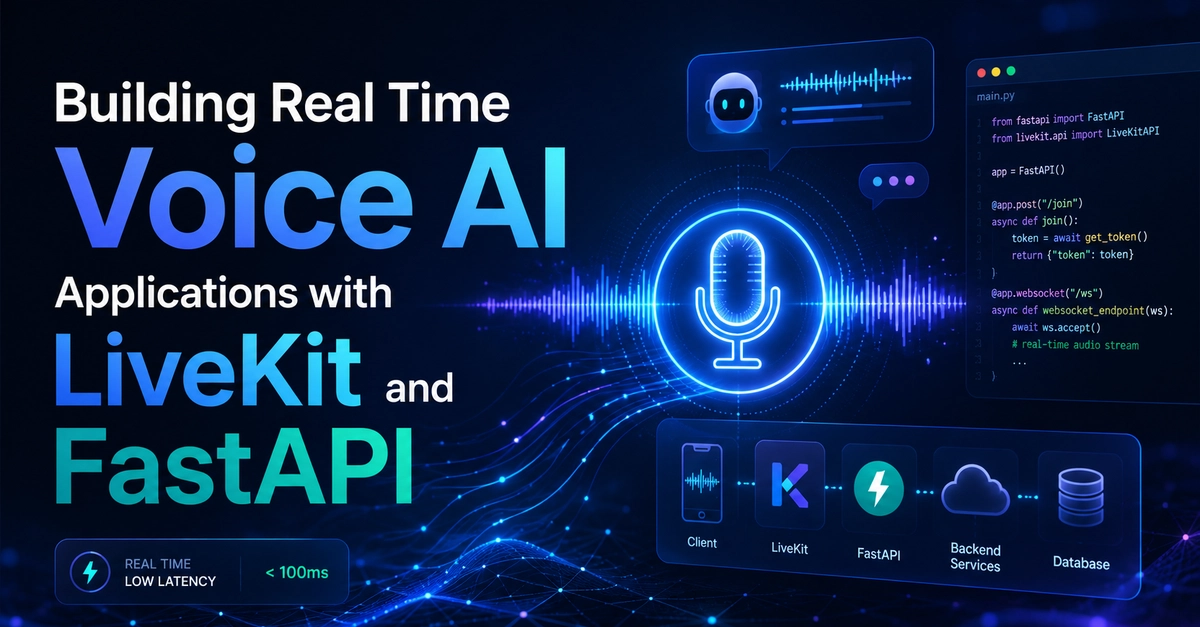
Legacy Interactive Voice Response (IVR) systems frustrate customers with rigid, robotic menus, yet migrating to cutting-edge voice agents can quickly balloon cloud budgets or trigger severe compliance failures. For engineering leaders, choosing how to build interactive voice pipelines is a high-stakes decision. Evaluating openai realtime api vs livekit for enterprise voice deployments requires looking beyond simple API wrappers to analyze transport protocols, token economics, and data boundaries. This guide will help you confidently choose between OpenAI's managed Realtime API and a self-hosted LiveKit open-source pipeline based on your latency, cost, and compliance constraints.
OpenAI Realtime API vs LiveKit for Enterprise Voice: Core Architectural Differences
To build a voice agent that feels truly human, you must choose between two fundamentally different engineering philosophies: a monolithic cloud model or a modular, decentralized transport pipeline.
OpenAI’s Realtime API is a managed, all-in-one solution. It merges speech-to-text (STT), natural language reasoning, and text-to-speech (TTS) into a single, multimodal model hosted entirely on OpenAI's infrastructure. Communication occurs over a single, persistent WebSocket connection. While this eliminates the need to coordinate separate microservices, it binds your application entirely to OpenAI's cloud, leaving you with little control over the underlying audio processing or streaming mechanisms.