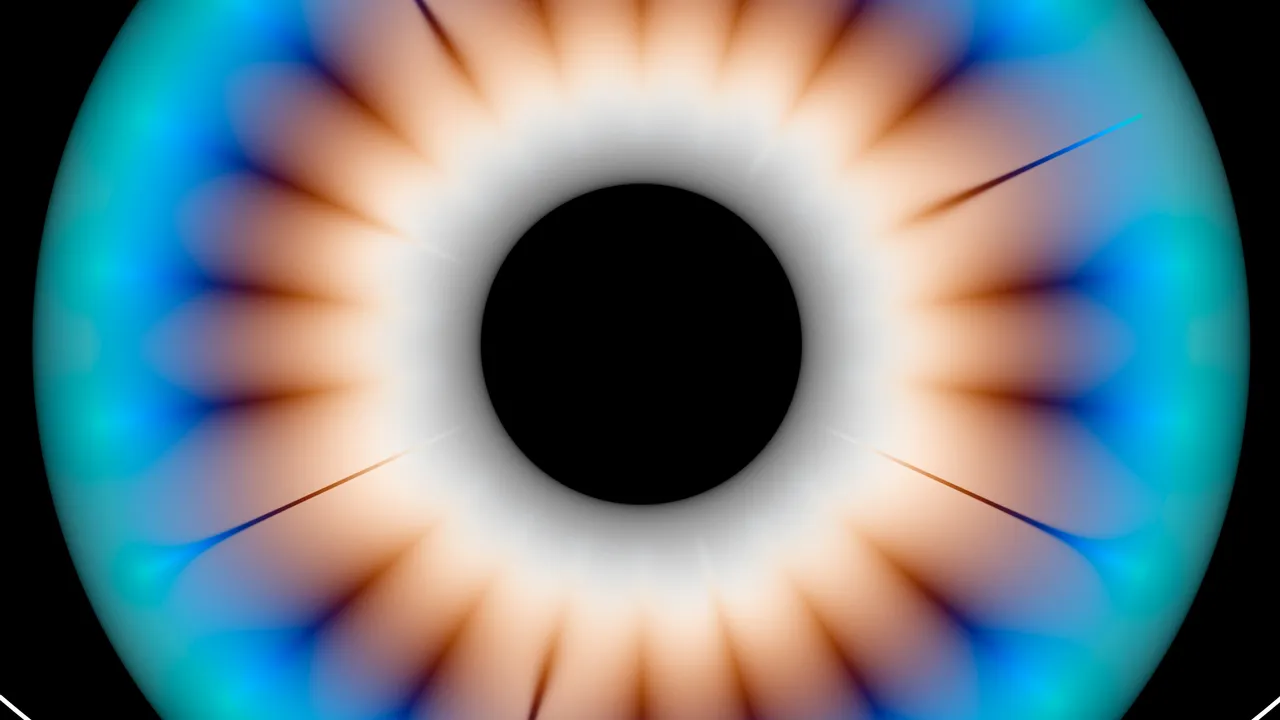
What we see can expand the vocabulary of our perception. One researcher said of olo, “If I was exposed to it enough I would probably say that the word ‘teal’ is not doing it for me anymore.”Illustration by Zach LiebermanWhen I first read about olo, a never-before-experienced color that scientists had conjured in a lab at the University of California, Berkeley, I realized I didn’t really know what color was. Olo, described as the “greenest green,” wasn’t a new wavelength of light. It wasn’t a new pigment. It wasn’t a philosophical thought experiment. Researchers had done something astonishing and mechanical at once: they had figured out how to stimulate an array of retinal cone cells in the eye in such a way that would never happen naturally, to allow for the perception of an altogether new color.Humans typically have three types of retinal cone cells, termed L, M, and S. In natural seeing, it’s always some mix of those three types that is stimulated. A person can only see olo when it’s just M cells being stimulated. What they would see, apparently, resembles the iridescent teal of a peacock feather, but somehow more intense. In my reporting for a story in this week’s issue, I spoke with the olo scientists and with other color experts, including my friend Julian Kreimer, an artist who has taught courses on color for many years. “What I wouldn’t give to have hummingbird eyes for a day,” he said, because hummingbirds have four types of retinal cone cell, in contrast to our three, giving them a baseline experience of four primary colors.I wasn’t able to interview any hummingbirds, but I did learn from Gabriele Jordan, a Ph.D. student in experimental psychology at Cambridge University, about her research with rare women who, like hummingbirds, have four functional cone-cell types, moving through the world with a dimension of color beyond what most of the rest of us experience. “It was a once-in-a-lifetime feeling of true discovery,” she said, of the realization that there’s a population with this anomaly. Before working with Jordan, these women had no sense of themselves as having extraordinary vision.Only seven people have ever seen olo. It cannot be printed, painted, or photographed. I came to learn that experiencing a color, any color, is far more complicated than engaging a pattern of cone-cell stimulation, and that olo, in addition to being a previously unseen color, was also a clue to the still mysterious details of how we see color itself.Illustration by Princess HıdırAfter a walk in the park one day, in Berlin, Ben Crair experienced an excruciatingly itchy rash. It apparently came from an encounter with the toxic, microscopic hairs of oak processionary caterpillars, which, according to one study, can be “projected in the air as a fine powder.” It turns out, Crair got off easy with only the itch—there are much worse outcomes. And caterpillar infestations of this kind are becoming a regular part of European summers. Read or listen to the story »More Top StoriesThe midterms are becoming a referendum not just on Trump but on the Democratic Party. Will Abdul El-Sayed, who is running for the Senate in Michigan, be a savior of the Party—or a spoiler? He spoke with David Remnick on The New Yorker Radio Hour about campaigning with Hasan Piker, holding the President to account, and why his fellow-Democrats need to “stop compromising.” The Justice Department is attempting to prosecute James Comey for posting an Instagram photo of seashells arranged to read “86 47.” It’s a case of “tragicomic excess,” Ruth Marcus writes. Decades after Milli Vanilli’s lip-synching scandal, the singer Fab Morvan is still reclaiming his legacy—with a documentary, an EP, and an almost-performance at Trump’s state fair. The most-clicked item in yesterday’s newsletter was about the case of Lindsay Clancy, who killed her three young children while she was in the midst of a postpartum mental-health crisis.
A Color Only Seven People Have Seen
From the daily newsletter: What would it be like to see an entirely new color? A handful of researchers don’t have to wonder.
651 words~3 min read