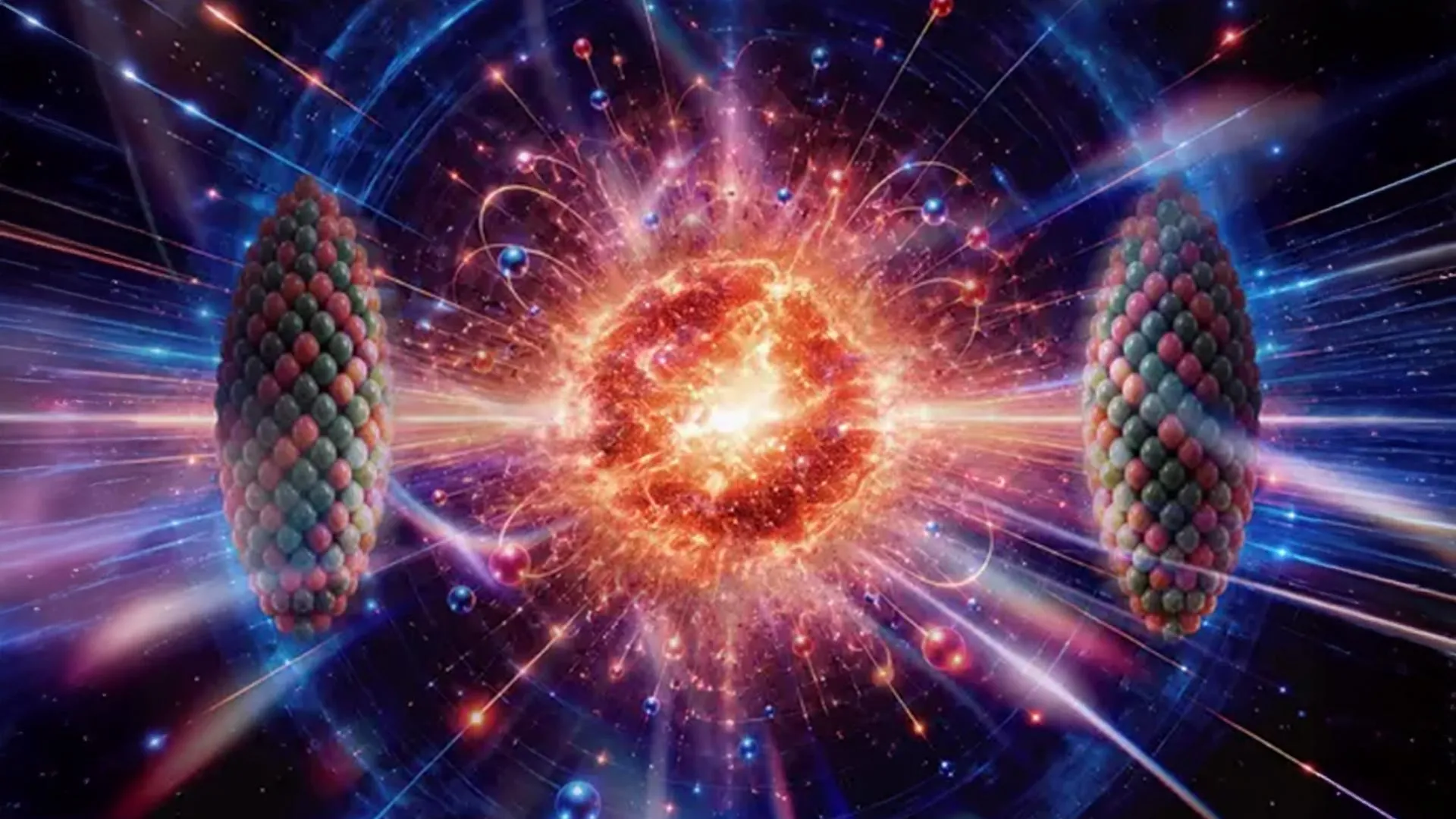
When atomic nuclei crash into one another at nearly the speed of light, they briefly produce quark-gluon plasma, an extraordinarily hot state of matter in which quarks and gluons can move freely. This exotic material behaves like an almost perfect fluid and offers scientists a way to study conditions similar to those that existed shortly after the Big Bang.
Researchers have devoted considerable attention to the plasma's intense swirling motion and powerful electromagnetic fields. Its acceleration, however, has received far less scrutiny, even though it directly contributes to the fireball's rapid expansion. In hydrodynamics, acceleration is considered just as fundamental as vorticity, much as electric and magnetic fields are treated as equally important parts of electromagnetism.
Mapping Acceleration Across Collision Energies
A research team led by Fudan University physicists Yu-Gang Ma and Xu-Guang Huang set out to map how acceleration forms and changes inside quark-gluon plasma.
The researchers combined two widely used particle transport models, AMPT and UrQMD, with a Gaussian smearing method. This technique transformed individual particle distributions into continuous energy, momentum, and velocity fields, allowing the team to examine the plasma as an evolving fluid.