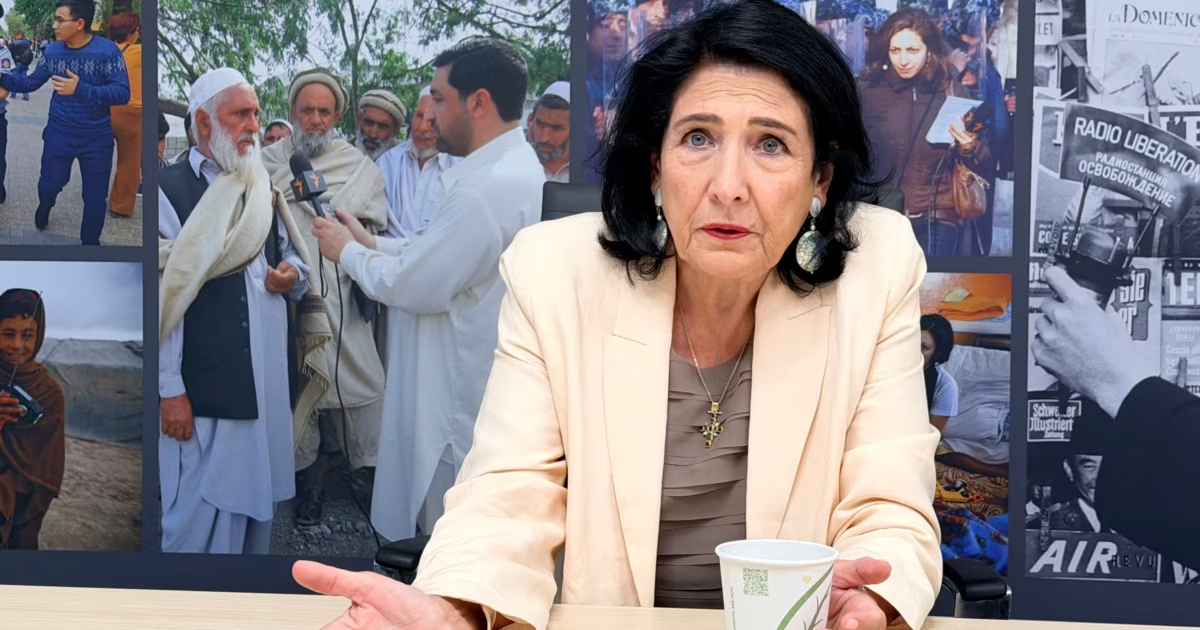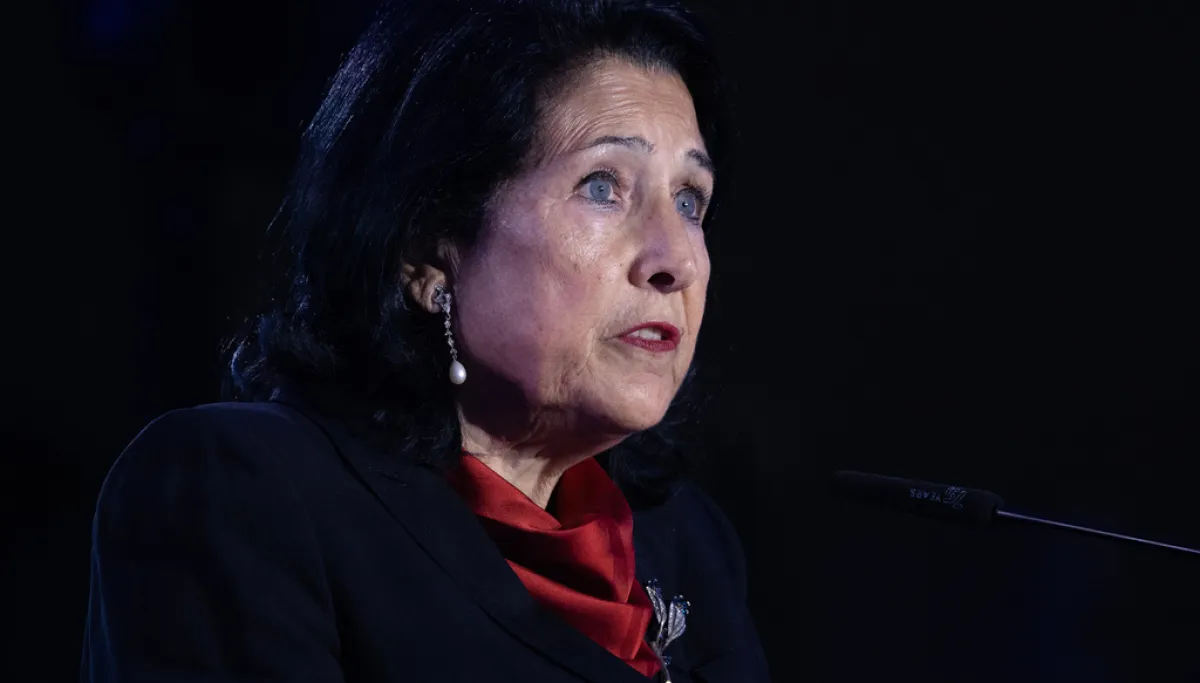
In the summer of 2008, as Russian tanks rolled toward Tbilisi, the woman who is today the symbol of Georgia’s pro-Western opposition was writing the book that Russia would later carry into a courtroom in The Hague and read aloud against my country.That sounds like a polemic. It is a matter of record, and it explains something Washington keeps getting wrong about Georgia.Salome Zourabichvili was born in France, the granddaughter of Georgian emigres, and had a real diplomatic career in Paris. After the Rose Revolution, many of us were intoxicated by the idea of bringing our emigres home and handing them the state to rebuild. In 2004, President Mikheil Saakashvili detached her from the French foreign service and made her Georgia’s foreign minister. Her appointment was read as a signal of Western intent.
AMERICA LEFT THE BUILDING. UKRAINE TOOK THE WHEELI was not reading that signal from abroad. I read it from a desk in Tbilisi, as a serving counterintelligence officer, when she was appointed in 2004 and again when she was dismissed in 2005 — and a foreign ministry is watched closely, from the inside as much as the outside.The book
In 2008, the year of the war, she published “La tragédie géorgienne, 2003-2008” in Paris, a memoir of disillusion with the government she had served. As literature, that was her right. Here is what happened to it next.On Aug. 12, 2008, Georgia filed suit against the Russian Federation at the International Court of Justice, accusing Moscow of ethnic persecution in South Ossetia and Abkhazia. On Dec. 1, 2009, Russia filed its preliminary objections. And in that filing — pages 31 to 32 and 34, a matter confirmed by Georgia’s own fact-checking organization with a verdict of “true” — Russia quoted Zourabichvili’s book to build its case against Georgia.Moscow used her account of 2004 to argue that Tbilisi “spoke with the language of arms.” It used her description of the defense budget to argue that Georgia, “behind the appearance of a defense policy,” was pursuing “military revenge and the forcible reintegration of the lost lands.” The aggressor reached into the memoir of a former Georgian foreign minister and read it back to the world as a confession — a citation, in a legal brief, by the country that occupies 20% of Georgia’s soil.That is the whole method. I am not claiming she was a Russian agent, and I have no reason to think she was, which is the point. Moscow did not need to recruit her, and it did not need to invent her. It only needed her to write the sentences down. The Kremlin does not require ideological consistency from the people it quotes. It requires only useful quotations.The line the Kremlin loved