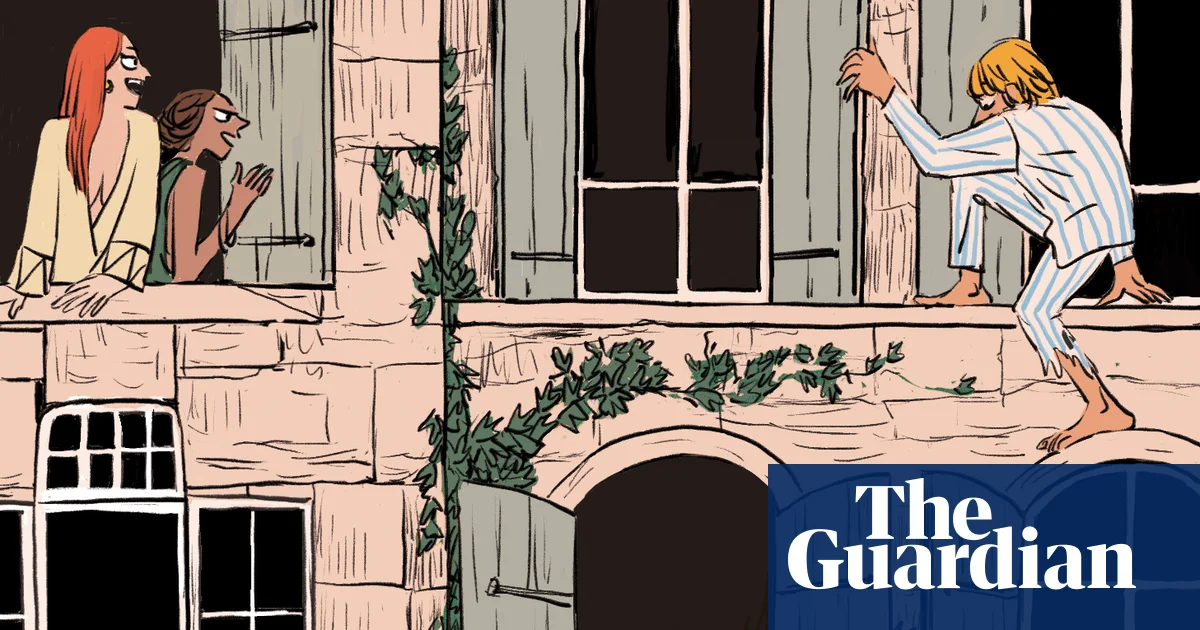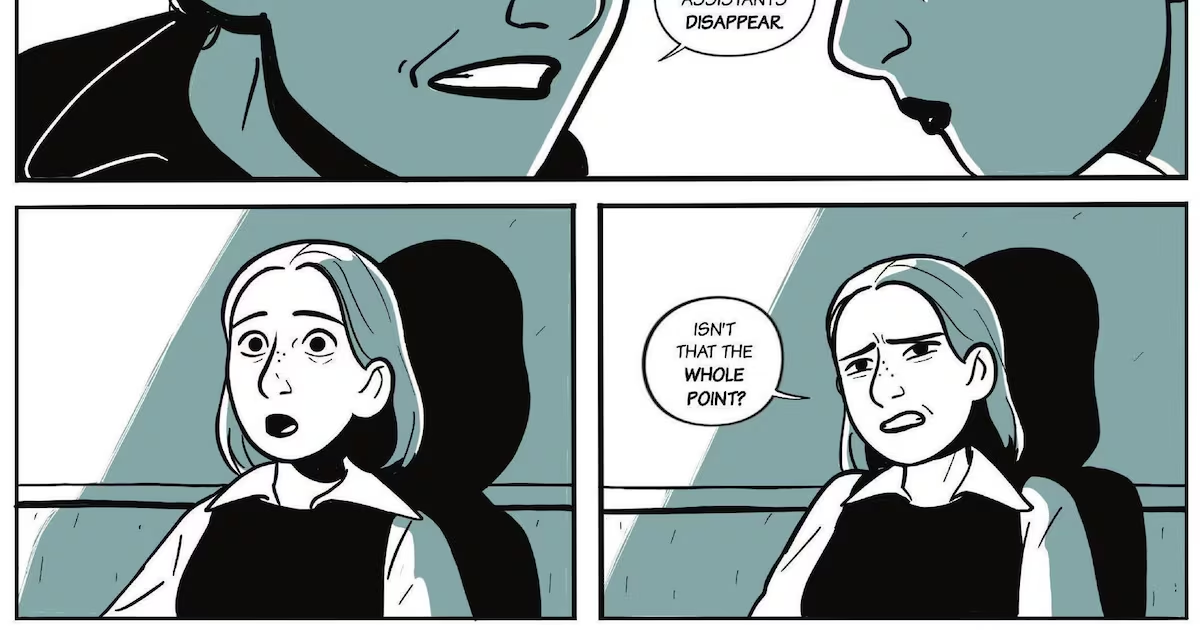
Sometimes, when describing a work as “charming”, there is the distant suggestion of something like faint praise. The sense that maybe, somewhere between a work being good or bad, there sits some nebulous middle quality of “charm”, behind which a cowardly reviewer can hide. What, then, is a critic to do with Dogs on Dates, by Luke Healy (Faber), which is not just a joyful and hilarious read but so bloody charming that it’s impossible not to say so?Dogs on Dates is a romantic comedy about two gay dogs, Bernie and Brad, looking for love and companionship in the city of Dogtown. We follow their relationship through a series of numbered dates, some of which are longer treatments, hewing to the standard grammar of romcom high jinks: Bernie is cataclysmically late for their first date because of a bravura series of unlikely mishaps; Brad agonises over introducing his rich, snooty family to his cooler, more down-to-earth beau; both find themselves trapped in an escape room with an unwelcome ex.Most of their dates, however, are single-page affairs, with a phenomenally high gag rate and, yes, more charm than you can throw a knobbly stick at. Whether breezily dispatched reflections on modern life, food trends or pop culture, these snapshots are also about something much weightier: the always-messy business of falling in love.The Woodchipper, by Joe Ollman (Drawn & Quarterly), begins with a gloriously self-deprecating introductory strip in which Ollman draws himself directly addressing the reader, begging us to believe that graphic short stories are the hot new craze all the kids will love.[ How a St Brigid miracle not taught at school was reclaimed by a graphic novelistOpens in new window ]What comes next are five warm, tender tales from blue-collar Canada, each surveying the quotidian humiliations of modern life: an abattoir security guard develops an unlikely friendship with one of the animal-rights activists protesting her place of work; a book clerk is trapped in a bathroom on Christmas Eve; a schlubby husband attempts to navigate a torturous birthday party for his fancy, academic wife. Each broadcast Ollman’s rare flair for elevating the everyday to the pitch of high drama, and his nous for interrogating the neuroses at the centre of contemporary life. His characters are stuck, sad, confused, conflicted and lost in their own self-obsession. Which is to say they’re human. Ollman may have been joking when he said graphic short stories should be the next big literary craze. But, on the strength of this collection, he might well be right.The Woodchipper, by Joe Ollman. There’s more evidence for his assertion in Fault Lines, by Rob Cullen (Ablaze), an engrossing suite of three short stories, each of which carries an undercurrent of the macabre. The Vanishing Act concerns an Irish singer in Blackpool who takes on a job with a magician who may or may not be making his pretty young assistants permanently disappear. How to Be a Ghost is a meditation on parental grief disguised as a ghost story. Siren is an exploration of guilt that cleaves closely, but not too closely, to the seminal X-Files episode Drive.[ Best graphic novels of 2025 so far: ‘One of the most affecting reading experiences I’ve had for many years’Opens in new window ]The tone throughout is more one of gentle unease than pitch-black horror, more Roald Dahl or EL James than Clive Barker. But each has an absorbing, moreish quality, rooted in real emotion and psychological depth.These are quiet, assured tales that reward rereading, and the best compliment I can pay to this collection is to say that three is simply not enough.Dear Historian, by Joff Winterheart (Jonathan Cape), tells the story of Dr Margaret Crypt, a septuagenarian historian, and Lucy, a 30-something TV producer. Lucy thinks Margaret would be great on telly, but Margaret is less convinced, as she has little interest in the world beyond her academic interests, least of all television, which she reviles. Her main preoccupation, we discover at some length, is the obscure 17th-century polymath JW Preece, the study of whose life and works she has made her vocation.From Dear Historian, by Joff Winterheart. What follows is, on one level, a gently biting satire on the populism of mainstream history telly – the dumbed-down documentary outfit Lucy works for is named, unimprovably, Giant Past – but also at the pedantry and sneering of professional historians who see no good at all in diluting the complexity of their research for a general audience.All of that, however, is mere background to Dear Historian’s true appeal as one of the tenderest depictions of intergenerational friendship you’ll find anywhere in fiction. We grow to love both Margaret and Lucy for their foibles, as well as the hopes, griefs and disappointments that follow them wherever they go. Neither is a cliche of her world views, and each is given a fully three-dimensional personality. There is an old-timey feel to Children of Light’s plotting and structure, its panels topped with prolix word balloons filled with tropey, formulaic sci-fi worldbuildingWinterheart’s writing is whip-smart and his dialogue a miracle of realism, devoid of false notes or easy laughs, making both his leads a pleasure to spend time with, and so making Dear Historian very dear indeed.Children of Light, by Jean Pleyers (translated by Luke Burns; NYRB Comics) is the definition of a space oddity. Originally serialised in the 1980s by the French sci-fi anthology Métal Hurlant, Les Êtres de Lumière is a galaxy-spanning space opera that charts the troubles of the Zors, an alien species forced to abandon their native planet and travel through the cosmos to find a new home. This odyssey requires them to brave the perils of deep space in a planet-sized spacecraft, confronting predation by other alien races, and factional ruptures among their own kind.There is an old-timey feel to Children of Light’s plotting and structure, its panels topped with prolix word balloons filled with tropey, formulaic sci-fi worldbuilding. The Zors are literally little green men who travel in flying saucers and conduct themselves like, well, the 1950s ideal of a race of technologically advanced aliens. The book’s pacing, too, is patchy, at times languorous and stately, at times brisk to the point of bluntness – no doubt a holdover from cramming Pleyers’s cosmos into the distinct pagination in which it was originally serialised.What elevates the work into something altogether more satisfying is the sheer energy of Pleyers’s art and his glorious unselfconsciousness as a storyteller. Tropes that might induce groans early in the text soon become background to the sweep and scale of the world he has built for us. Layer by layer, we get glimpses of the culture, technology and politics of his creations. As the Zors plot, scheme and backstab each other en route to colonising another planet that turns out to be not all they bargained for, we also discern glimmers of satirical intent within each strand of its preposterous narrative.Not that its author would agree that this is a moral fable, or even a fabulation in any sense. In an eye-popping interview included at the book’s end, Pleyers rejects the notion that his long-lost work is fiction at all. Suffice to say, the numerous, detailed accounts of his own alien experiences are worth the price of admission all by themselves.
Séamas O’Reilly on best graphic novels of 2026 so far
Dogs on Dates, by Luke Healy; The Woodchipper, by Joe Ollman; Fault Lines, by Rob Cullen; Dear Historian, by Joff Winterheart; and Children of Light, by Jean Pleyers
1,215 words~6 min read