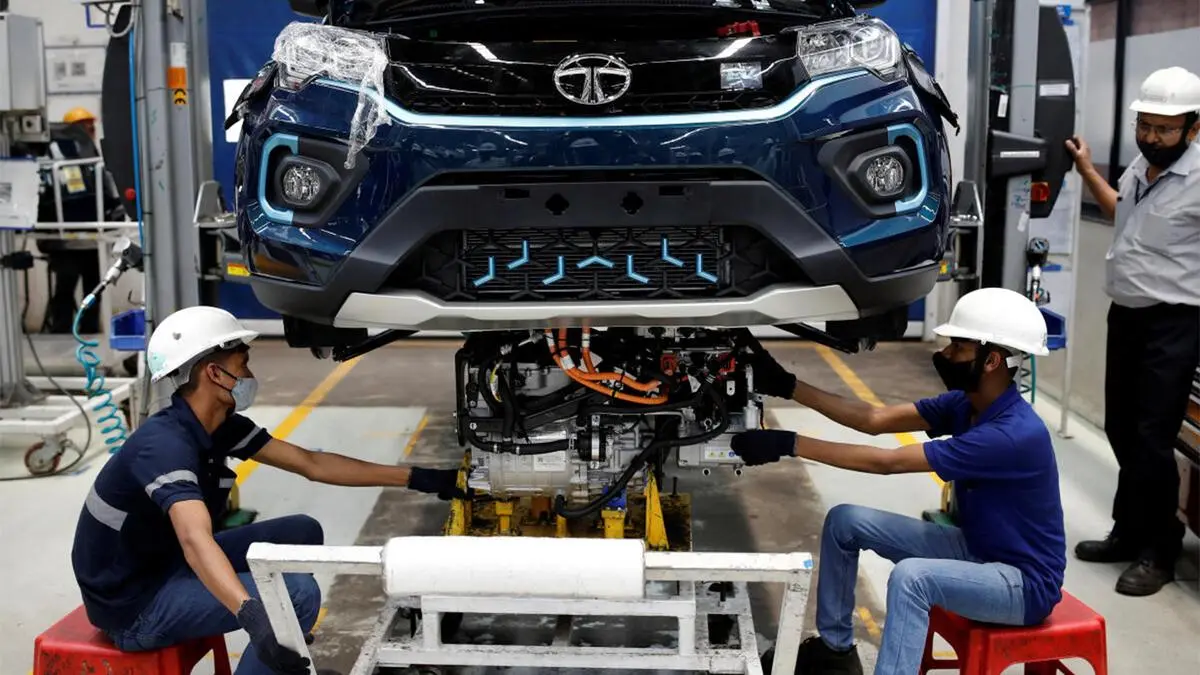
India’s long-awaited private sector capital expenditure (capex) cycle is gathering force, signalling growing confidence in the country’s long-term growth prospects, despite global uncertainties. Companies across the infrastructure, manufacturing, automobile, energy, food processing and digital sectors are unveiling investment plans worth several lakh crore rupees.A key indicator of this trend is the sharp acceleration in corporate credit. Reserve Bank of India (RBI) data shows credit to industry grew 19.2 per cent year-on-year in June 2026, compared with just 6.3 per cent a year earlier, reflecting rising demand for funding large expansion projects across sectors.Borrowing shiftBankers say the nature of corporate borrowing has also changed significantly. “We are seeing a healthy demand for borrowing for setting up greenfield projects. Corporate credit demand is coming from renewable energy, data centres, warehouses, and food processing, among others,” said Kalyan Kumar, Managing Director and CEO, Central Bank of India, recounting how the bank had, jointly with another public sector bank, recently sanctioned a loan to a company for setting up a data centre.Central Bank of India’s own performance is marked by a stronger growth in corporate lending, alongside retail and MSME loans.Industry-wide credit data also points to broad-based investment recovery. Lending has accelerated across medium and large industries, with infrastructure, engineering, construction, textiles, petroleum products and chemicals emerging among the fastest-growing sectors.Market participants believe the current investment cycle differs fundamentally from the previous one because it is driven by expansion rather than maintenance spending. “The private capex has crossed public capex after a long time. The best indicator is the capex-to-depreciation ratio, which has crossed 2x from a bottom of 1x, indicating that capex is now more than about maintenance,” said Manish Bhandari, Managing Director and Portfolio Manager, Vallum Capital.This view finds an echo in an ICICI Securities report, which estimates that listed companies will spend nearly ₹12.6 lakh crore on capex in 2026, taking corporate investment close to historic highs. Significantly, it captures a broader trend: the 2023-26 investment trajectory bears striking similarities to the 2001-04 period, just before India entered a multi-year phase of accelerated growth. The research firm notes that the capex-to-depreciation ratio has risen to 1.9x, reflecting a shift towards growth-oriented investments rather than asset replacement.Corporate India’s strengthened financial position is an added support. According to the report, the ratio of cash flow from operations to capex stands at 1.5x, indicating sufficient internal resources to fund expansion while maintaining healthy balance sheets. The number of firms investing more than ₹1,000 crore annually has reached a record 168, compared with 91 at the previous peak in 2012.The combined capex of listed companies, the Centre and states is estimated at nearly ₹32 lakh crore in FY26, creating a powerful investment multiplier.Adani to the foreThe infrastructure and energy sectors remain central to the emerging capex cycle, with the Adani Group alone outlining cumulative investment exceeding ₹3 lakh crore across the power, airports, renewable energy, aluminium, defence, logistics and industrial manufacturing segments. For FY27, the group’s listed companies have guided capex exceeding ₹1.47 lakh crore.Among its largest planned investments is the newly announced ₹1.08 lakh crore aluminium project in Odisha, developed by Adani Enterprises in partnership with Abu Dhabi-based International Resources Holding (IRH).The conglomerate has also broken ground on a ₹2,500-crore integrated missile manufacturing ecosystem in Madhya Pradesh, while separately unveiling a ₹2-lakh-crore investment plan over five years in its power business, including its proposed entry into the nuclear energy segment.The expansion follows a record ₹1.53 lakh crore capital expenditure in FY26, which Chairman Gautam Adani recently said accounted for more than 30 per cent of India’s private-sector capex during the year.The group’s financial position has strengthened alongside its investment programme. After spending ₹1,52,967 crore on new projects in FY26, the Adani Group has expanded its total asset base to ₹7,85,098 crore while maintaining cash and cash equivalents of ₹55,852 crore, which is about 15 per cent of total debt. Its average borrowing cost has declined to 7.8 per cent from 9 per cent two years ago, aided by multiple credit-rating upgrades.Auto revs upAutomobile manufacturers are also driving private investment, collectively committing more than ₹1 lakh crore towards expanding capacity and accelerating the transition to electric mobility. Tata Motors has outlined a nearly ₹35,000-crore passenger vehicle investment programme through FY30, while Mahindra & Mahindra plans to invest about ₹27,000 crore over the next three years to strengthen its SUV and electric vehicle portfolios.Maruti Suzuki has committed ₹14,000 crore for capacity expansion, while Hyundai Motor India recently announced ₹7,500 crore investment in its manufacturing operations in Maharashtra.Steel, FMCG and moreITC has outlined a ₹20,000-crore investment pipeline spanning manufacturing and food processing. JSW Steel has announced some of the country’s largest manufacturing investments as part of its strategy to double domestic steel-making capacity to 62 million tonnes by FY32. The company recently approved a ₹16,350-crore, two-phase electric arc furnace-based steel plant in Andhra Pradesh, including a first-phase investment of ₹4,500 crore.This comes on the heels of a ₹65,000-crore greenfield steel project in Paradip, Odisha, and a proposed ₹69,000-crore joint venture with South Korea’s POSCO to establish a six-million-tonne integrated steel plant in the State. Collectively, these projects represent more than ₹1.5 lakh crore of planned investment.Significantly, JSW Steel reduced net debt by more than ₹22,600 crore to around ₹54,000 crore in FY26, supported by strong profitability and asset monetisation.Green powerRecently, ACME Solar Holdings secured ₹3,405 crore in long-term project financing from State-owned Power Finance Corporation (PFC) for its 250 MW ‘firm and despatchable renewable energy’ (FDRE) project across Rajasthan and Gujarat, taking the company’s total project financing raised this fiscal to ₹6,051 crore.Meanwhile, Tata Power is maintaining an intense investment pace, with second-quarter capex expected to touch ₹6,500 crore, of which nearly half would be earmarked for renewable energy projects.The company is also targeting rapid growth in rooftop solar, with Managing Director and CEO Praveer Sinha stating, “Year before last we were ₹2,300 crore, last year we did ₹4,800 crore. I think we will cross ₹30,000 crore in 2029 itself and not in 2030.”The investment revival is also visible in sections of the real estate market. According to Anarock, housing launches across the top seven cities increased 7 per cent year-on-year to around 1.06 lakh units during the April-June quarter, even though housing sales declined 6 per cent. Mumbai Metropolitan Region and Bengaluru accounted for more than half of the new supply.New lending landscapeBankers say healthier corporate balance sheets are a defining feature of the current capex cycle. Unlike the previous investment boom, many large companies are entering expansion phases with lower debt levels, stronger cash flows and improved credit profiles. This has increased lenders’ willingness to finance long-gestation projects in infrastructure, manufacturing, clean energy and digital infrastructure.The sectors attracting the strongest financing demand closely mirror the government’s policy priorities around production-linked incentives, energy transition and industrial development.Analysts believe the ingredients for a sustained capex cycle are in place. Rising utilisation of manufacturing capacity, strong corporate profitability, lower leverage, healthier bank balance sheets and emerging opportunities in power, defence, energy security, data centres, green energy, electric vehicles and semiconductors are creating fresh avenues for investment.After nearly a decade of cautious spending, India Inc appears to be entering a new growth phase. What began as a recovery in public-sector spending has evolved into a broader private-sector investment cycle.(Inputs from Ram Kumar, Suresh Iyengar, Amit Vijay Mohile and Aneesh Phadnis in Mumbai, and Avinash Nair in Ahmedabad)Published on August 3, 2026
India Inc’s big capex surge
India's private sector is experiencing a significant capex surge, indicating robust investment across various industries despite global uncertainties.
1,232 words~6 min read