15 MIN(s) ago
12 MIN(s) ago
Star Business Report
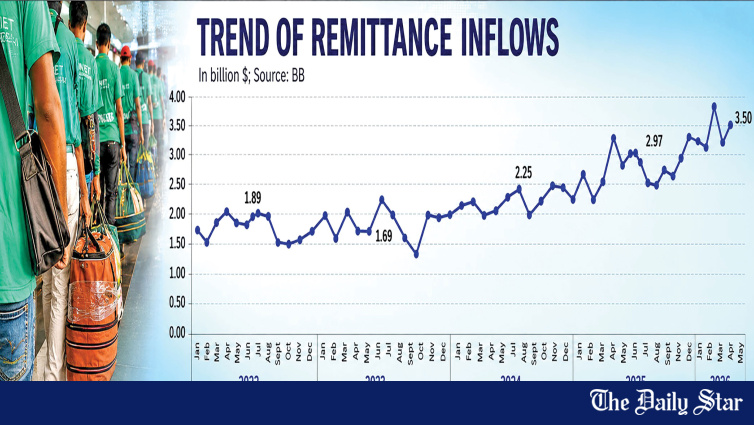
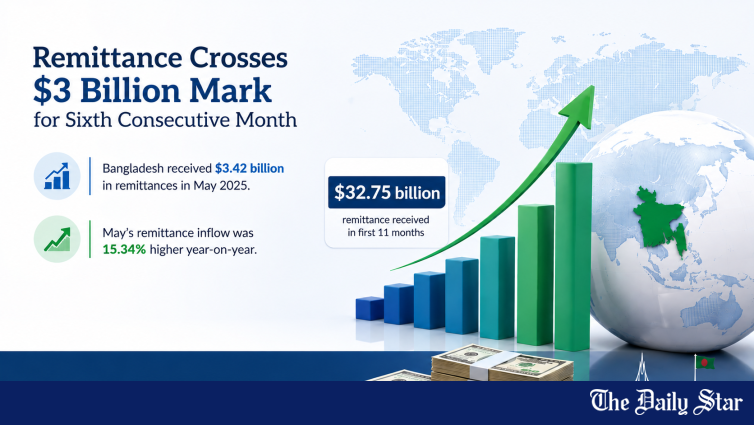
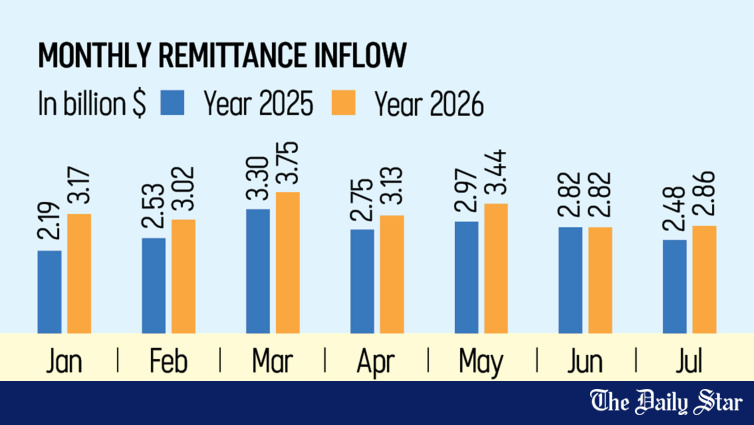
Bangladeshis living abroad sent home 15 percent higher year-on-year remittances in July, but the overall inflow stood below $3 billion for the second consecutive month, according to Bangladesh Bank (BB) data released yesterday.The country received $2.86 billion in July in remittances. Inflows were above the $3 billion mark from December 2025 to May this year. Remittances stood at $2.81 billion in June.The latest figures have raised concerns as demand for foreign currency continues to grow to meet import payment obligations.At a time when export earnings are weakening, import costs remain high, and repayments of foreign loans continue to put pressure on the economy, remittances could provide crucial support in meeting external payment obligations, including import bills.Md Deen Islam, professor of economics at Dhaka University, said remittances staying below $3 billion is more worrying because of continued problems in the foreign exchange market and growing political risks in the Middle East, where a large share of Bangladeshi migrant workers are employed.“From the macroeconomic point of view, continued growth in remittances is necessary to improve foreign exchange reserves, relieve pressure on the exchange rate, cover the current account deficit, and support stability in the external sector,” he said.“If remittances start to slow down, there will be fewer buffers to defend the exchange rate, and the economy may experience imported inflation because of rising import costs and the reduced ability of the Bangladesh Bank to conduct monetary policy,” he warned.Bangladesh’s imports rose 6.26 percent year-on-year to $64 billion during the July-May period, driven mainly by higher prices for fuel and fertiliser. Exports, however, fell 2 percent year-on-year to $40 billion in fiscal year 2025-26, BB data showed.By contrast, remittances jumped 17 percent year-on-year to a record $35.5 billion in FY26, providing strong support for the country’s macroeconomic stability.Md Altaf Hossain, acting managing director of Islami Bank, the country’s largest remittance collector, said some Middle Eastern countries are now reluctant to issue visas, which may be one reason for the slowdown.He added that July’s remittance inflows were not disappointing compared with May, when migrant workers sent more money home ahead of the celebration of Eid-ul-Fitr.A senior official at a private bank said many Bangladeshis work in the hospitality sector in the Middle East, the main destination for the country’s migrant workers.“The war in the region has affected the flow of tourists, as well as the income of many of them,” he said. “It appears that the cost of living has also increased in the region because of disruptions to shipping. These may be the reasons for the slowdown in remittance inflows.”