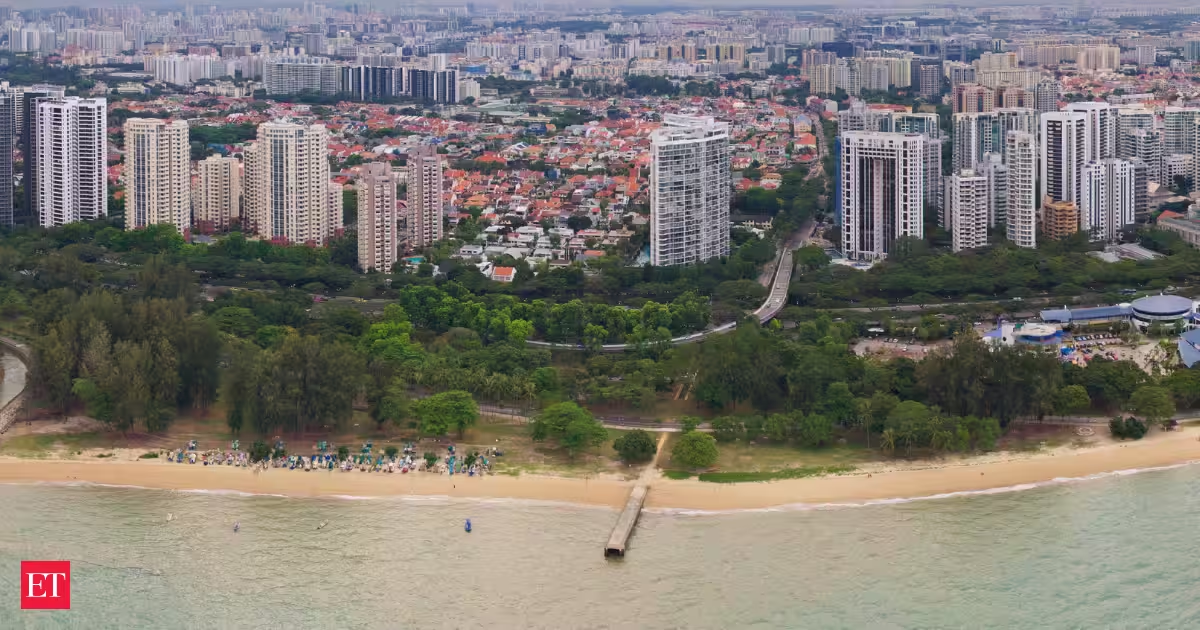
Singapore's latest megaproject is one example of climate adaptation. According to the Urban Redevelopment Authority (URA), Singapore is moving ahead with plans to reclaim about 800 hectares of land off its East Coast, a project nicknamed "Long Island," designed to protect the city-state from rising seas while also addressing water shortages and a shrinking supply of buildable land.Why this matters nowSingapore is a small, low-lying island nation, and according to Singapore's Ministry of Sustainability and the Environment, that makes it particularly vulnerable to rising sea levels. According to Singapore's Ministry of Sustainability and the Environment, 30 percent of the island is less than five meters above sea level.The bigger concern is what happens by the end of this century. Based on Singapore's Third National Climate Change Study, the government projects that mean sea levels around the island could rise by up to 1.15 meters by 2100 under a high-emissions scenario and by around 2 meters by 2150, according to the National Climate Change Secretariat. When storm surges and unusually high tides coincide, water levels could temporarily rise to up to 5 meters above normal, the agency states.The page adds that Singapore is already moving from planning to implementation: since 2021, PUB has been conducting site-specific studies along various stretches of the coast, with the City-East Coast study covering the Greater Southern Waterfront, Changi, and the East Coast, which was completed in 2025. It says that the study recommended coastal barriers for the Greater Southern Waterfront, and a mix of raised structures and tidal gates at Changi, with further design work still to come. East Coast Park, along Singapore's low-lying eastern shoreline where coastal flooding has occurred during high tides. Image Credit: Wikimedia CommonsThe plan: reclaim land along the East Coast Singapore initially considered a conventional seawall, but officials decided it would create an artificial barrier between people and the shore. According to the URA, however, the design will include creating islands comprising about 800 hectares of reclaimed land along the East Coast. These islands would be connected to the mainland at both ends, with gates to regulate the flow of water to and from the sea.The project is also expected to create a new reservoir, which PUB, Singapore's National Water Agency, has said would become the country's 18th reservoir. Currently, Singapore depends in part on water imports from Malaysia. There have been times when Malaysia's water supply has caused disagreements between Singapore and Malaysia. Thus, having a local water supply is strategically important.The project will also see the development of new waterfront parks along the coastline, becoming part of the larger area of public coastal lands being developed by Singapore along its southern coast.A slow, deliberate buildThe URA has said Long Island requires years of technical and environmental studies before reclamation begins, and reclaimed land generally needs time to settle before construction can start. National Development Minister Desmond Lee has said the project will take several decades to plan, design, and develop, according to a report by The Straits Times.Public engagement has already been extensive. More than 14,000 members of the public and stakeholders have shared feedback on the project since engagement began in November 2023, according to the Urban Redevelopment Authority.Singapore's estimated costs show how seriously it is treating the challenge. According to CNN, former prime minister Lee Hsien Loong estimated in 2019 that protecting the country from rising sea levels could cost around S$100 billion, or roughly $78 billion, over the next century. That figure applies to Singapore's broader coastal defense efforts overall, not to the Long Island project alone. Reclamation on this scale also requires enormous volumes of infill material, which has traditionally come from imported sand. According to CNN, Indonesia, Malaysia, Cambodia, and Vietnam have all restricted sand exports at various points, prompting Singapore to explore alternatives such as ash from incinerated waste.Mangrove horseshoe crabs are among the marine species considered in environmental assessments for Singapore's Long Island project. Image Credit: Wikimedia CommonsOther questions that need to be answered include the source of the filling material to be used in the land reclamation and how the filling may affect marine life in the area, specifically horseshoe crabs, which nest along the region's shorelines. Singapore is also considering other sources of sand for land reclamation, in addition to imported sand.Public engagement has already been extensive. More than 14,000 people have shared feedback on the project since agencies began public consultations in November 2023, according to statements from the URA and its partner agencies.Some questions remain open, including the source of fill material for reclamation and the impact on local marine life along the East Coast, such as horseshoe crabs and nesting shorebirds. Singapore has also been exploring alternatives to imported sand, including incinerated ash and construction debris, partly because several regional sand exporters have restricted exports over environmental concerns in recent years.Why this matters beyond SingaporeSingapore is not alone in facing this problem. Jakarta, Indonesia, is sinking so fast in some areas that the country is relocating its capital city, in part because of it, according to Reuters reporting on the move. Singapore's strategy, building outward with reclaimed land and tidal gates, stands in contrast to that kind of retreat. Ultimately, the question is how much water these cities' coastlines can absorb before flooding becomes routine.
With 30% of its land below five meters, Singapore plans to build 800 hectares of new land in the sea
Singapore is planning to reclaim 800 hectares of land off its East Coast to combat rising sea levels and address water shortages, featuring innovative tidal gates and new waterfront parks.
879 words~4 min read