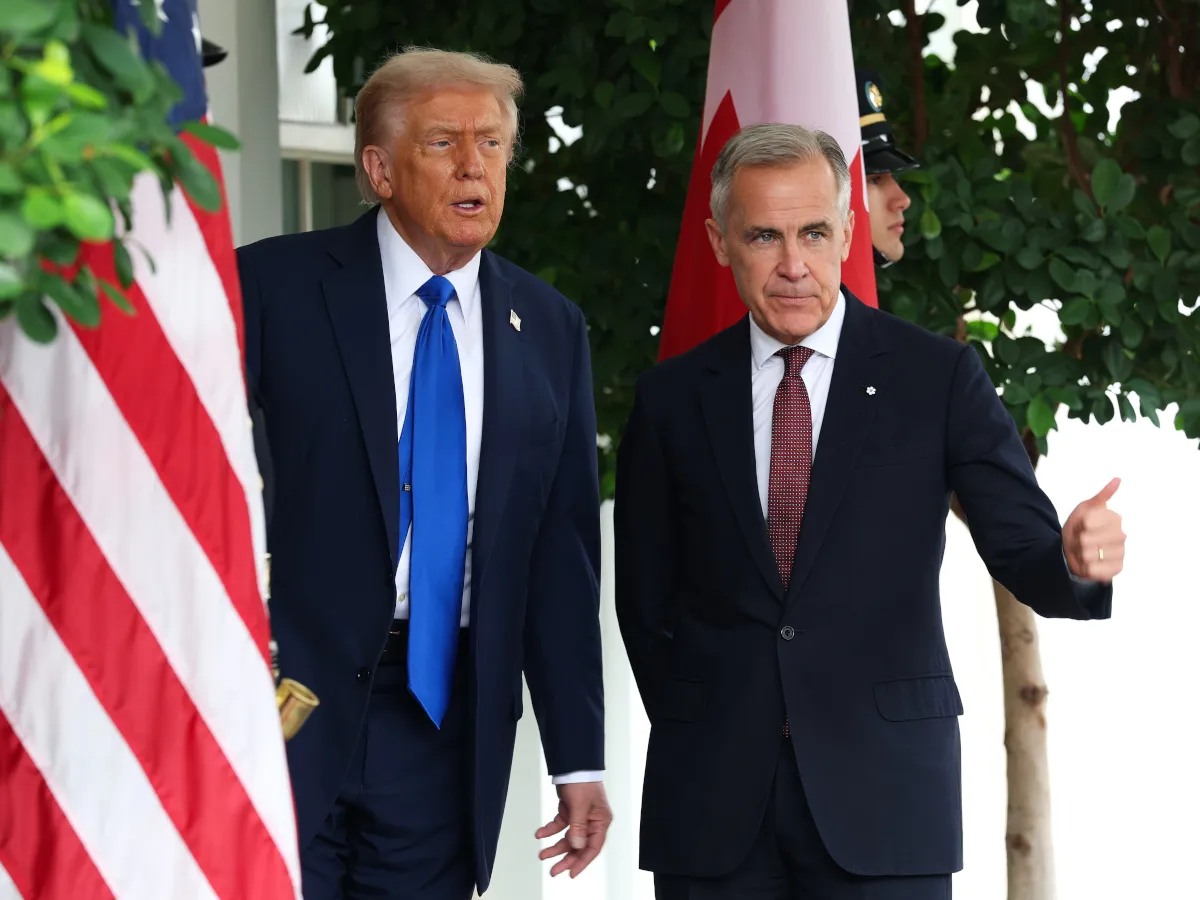
Skip to Content Subscribe Our Offers My Account Manage My Subscriptions FAQ Newsletters Canada Canadian True Crime Canadian Politics Health World Israel & Middle East Financial Post NP Comment Longreads Puzzmo Diversions Comics NP News Quiz New York Times Crossword Horoscopes Life Eating & Drinking Style Sponsored Play for Ontario Travel Travel Canada Travel USA Travel International Cruises Travel Essentials Culture Books Celebrity Movies Music Theatre Television Business Essentials Advice Lives Told Tails Told Shopping Buy Canadian Home Living Outdoor Living Kitchen & Dining Tech Style & Beauty Personal Care Entertainment & Hobbies Gift Guide Travel Guide Amazon Prime Day Deals Savings National Post Store More Sports Hockey Baseball Basketball Football Soccer Golf Tennis Driving Vehicle Research Reviews News Gear Guide Obituaries Place an Obituary Place an In Memoriam Classifieds Place an Ad Celebrations Working Business Ads Archives Healthing Epaper Manage Print Subscription Profile Settings My Subscriptions Saved Articles My Offers Newsletters Customer Service FAQ Newsletters Canada World Financial Post NP Comment Longreads Puzzmo Diversions Life Shopping Epaper Manage Print Subscription HomeNP CommentConrad Black: Trump's unfair tariffs are an opportunity for CanadaWe must work to improve our competitiveness and standard of livingLast updated 5 minutes ago You can save this article by registering for free here. Or sign-in if you have an account.U.S. President Donald Trump, left, welcomes Prime Minister Mark Carney outside the West Wing of the White House in Washington, D.C., on Oct. 7, 2025. Photo by Anna Moneymaker/Getty ImagesIt is not clear why the Trump administration keeps scraping the tariff barrel. The latest tariff elevation reaches back 96 years to an obscure provision entitling the president to impose tariffs on countries that discriminate against U.S. commerce. Canada’s offence in this regard is apparently our odious system of supply management, our retaliatory tariffs against American cars and provincial alcohol bans. Another 60 countries were also threatened with new duties under a law entitling the United States to impose tariffs on countries that import from other countries that employ slave labour. It was an ingenious method of skirting around the Supreme Court’s decision that the administration could not impose its “Liberation Day” tariffs on the grounds of a national emergency.Enjoy the latest local, national and international news.Exclusive articles by Conrad Black, Barbara Kay and others. Plus, special edition NP Platformed and First Reading newsletters and virtual events.Unlimited online access to National Post.National Post ePaper, an electronic replica of the print edition to view on any device, share and comment on.Daily puzzles including the New York Times Crossword.Support local journalism.Enjoy the latest local, national and international news.Exclusive articles by Conrad Black, Barbara Kay and others. Plus, special edition NP Platformed and First Reading newsletters and virtual events.Unlimited online access to National Post.National Post ePaper, an electronic replica of the print edition to view on any device, share and comment on.Daily puzzles including the New York Times Crossword.Support local journalism.Create an account or sign in to continue with your reading experience.Access articles from across Canada with one account.Share your thoughts and join the conversation in the comments.Enjoy additional articles per month.Get email updates from your favourite authors.Create an account or sign in to continue with your reading experience.Access articles from across Canada with one accountShare your thoughts and join the conversation in the commentsEnjoy additional articles per monthGet email updates from your favourite authorsSign In or Create an AccountorThis was an understandable ambition, and U.S. President Donald Trump has improved the comparative American trading position with almost every economically serious country in the world except China and Canada. He had reduced the absurd trade deficit in goods of almost $1.3 trillion in 2025 to an extent that justifies the slight inflationary pressure that was counterbalanced by a generally declining inflation rate until the numbers became skewed by the Middle East war. Trump would surely appreciate less agitated relations with Canada, though that was not discernible in his high-handed treatment of the new bridge between Detroit and Windsor, Ont. That was an annoying episode, compounded by Prime Minister Mark Carney’s pretense that he made a good deal of it.The National Post newsletter that doesn’t hold back, giving readers the unvarnished truth on media, politics and culture.By signing up, you consent to receive the above newsletter from Postmedia Network Inc.A welcome email is on its way. If you don't see it, please check your junk folder.The next issue of Right? will soon be in your inbox.We encountered an issue signing you up. Please try againWe do have the ability, gradually, to reduce trade with the United States as a percentage of our economic activity. But it requires disciplined policymaking and execution. Prior to the First World War, trade with the United States was equivalent to around 40 per cent of our economy; by the early 21st century, it rose to roughly 80 per cent and is now down to approximately 64 per cent. The lower figure represented John A. Macdonald’s National Policy based on building East-West trade within Canada by completing the Canadian Pacific Railway and building Canadian manufacturing to supply the domestic market behind relatively high tariffs. This led to the reciprocity election of 1911, in which Wilfrid Laurier proposed freer trade with the United States but was rejected by voters.Tariffs were a huge issue in many industrialized countries for many decades, and it was one of the principal issues in the American presidential elections from 1876 to 1892, which were all close in the popular vote. The Republicans, like Macdonald in Canada, liked tariffs to build industry and profits and create jobs, and the Democrats, like Laurier, preferred lower tariffs to produce a lower cost of living for people of modest incomes. These were both reasonable positions. Because the population of the United States tripled, from 31 million to over 90 million between the Civil War and the First World War, the American domestic market became so immense, trade only accounts for less than 25 per cent of the American GDP, not a third of the total in this country, so the United States can be more cavalier in this area than most other countries.Only a trade wonk could comment authoritatively on the series of partial free-trade agreements that Prime Minister Carney has been buzzing around the world announcing. But it is not clear that freer trade with Norway or Turkey or Myanmar is going to accomplish much: Norway is an astronomically rich petro-state whose sovereign fund earns enough each year that it could simply salary the entire adult population. This would be too much of an affront to the Nordic Lutheran ethos and mass idleness has its hazards. Instead, almost everything is free, starting with education and health care, and the sovereign fund keeps growing. I doubt that Turkey and Canada have much to trade with each other and under its present government Turkey is a dodgy political enterprise. Myanmar, which is part of the ASEAN bloc that Carney is negotiating with, is a primitive pariah state.Mark Carney after 16 months as prime minister, one third of the normal term and already longer than (in a few weeks) six former prime ministers, has shown no recognition of the principal requirements for increasing economic growth and narrowing the unprecedentedly large gap that has arisen between the per capita income of the United States (US$94,000) and Canada (US$60,000, behind, inter alia and with no acceptable excuse, Ireland, Denmark, the Netherlands, Australia, Sweden, Israel, Austria, Germany, Belgium and the United Kingdom). Even though Canada now has a lower per capita income than the United States, predictably, the Toronto Star and the Globe and Mail are waffling that a larger percentage of Canadians than Americans have an acceptable and sustainable standard of living because the United States has a larger poor underclass and a larger percentage of people of extremely great wealth. This is a quibble — the issue is that the total per capita amount of wealth in Canada has declined uncompetitively in the last decade opposite the United States, the country that for most of our history we were only narrowly behind by that measurement. How the national incomes are divided follows social and political preferences. The Americans are rugged individualists still dealing with the legacy of slavery and reckless immigration. By the universally recognized measurement of per capita national income, we are not competitive, and this government is not moving perceptibly to reverse that failure.Carney should have gathered the provincial premiers and banged their heads together in the conjured Trump-based national emergency; ended the trade barriers between the provinces; scrapped the exorbitant supply management system so much favoured by Quebec and replaced it with direct income supplements to designated farmers, reducing food prices; and reduced the corporate income tax to 20 per cent so we can compete with the U.S. for investment. And we should have agreed to an incentivized program across all levels of government to eliminate duplicative work and reduce the number of people in the entire public sector over time by not replacing those who retire, from a suffocating 21 per cent of the workforce to not more than eight per cent, exempting increased national defence numbers.The federal government should use its influence as an indispensable contributor to the health and education budgets of the provinces to require that more post-secondary students study and graduate in fields where they can earn a living and be economically useful, including skilled trades (which should get greater academic recognition), and to ensure that we increase the number of doctors in the country, and permit tax-deductible private medicine for those who can afford it. This would shrink waiting times for urgent non-elective patients. Canada would start moving back up the competitive ladder again.National Post Join the Conversation This website uses cookies to personalize your content (including ads), and allows us to analyze our traffic. Read more about cookies here. By continuing to use our site, you agree to our Terms of Use and Privacy Policy.
Conrad Black: Trump's unfair tariffs are an opportunity for Canada
We must work to improve our competitiveness and standard of living
1,653 words~8 min read