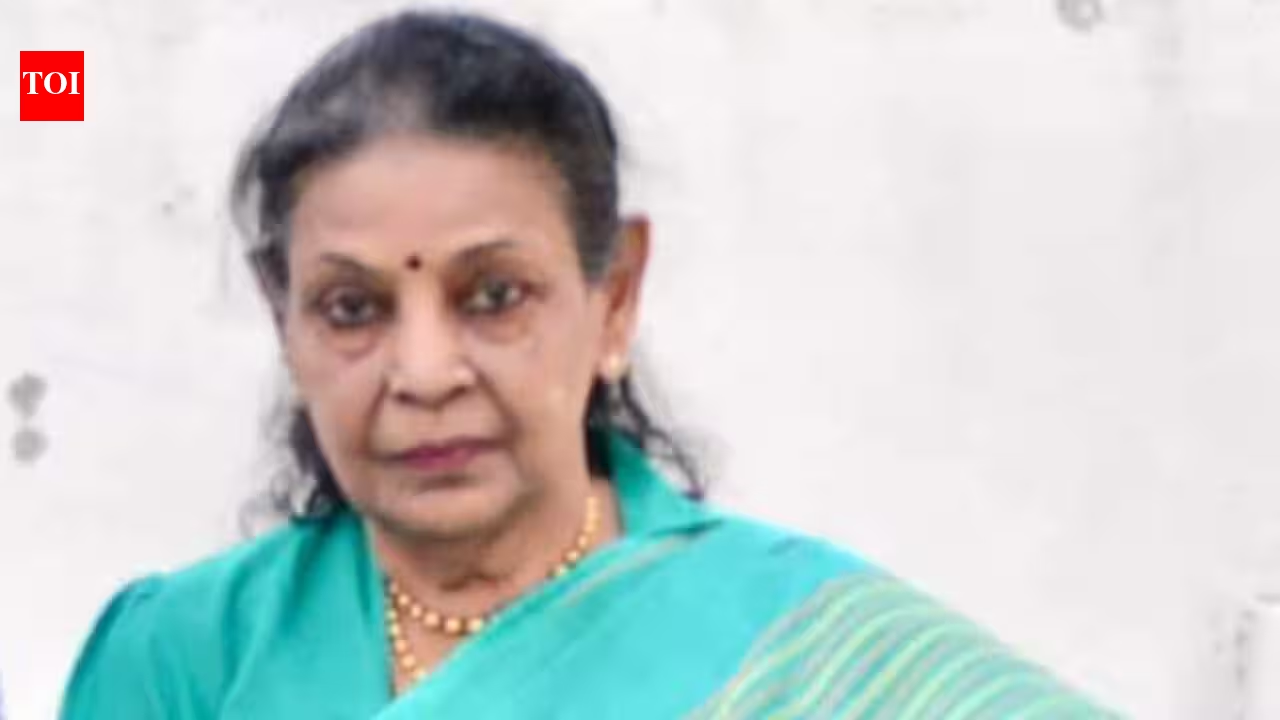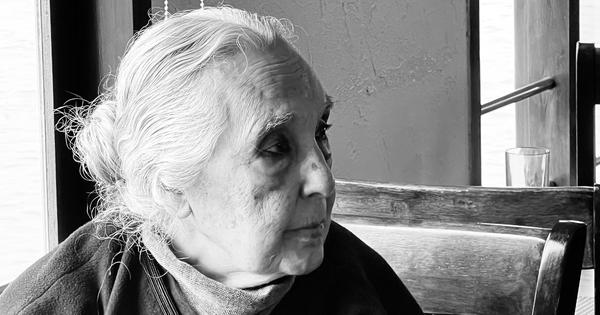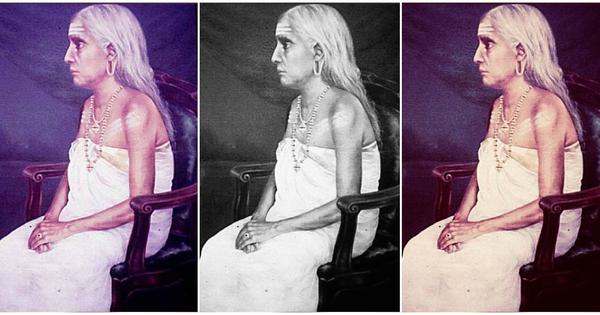
A gaunt elderly woman, her face sombre and framed by wispy grey hair left loose over her shoulders, gazes out in the side-profile. She wears the unmistakable symbols of an upper caste elite woman from 19th-century Kerala: the mundu mulakacha wrap tied across her chest, layers of gold around her neck, and a yawning ear piercing that signals a lifetime of wearing heavy gold earrings. Yet to dismiss Kuttykunju Thangkachi as merely a privileged noblewoman would be a profound mistake.The tumultuous 84 years of her life, which ended in 1904, were packed with triumphs virtually unheard of for women of her era. She was the earliest female dramatist in Malayalam with her play Ajnatavasam, the first woman to write attakathas, or librettos, for Kathakali, and a prolific creator across Kerala’s indigenous musical forms, including kummi, thiruvathira pattu, kurathipattu and thullal. Crucially, she was the first female Carnatic composer from Kerala at a time when only men were accorded the elevated title of vaggeyakara (writer-composer).Thangkachi’s oeuvre is well known within a tight circle of Kerala’s musicians, historians and literary scholars, but beyond these circles it has received relatively little attention. That dynamic shifted recently. At a Chennai concert organised by the Sruti Foundation to celebrate Carnatic composers of Kerala, vocalist KS Vishnudev selected Thangkachi’s popular kriti, Pahi Mohanaakrute in raga Khamas, to highlight her underestimated artistry.“Her contributions to music and literature were incredible,” said Vishnudev. “Pahi Mohana, for instance, is a sthala kriti [dedicated to a particular place and its deity, in this case the Krishna at Neyattinkara in Thiruvananthapuram]. It needs poetic and musical skill to compose and many of her compositions, like that of other Kerala vaggeyakaras, appear influenced by the poetry of dance and the music of Kathakali.”Are the melodies known today identical to how she set them two centuries ago? Were they reworked, partially or fully? The questions that apply to all classical composers of centuries past, including her contemporary Swati Thirunal, apply to her as well. Pahi Mohana, for instance, Vishnudev notes, was tuned by master musician Cherthala Gopalan Nair. “All great work is collaborative, never that of a single genius, and that must be credited,” he said. “Which is not to deny Kuttykunju Thangkachi’s greatness, for which we have historical evidence.”Private limitsStarting in the late 18th century, several women from the royal and noble families of Kerala – highly educated in Malayalam, Sanskrit and Tamil – began writing prose and poetry. However, their creativity was strictly contained within private spheres.“Patriarchy exerted its power over woman by equipping her privately in accomplishments relating to the arts and letters, and then demanding non-expression of them in public,” writes researcher and literary critic Jancy James in the journal Social Scientist in her paper From Veneration to Virulence: A Case for a Women’s Literary History in Malayalam.
The story of Kerala’s first female writer-composer who transcended her time
Kuttykunju Thangkachi broke new ground in music, theatre and literature at a time when women’s creativity was expected to remain private.
1,630 words~7 min read