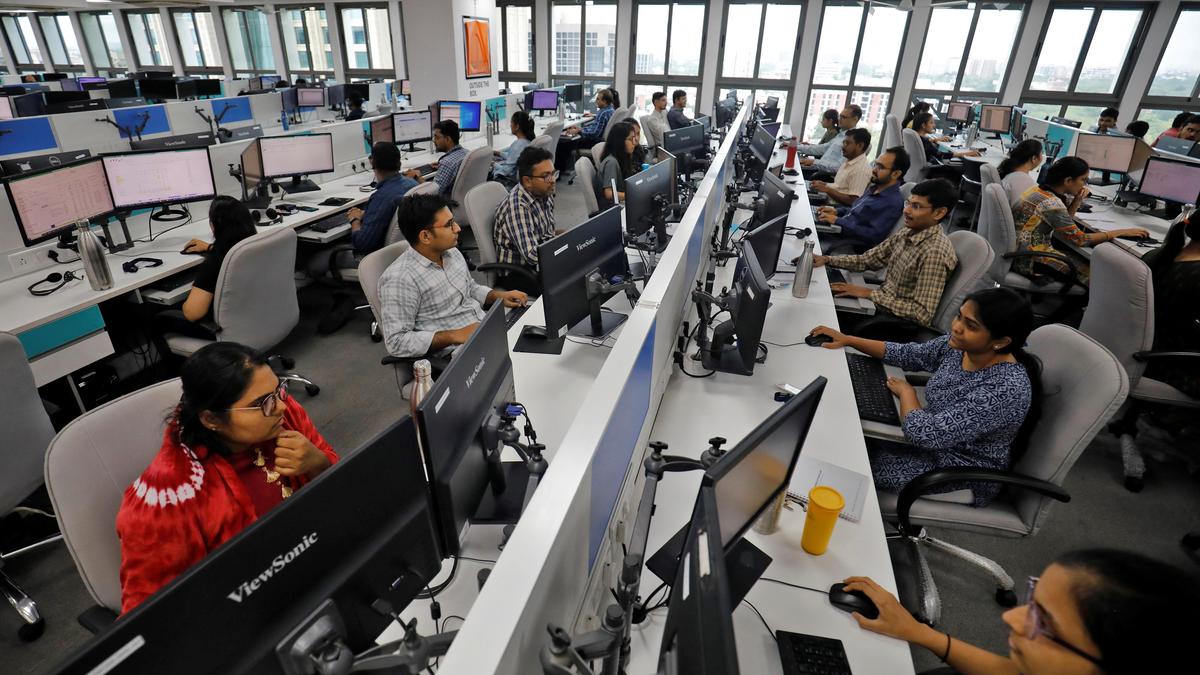
The June quarter highlighted a structural shift in India’s IT services industry from a hiring-led growth model to a productivity-led one, with several Tier-I firms improving revenue per employee (RPE) despite flat or declining headcount.“The trend across Tier-I companies points to improving productivity rather than workforce expansion,” said Gaurav Vasu, Founder and CEO, UnearthInsight.TCS reduced its headcount by 3.1 per cent year-on-year while increasing RPE by 6.1 per cent. Tech Mahindra’s workforce shrank 1.2 per cent, but its RPE rose 7.4 per cent.“This reflects a combination of workforce rationalisation, higher utilisation and the early benefits of AI-led productivity improvements,” Vasu said.Infosys and HCLTech, meanwhile, managed to increase both headcount and productivity. Infosys expanded its workforce by 1.3 per cent and improved RPE by 1.5 per cent, while HCLTech added 0.3 per cent to its headcount and raised RPE by 2.6 per cent.“These companies are absorbing new talent without compromising productivity, reflecting stronger execution, better delivery optimisation and AI-driven efficiency gains,” Vasu added.During Infosys’ Q1FY27 earnings call, CEO and MD Salil Parekh attributed the company’s improving revenue productivity to sustained efficiency gains. “We recruited 20,000 college graduates last year and plan to recruit another 20,000 this year. Around 4,000 joined in the first quarter, while productivity improvements continue,” he said.Mixed picture for Tier IIThe trend is more varied among Tier-II firms. Mphasis increased headcount by 3.3 per cent while lifting RPE by 11.2 per cent, indicating strong demand alongside efficient talent deployment.In contrast, Wipro and LTTS expanded their workforce but saw RPE decline by 3.9 per cent and 8.4 per cent, respectively, suggesting hiring has outpaced revenue growth as they invest ahead of an anticipated recovery.According to Sanketh Chengappa, Director-Professional Staffing and Business Head, Adecco India, RPE is increasingly evolving from a scale-driven metric to a productivity-driven one.“The June quarter reflected stabilisation with pockets of improvement, particularly among Tier-I firms that sustained revenue growth while maintaining discipline on headcount expansion,” he said.Among Tier-I companies, higher RPE was driven by improved utilisation, tighter bench management, selective hiring, moderated fresher intake and a greater focus on high-value services such as AI, cloud, cybersecurity, data and digital transformation.Tier-II companies, however, present a mixed picture. Chengappa said niche players are benefiting from capability-led growth strategies, while firms with greater exposure to discretionary spending and weaker pricing power have seen more modest productivity gains.“In many cases, RPE improved because workforce expansion slowed, talent deployment became more efficient and companies focused on higher-margin services. Selective hiring, attrition management and organisational restructuring also supported productivity despite modest revenue growth,” he said.AI boosts productivity, not jobsAnalysts stressed that hiring has not come to a halt. Companies with stronger demand visibility continue to recruit, particularly in AI, cloud and engineering, while maintaining productivity gains. Others are deliberately hiring ahead of demand, which may temporarily weigh on RPE until revenues catch up.“Companies that have improved RPE are those that have become more disciplined about hiring while extracting greater value from their existing workforce. AI is automating routine work, improving developer productivity and streamlining delivery, but its financial impact is still evolving. For now, AI is acting more as a productivity multiplier than a standalone growth driver,” Vasu said.Overall, the relationship between revenue growth and headcount growth is weakening. The industry is steadily moving from a scale-led model to one driven by productivity, where AI-assisted delivery, better utilisation and operational efficiency are becoming as important as workforce expansion.Published on July 31, 2026
Top IT firms boost productivity even as hiring slows
India's IT firms are enhancing productivity through improved revenue per employee despite slowing hiring trends, driven by AI and efficiency measures.
TL;DRAI
India's Tier-I IT firms—TCS (+6.1% RPE with -3.1% headcount), Tech Mahindra (+7.4% RPE with -1.2% staff)—shift from hiring-led to productivity-led growth. AI automation and utilization gains now drive margins more than headcount, reshaping IT services economics.
570 words~3 min read