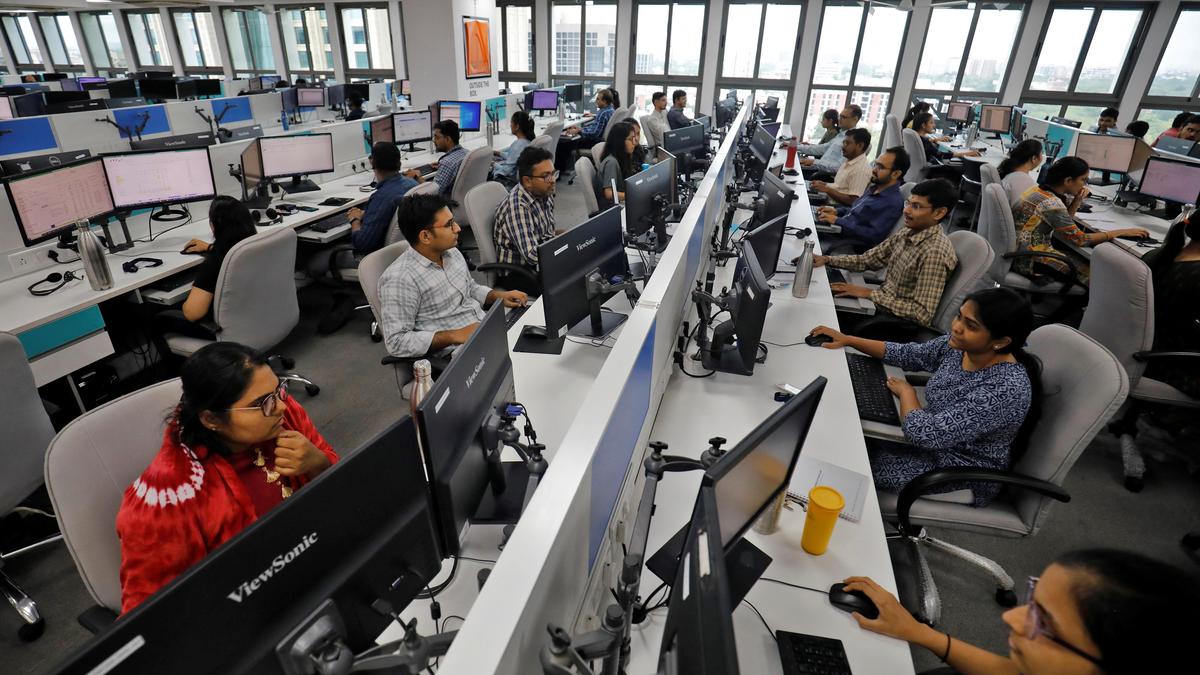
While the demand environment has improved in certain areas, organisations are continuing to balance client commitments with higher productivity from AI and automation.
India’s IT services industry hints at hiring stabilisation in a macro-economically challenged Q1, after nearly a year-long churn in total headcount. The overall consensus among experts leans towards an encouraging hiring trend, even as analysts continue to wait for the earnings of IT firms.Overall headcount for IT firms announced by July 19 rose by 5,948 employees, roughly 0.5 per cent largely led by Tata Consultancy Services (TCS). During the June-ending earnings result, TCS reported an increase of over 9,000 employees in their total workforce, the highest quarterly net addition in 15 quarters.Excluding TCS, the IT firms’ headcount as a group contracted in absolute numbers. Even so, attrition rates have come down for many companies. On an annual basis, Tech Mahindra’s attrition went from 12.6 per cent to 11.8 per cent while Wipro’s attrition went form 15.1 per cent to 13.9 per cent. The latter increased overall workforce by 888 employees following the MindSprint acquisition.“This strong hiring rhymes well with the strong 12,000 headcount addition reported by Accenture this quarter,” said Nuvama Institutional Equities following TCS results.IT headcountFurther, Tech Mahindra also talked about restarting campus hiring, even as its IT headcount of 74,689 employees in the quarter was down by 688 employees sequentially.“Campus hiring has been volatile because we have had limited visibility into revenues. Now that our visibility is stronger, the campus hiring programme will restart, though we do not have any numbers to share on annual intake at this point,” said Mohit Joshi, CEO and Managing Director of Tech Mahindra.As per experts, these developments indicate early signs of hiring stabilisation in the industry. Describing the latest numbers as encouraging, CIEL HR hiring solutions firm said companies are hiring individuals wherever they see a clear business need, while being cautious on overall workforce expansion. While the demand environment has improved in certain areas, organisations are continuing to balance client commitments with higher productivity from AI and automation.“We expect this trend to become more pronounced. By 2030, more than half of the industry’s talent demand is expected to be concentrated in professionals with three to nine years of experience, reflecting the need for deployment-ready talent that can support cloud transformation, cybersecurity, data, engineering and consulting programmes from day one,” said Aditya Narayan Mishra — MD and CEO of CIEL HR, meaning that any hiring revival may still bypass freshers altogether.Greyhound Research also cautions that if discretionary spending stays weak, captives absorb more strategic work and productivity targets intensify. This means that companies will protect margins through utilisation and slower onboarding, and total headcount will stay flat even as revenue grows. Entry-level generalists, manual testers and routine support roles carry the greatest exposure.Precision hiring“What is returning is precision hiring, not volume hiring. Entry-level openings fell 44 per cent in a year to 10,000, while captive-centre demand rose 31 per cent, the only cohort that grew. The contest is for people who build, secure and govern AI systems inside enterprises, and for the specialists who validate what machines produce. Generation is becoming abundant; verification remains scarce,” said Sanchit Vir Gogia, Chief Analyst and Founder at Greyhound Research.To Gogia’s point, the hiring momentum is now concentrated around skills that are directly linked to technology transformation.Roles in AI, data, cloud, cybersecurity, digital engineering and enterprise technology see healthy demand, as per CIEL HR. Entry-level hiring also continues to play an important role, accounting for nearly 14 per cent of total demand in 2025, as per CIEL’s recent study.However, employers are becoming more selective, as the biggest gap between campus readiness and industry expectations is in cloud, data and AI, areas where demand is growing the fastest. This is prompting companies to invest in specialised fresher cohorts while also relying on experienced professionals who can contribute with minimal ramp-up.Published on July 19, 2026