cognitive-cache started from an observation I still think is correct: every coding tool decides what goes into the context window, and almost none of them treat that decision as an explicit selection problem. Cursor greps, RAG systems embed and cosine-search, and plenty of harnesses just stuff files until the budget runs out. The OS analogy is hard to unsee once you have it. The context window is RAM, eviction and retrieval are virtual memory, and token budget allocation is an allocator that nobody has written.
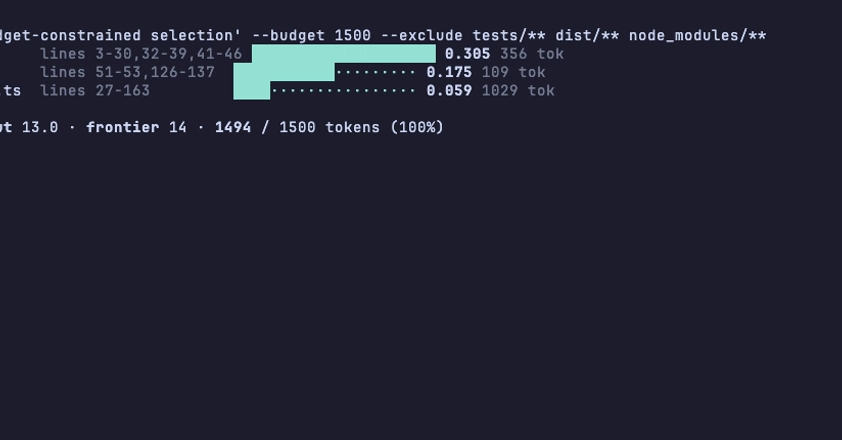
So I wrote one. Six weighted signals score every file in a repo against a task description, and a two-phase greedy submodular selector picks the highest-value set that fits a token budget. Nine languages, no LLM calls, no API keys. It shipped to PyPI and I used it through MCP for a while.
Then I built a benchmark harness, and the harness spent the next two months dismantling most of what I believed about the tool. This is that sequence, in order, because the order is the interesting part.
The first honest measurement said it does not beat grep
The original benchmark was bad in the way most self-benchmarks are bad. It coupled retrieval to LLM patch generation, reported rank-blind full-set recall, had no significance test, and I almost never ran it.