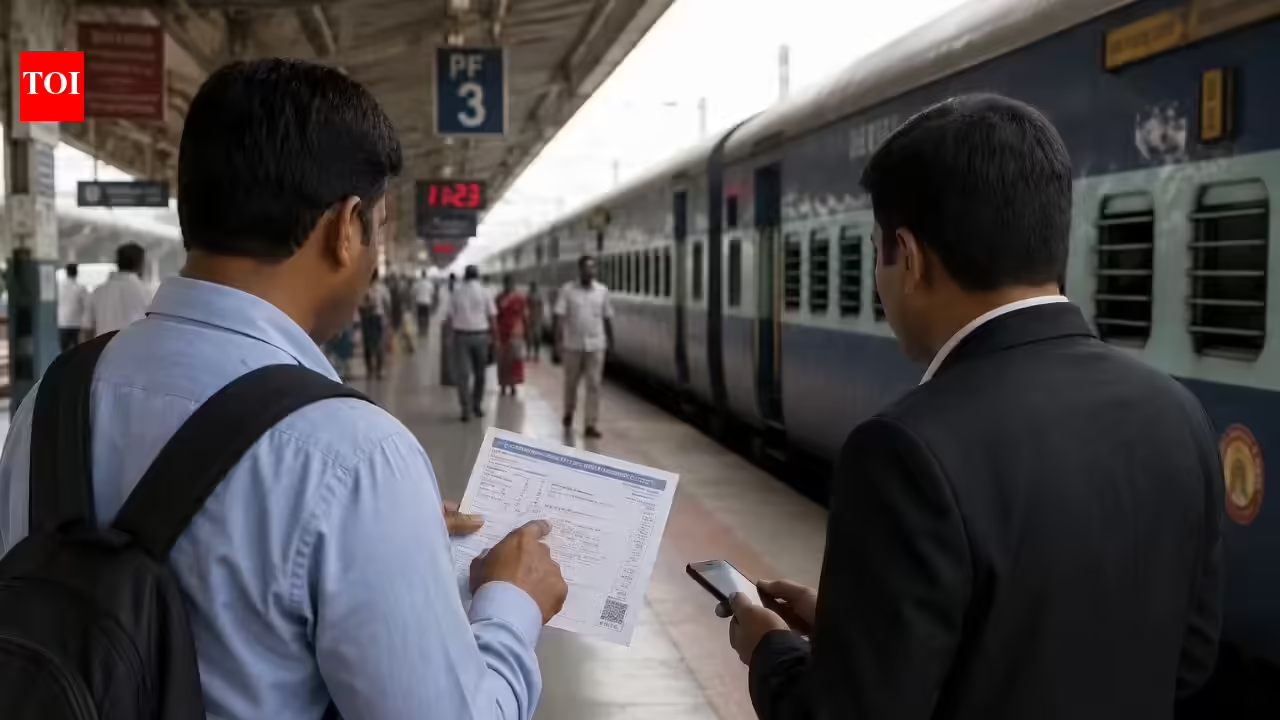
AI generated image used for representational purposeNEW DELHI: A Hyderabad consumer commission has held Southern Railway guilty of deficiency in service after finding that it failed to inform a businessman in advance that his train had been diverted, resulting in a 16-hour delay. While acknowledging that the route diversion was necessary for operational reasons, the commission said the Railways were at fault for not notifying the passenger about the diversion and the likely delay despite having sufficient time to do so.Why did the passenger approach the commission?The complainant, a cashew nut trader, had booked a premium tatkal ticket on the Tamil Nadu Superfast Express from Chennai to New Delhi for September 28, 2024. He was travelling to attend a business meeting with the managing director of a company in Delhi on September 30, as per the commission's order.When he reached Chennai railway station, he found that the train had been diverted. He claimed that he had received no SMS or prior intimation about the route change. Owing to the diversion, the train reached New Delhi around 16 hours late, causing him to miss both his business meeting and his return flight to Hyderabad. He later approached the Railways seeking compensation, but received no relief."The complainant not only lost his business appointment with the M.D. of the factory scheduled at 1 p.m. on 30.09.2024, but also missed his return flight at 22:55 hrs. on 30.09.2024," the court order reads.However, the Railways argued that the route had been diverted because of planned non-interlocking work for improving railway infrastructure and ensuring safe train operations. It said SMS alerts were sent only to passengers boarding from stations on the diverted route and not to those boarding from Chennai, where the complainant had started his journey.Why did the commission hold the Railways liable?The bench comprising President B Uma Venkata Subba Lakshmi and members C Lakshmi Prasanna and V Janardhan Reddy noted that the diversion had been planned well in advance through a notification issued on September 5, 2024. It also found that the notification specifically stated that all passengers of the affected trains should be informed through SMS. Despite this, no message was sent to the complainant before his journey."Though the notification at Ex.B2 regarding diversion was issued on 05.09.2024, the electronic reservation slip mentioned... New Delhi arrival 06:30 on 30.09.2024. It is also established that though the notification specifically mentioned intimation to all the passengers, the opposite parties failed to give intimation," the bench noted.The commission said that the diversion and the resulting delay were part of a planned activity and not an unforeseen event. Had the passenger been informed in advance, he could have made alternative travel arrangements depending on the urgency of his business meeting."While the opposite parties provided reasons for the delay, the reasons were neither unexpected nor sudden... the opposite parties should have been prepared to communicate the diversion and possible delay to all the passengers in advance, allowing them to make alternative arrangements," the bench further added.Holding that the Railways had failed to provide the expected standard of service, the commission concluded that not informing the passenger about the route diversion deprived him of the opportunity to make an informed choice."Therefore, in our considered view, not communicating/intimating the complainant regarding diversion of the route to make an informed choice/alternative arrangement depending upon the urgency of the situation of the passenger/complainant is nothing but deficiency in service on the part of opposite parties," the commission concluded.While the commission noted that the complainant had failed to produce documentary proof of the alleged loss of business worth Rs 1 crore, it accepted that the delay caused him mental agony and forced him to book another flight. It directed the Southern Railway to pay Rs 25,000 as compensation and Rs 10,000 towards litigation costs, taking the total payout to Rs 35,000.
Railways failed to inform passenger about train diversion, commission awards Rs 35,000 compensation
NEW DELHI: A Hyderabad consumer commission has held Southern Railway guilty of deficiency in service after finding that it failed to inform a businessman in advance that his train had been diverted, resulting in a 16-hour delay. While acknowledging that the route diversion was necessary for operational reasons, the commission said the Railways were at fault for not notifying the passenger about the diversion and the likely delay despite having sufficient time to do so.
638 words~3 min read