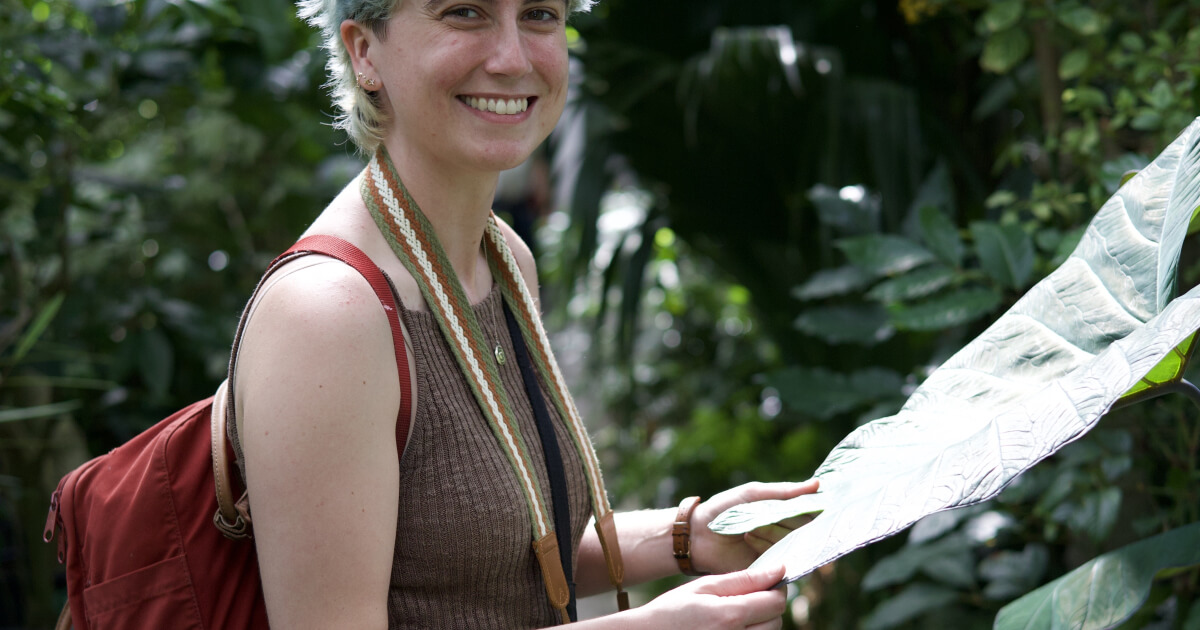
Ciara Sypherd, Ph.D. candidate in bioengineering (Pil Rosted Christensen)
Fresh off degrees in astrobiology and aerospace engineering at Arizona State University, Ciara Sypherd took on a one-year research position at the University of Copenhagen to study how neural networks can be used to classify vocalizations of pigs.That experience changed the course of their career.“We were using machine learning to decode if the pigs were making positive or negative vocalizations, or what one of 19 contexts they were vocalizing towards,” they said. “The machine learning algorithm was able to pick out with very high accuracy if they were positive or negative or which situation they were vocalizing in. It was proof of concept that there is a communication system, there is something to decode, and we have a tool to decode it.”Sypherd came to the Harvard John A. Paulson School of Engineering and Applied Sciences (SEAS) for their Ph.D. to continue research at the intersection of machine learning and animal communication. Here, they are a bioengineering student co-advised by Robert Wood, the Harry Lewis and Marlyn McGrath Professor of Engineering and Applied Sciences, and Erin Hecht, Associate Professor of Human Evolutionary Biology in the Department of Human Evolutionary Biology. Sypherd first worked on Project CETI, an initiative co-led by Wood to study sperm whale communication in Dominica. As part of the Hecht Lab, they study communication in wolves and chimpanzees in the wild.Sypherd’s interest in animal communication began as an undergraduate at Arizona State, where they studied the alarm signals used by ants. They continued this research for two years as a NASA Space Grant Scholar, while also undertaking a summer research project at Caltech in which they developed a robotic wing to model the flight of fruit flies.“Everything started with the ant research, really,” they said. “That was when I got really passionate about research, and realized I wanted to do research for forever. I tried working on international continental ballistic missiles for a minute as a summer internship, and I realized a desk job just wasn’t for me. I wanted to be in a lab. I wanted to be studying animals and interacting with them.”