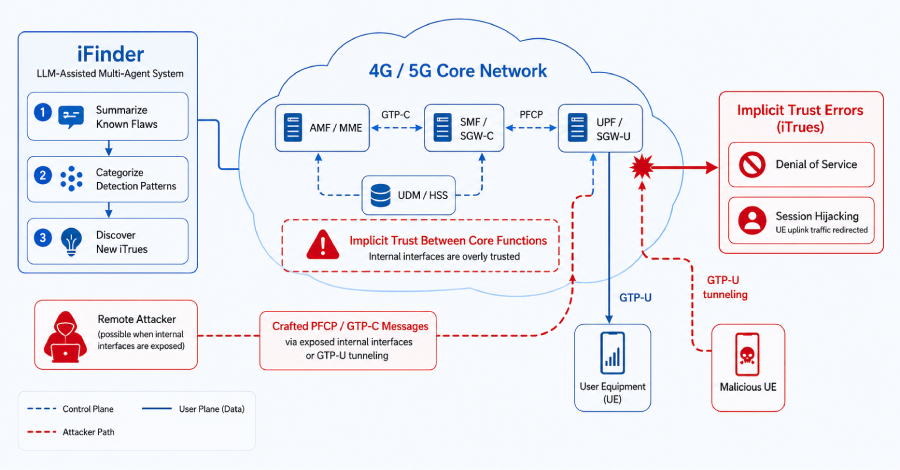
An academic study has disclosed a "widespread class" of security vulnerabilities impacting 4G and 5G core networks that, if successfully exploited, could trigger denial-of-service (DoS) attacks and even session hijacking, allowing an attacker to seize control of a user's network session.
The findings have been released by a group of researchers from Singapore's Nanyang Technological University in a paper titled "Understanding Implicit Trust Errors in Core Carrier Networks through Multi-Agent Flaw Discovery and Analysis."
The study has uncovered dozens of vulnerabilities in the signaling interfaces of LTE/5G core networks, and specifically covers two LTE implementations (Open5GS and OpenAirInterface) and five 5G implementations (Open5GS, free5GC, OpenAirInterface, SD-Core, and eUPF) across two core signaling protocols, GTP-C and PFCP.
"Our research finds these vulnerabilities share a single recurring root cause, implicit trust between core network functions, and are present in widely used open-source LTE/5G cores that back research testbeds and commercial deployments alike," the researchers said.
While cellular core networks (CNs) have historically incorporated physical isolation as a means to ensure interfaces between core network functions operate within a trust zone, the transition to cloud-native deployments has made the trust model "fragile" and expanded the attack surface, allowing adversaries to potentially reach previously internal interfaces.