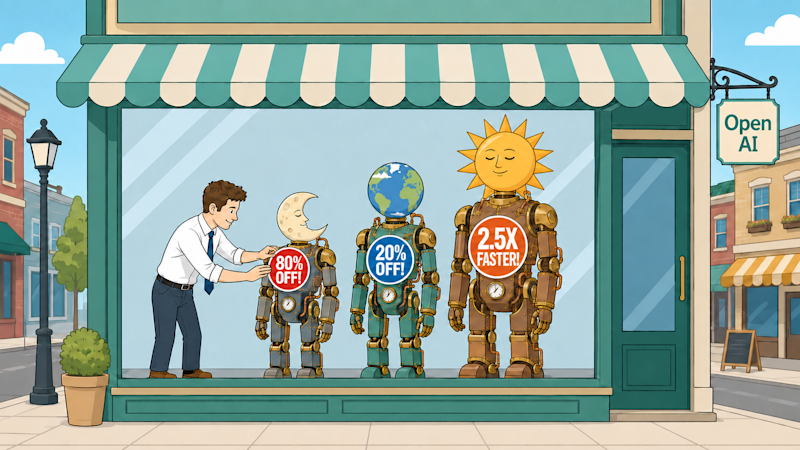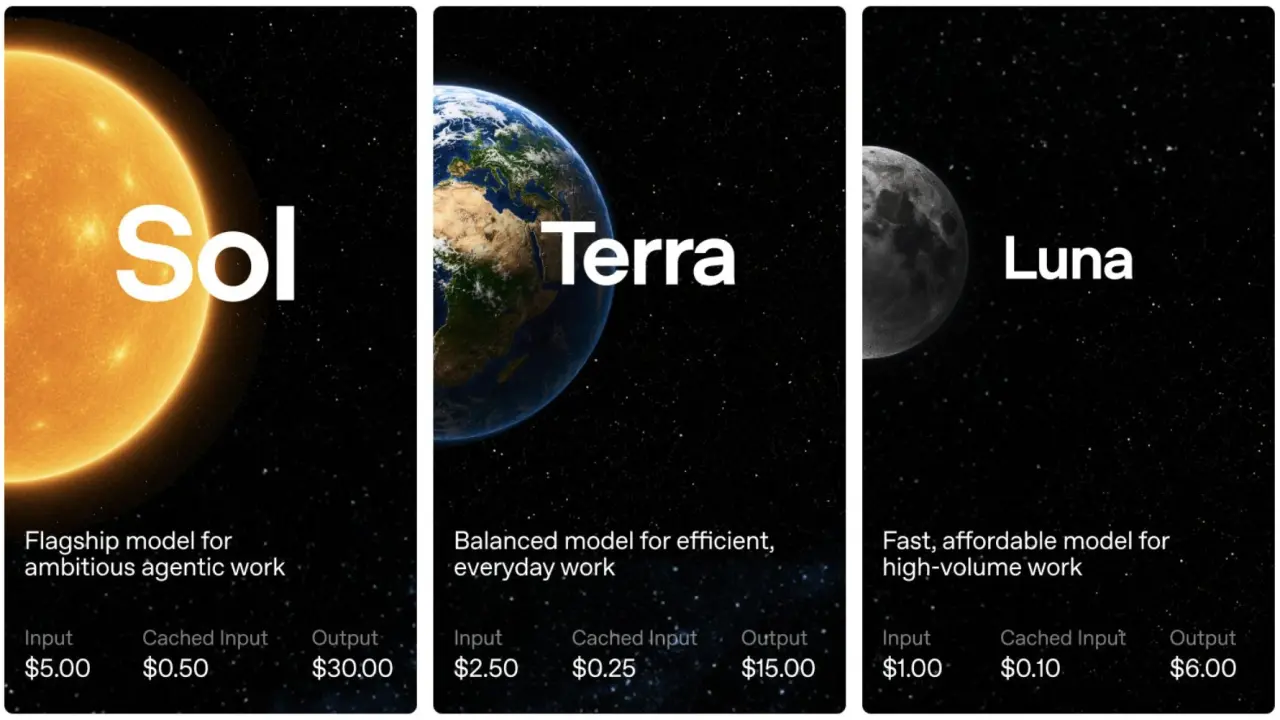
OpenAI cut its pricing for GPT-5.6 models and optimized speed, in a move designed to improve access to advanced AI as a resource for allGetty ImagesOpenAI just lowered GPT-5.6 pricing, in its mission to make “advanced intelligence more abundant, affordable, and useful,” per the company’s announcement.The GPT-5.6 price cuts come on the heels of Microsoft’s earnings call, in which the company highlighted its proposed move from a cost-per-user model to a cost-per-user-plus-consumption model, effectively raising enterprise AI budgets for teams who have multiple AI agents per employee and are AI power users.How Much Are GPT-5.6’s Sol, Luna, And Terra Models?Here are the exact models which have been affected by OpenAI’s change:LunaOpenAI has slashed costs for Luna, it’s fastest and least expensive model. For context, Luna is best used for high-volume busywork or routine work that doesn’t require knowledge-intensive task fulfilment or strategy. Because this is the model that would be used most often for admin tasks and “quick fixes,” Luna’s cost per million input tokens has been slashed to $0.20, and $1.20 per million output tokens.TerraThe next model up in the GPT-5.6 family, Terra, has also seen a price reduction. Terra is 20% less expensive, costing $2 per million input tokens and $12 per million output tokens. This is best used for everyday knowledge work and strikes a balance between speed and cost. It sits in the middle where most white-collar work, especially in areas like consulting or project management, gets done.SolSol has not seen a price cut; however, OpenAI announced that within the API, Sol now has the capability of being 2.5x faster without changing intelligence quality.Why Did OpenAI Cut GPT-5.6 Pricing?A significant catalyst behind OpenAI’s move to cut GPT-5.6 costs is the enterprise sentiment towards AI budgets. Over the last couple of months, several high-profile examples have emerged, for example:Uber burned through its 2026 enterprise AI budget in a little over the first quarter of the year, after Claude Code usage was maxed out by its 5,000 engineersMicrosoft also reportedly stopped Claude Code usage when the bill exceeded their annual budget within monthsOpenAI’s move to cut costs of ChatGPT-5.6 models is reflective of a widening problem within the evolving future of work:Enterprise AI cost is a real potential barrier to achieving full AI adoption, and this impact is amplified even more if you’re a company with a smaller or more modest tech budget.How Much Does Enterprise AI Really Cost?AI pricing is starting to lose control within organizations. In a Harness survey of about 700 finops and engineering leaders that was shared with me via email:The biggest AI cost drivers aren’t flashy customer-facing features, but rather, productivity tools like Copilot and coding assistants, which often slip past traditional cost tracking.Approximately 29% of organizations now attribute more than a quarter of their total cloud spend to AI.About 42% review AI costs only quarterly, even though spend can shift materially within a week; more than four in 10 still track it with spreadsheets.This means that many organizations are out of touch with their AI spend and do not yet have full visibility into costs until it’s often too late to be remedied.Here’s something else I find fascinating: many employers have not yet fully accounted for the cost of compute per employee. We see AI as a useful resource that amplifies productivity and slashes costs, when in reality, it might be significantly raising the company’s operating budget, even higher than it would have been had humans performed the work entirely.Chief Marketing Officer and board advisor Matteo Cellini wrote in his most recent Substack a piece called What If AI Costs More Than the Employee?, in which he argued:"Here is the calculation seducing every boardroom right now: a model completes in seconds a task that takes an employee thirty minutes. The API bill is twelve cents. The employee costs €30 an hour. Multiply across a department and the business case appears to write itself. “But twelve cents buys an output. It does not buy a completed, correct, accountable piece of work. And the gap between those two things, the output and the finished job, is where the entire economics of AI at work actually lives.” Cellini continued, “The argument cuts against how AI is usually sold. The claim is not that AI is expensive. It is that the token price is the smallest, most visible tip of a cost structure that is mostly invisible, and that for a large share of real workflows, the full cost of an AI system lands above the cost of the person it was supposed to replace.” Enterprise AI budgets frequently exceed forecasted spend because they are left unmonitored and no proactive measures are taken to prevent costs going out of handgettySo while of course, many organizations using ChatGPT enterprise plans will welcome OpenAI’s announcement of faster, more efficient, AI, there are two things I’m keenly watching right now that you should pay attention to as well:First, will OpenAI’s reduction of costs lead to an overall reduction in pricing for ChatGPT plans across the board? And will that mean that competitors, such as Microsoft and Anthropic, will begin to follow suit and realign their pricing to ensure their proprietary models are more accessible so they can retain their enterprise users?And finally, how will organizations monitor and proactively reduce spend? This could look like AI resource training, where employees are taught guidelines on how to use the right model for the right task so compute and tokens are not drained on trivial, lightweight work. This could also look like defining in a policy, what constitutes the difference between work that needs humans only, work that requires humans plus AI assistance, and a table outlining tasks that a specific model can make more efficient and where AI resources might be wasted.I see AI as becoming such a valuable commodity that it will almost be comparable to money and capital. (Venture capitalists are already offering compute and tokens as part of their offer to start-ups.)The determining question every leader will need to be accountable to the board for is: Is every dollar of AI spend translating into revenue, scalability, and meaningful growth?Or are we treating AI spend as a vanity metric, a KPI that makes us look future-forward but actually has little substance to show for it?
OpenAI Cuts GPT-5.6 Pricing Up To 80%, As AI Costs Come Under Scrutiny
OpenAI cut GPT-5.6 pricing for Terra and Luna while Sol is now 2.5x faster in the API. Here's why this matters, as AI budgets come under scrutiny due to mounting costs.
TL;DRAI
OpenAI cut GPT-5.6 pricing up to 80% (Luna $0.20/M tokens, Terra $2/M tokens) after enterprise customers like Uber and Microsoft burned annual AI budgets in weeks. Cost control is now the primary barrier to AI adoption at scale, forcing competitive pricing adjustments across the industry.
1,046 words~5 min read