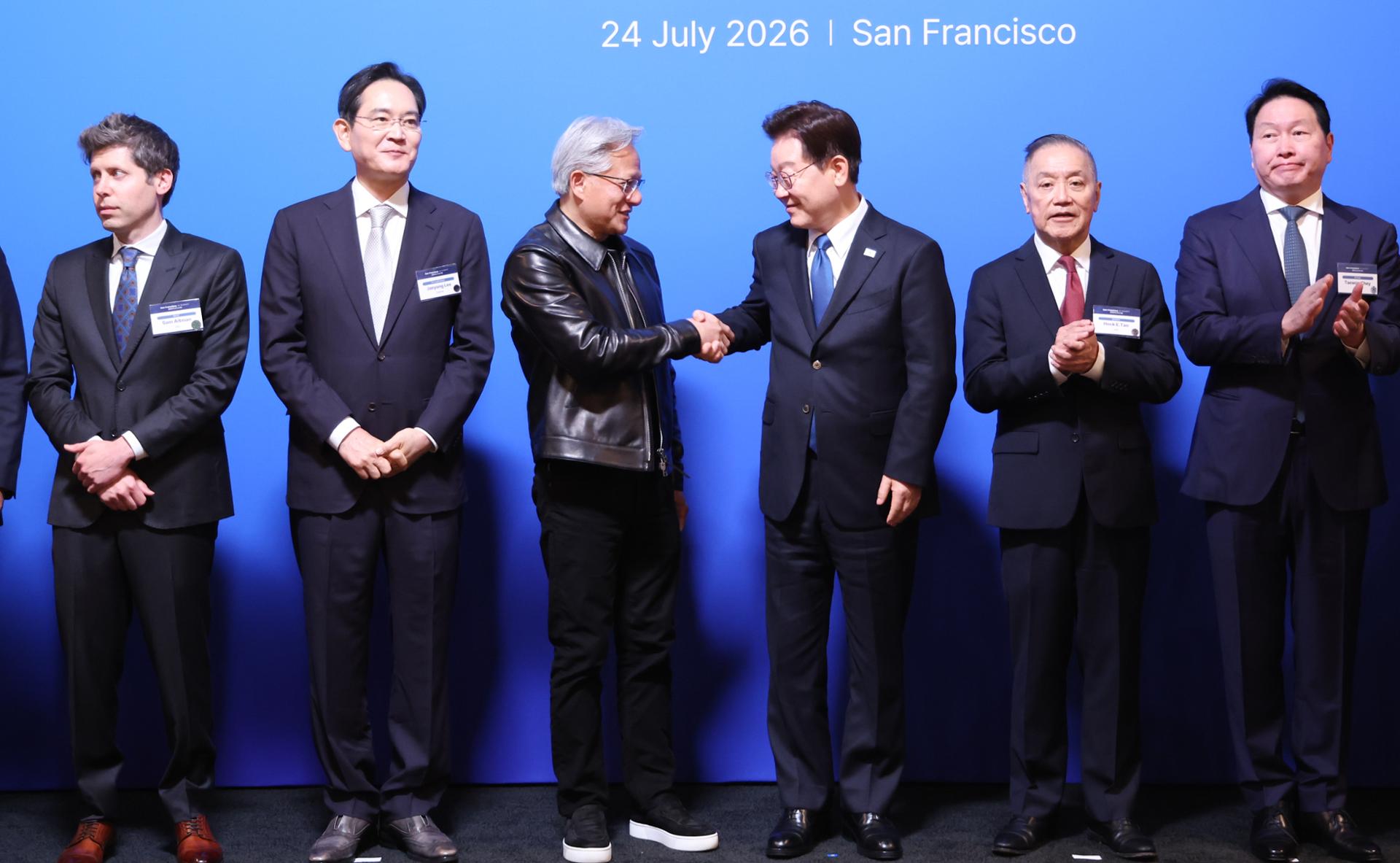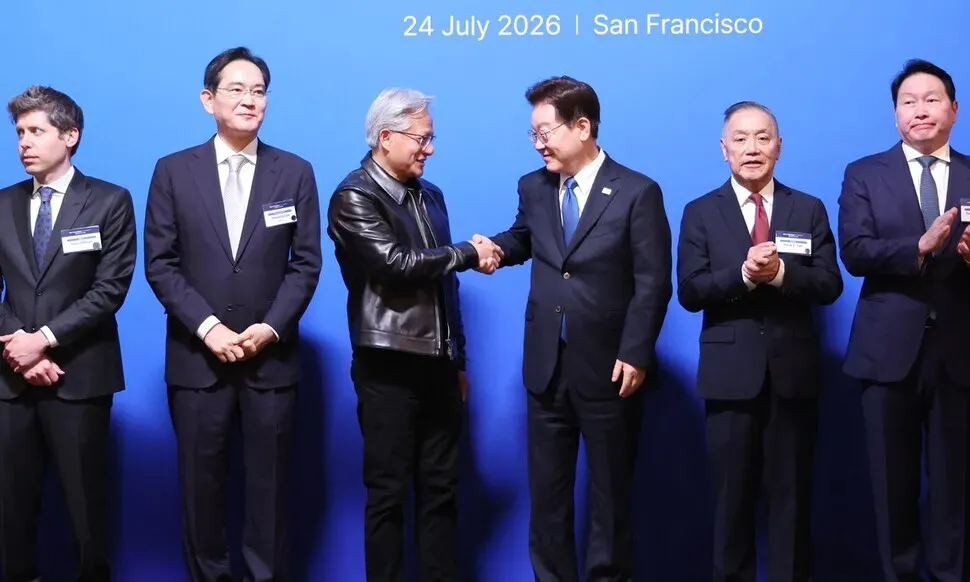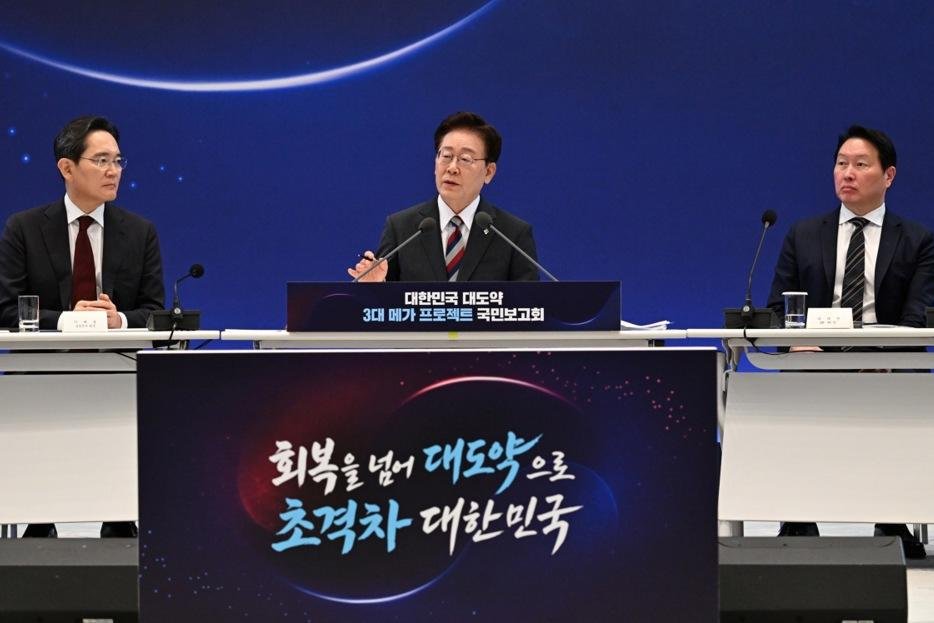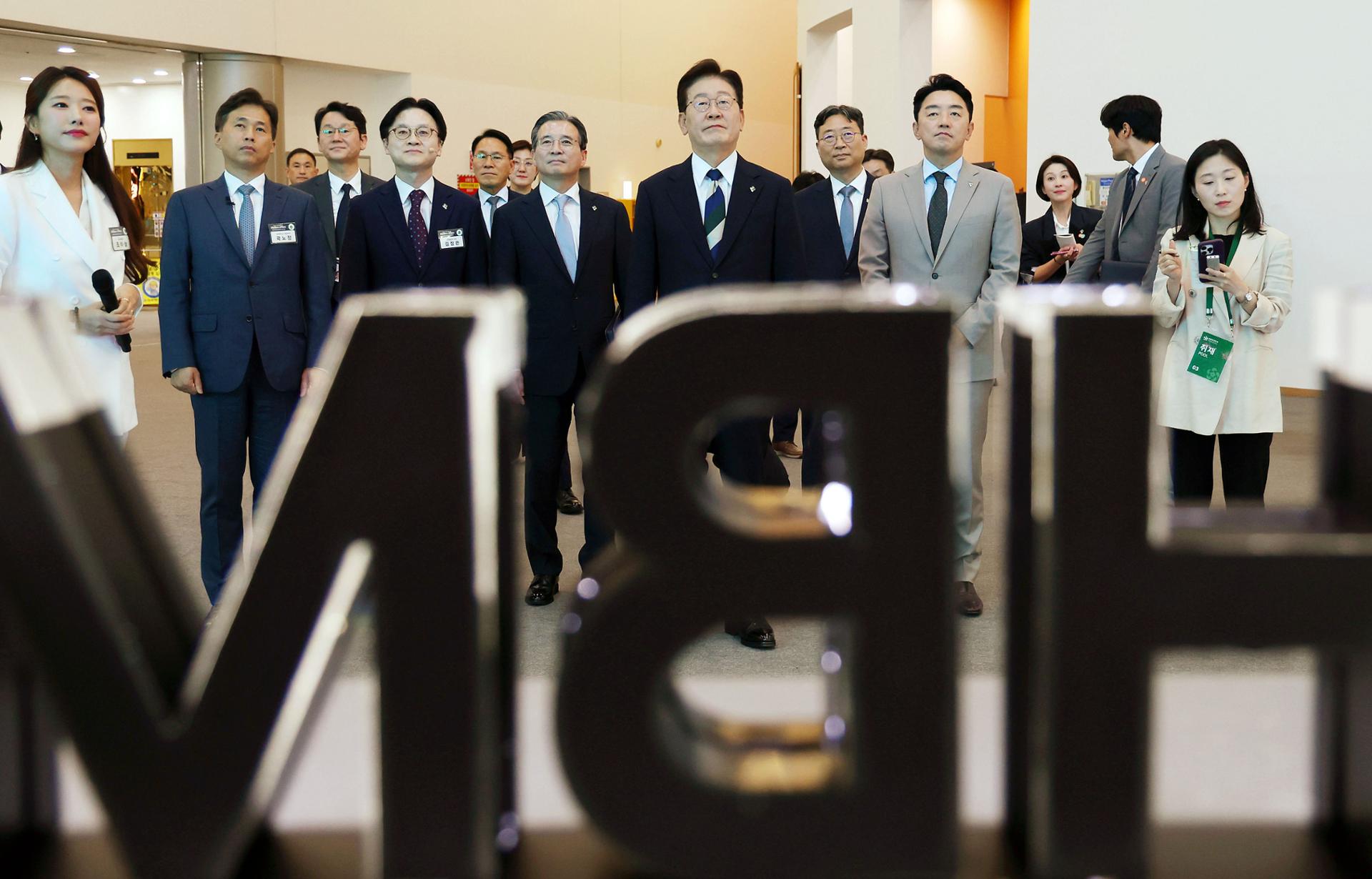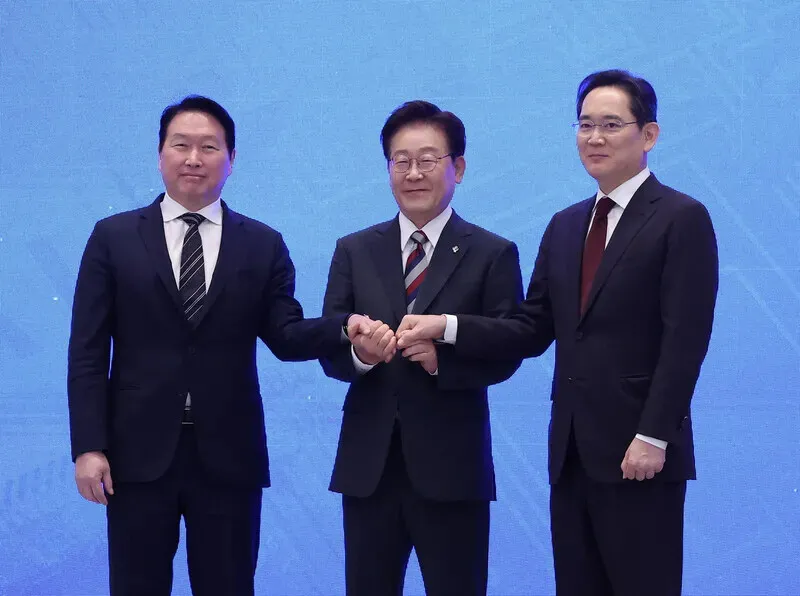
President Lee Jae Myung (center) joins hands with SK Group Chairman Chey Tae-won and Samsung Electronics Chairman Lee Jae-yong at an announcement of three “megaprojects” from the Blue House on June 29, 2026. (Park Jong-sik/Hankyoreh)
By Ahn Seon-hee, chief of the editorial board“No matter what anyone says, Samsung is getting into the semiconductor business, so run that in your paper,” declared Lee Byung-chull, the founder of Samsung Group, to his in-law Hong Jin-gi, the chairperson of JoongAng Daily, via an international call on Feb. 8, 1983, from the Okura Tokyo. A few days later, Chung Ju-yung, the founder of Hyundai Group, announced the establishment of Hyundai Electronics, which was later rebranded to SK Hynix. At the time, jumping into the microchip industry, which was dominated by the US and Japan, was a huge gamble. The resolve of two prominent businesspeople set the stage for the legendary beginning of Korea’s semiconductor sector. Of course, we’d be remiss not to mention the final player who set the stage. The Korean government completely supported the budding semiconductor industry by designing state-led research and development projects, handing out a wealth of low-interest loans and tax breaks, as well as the 1981 plan for the long-term promotion of that very industry. Another factor came into play. In the 1980s, Japan surpassed the US as the dominant force in the memory chip market. The US began imposing high tariffs on Japanese semiconductors, and in 1986, Japan ultimately signed the US-Japan Semiconductor Agreement, which limited the volume and price of DRAM exports to the US and required Japan to increase its imports of US chips. Along with the Plaza Accord, which was signed just a year earlier, this was part of the US strategy to contain Japan and curb its momentum, which was threatening the US’ status as the world’s leading economic power. While six of the world’s top 10 semiconductor companies in the 1980s were Japanese (Nippon Electric Company, Toshiba, Hitachi, Fujitsu, Mitsubishi Electric, and Matsushita Electric), none of them remain within the top 10 today. The void left by Japan was filled by Korea. “I’m not worried that semiconductor prices will drop, but that they’ll soar even higher,” commented SK Group Chairperson Chey Tae-won during a press briefing on July 15. The executive’s concern is “chipflation,” where the prices of computers, phones, and other items rise in tandem with soaring semiconductor prices. “If chipflation gets any worse, we will inevitably face geopolitical repercussions. We’ll follow in the footsteps of Japan and end up in a situation in which the US or China will continue to harangue us,” he said. Chey is most likely referring to the 1986 US-Japan Semiconductor Agreement when he warns that Korea may follow in Japan’s footsteps. Of course, a lot has changed in those 40 years. At the time, the problem lay in the fact that Japanese semiconductors, which were cheaper and of a better quality, were displacing US products. Today, the issue lies in the fact that prices are soaring due to a global supply deficit.But for the US, the source of anxiety today is much the same as it was 40 years ago.The US finds itself forced to rely upon foreign memory chips and chipmakers. In the 1980s, that foreign country was Japan; today, it’s Korea and Taiwan.Back in the 1980s, the semiconductor industry had already acquired the strategic valence of oil. Needless to say, given the race for AI supremacy, that remains true today.The push for silicon sovereignty is being witnessed around the world. The approach the US has arrived at is protecting homegrown chipmakers like Intel and Micron while pressuring Korean chipmakers Samsung Electronics and SK Hynix and Taiwanese chipmaker TSMC to build fabrication plants in the US.The US has a wide range of leverage at its disposal — security assets, tariffs and sanctions on technology.Considering that even the free trade champions in the Reagan administration bullied Japan with punitive tariffs in the 1980s, there’s no stunt the “America first” proponents in the Trump administration wouldn’t pull.In January, US Commerce Secretary Howard Lutnick said, “Everyone who wants to build memory has two choices: They can pay a 100% tariff, or they can build in America.”Lutnick revisited the subject on July 9, half a year later, reportedly saying “I want to bring [. . .] Samsung and SK Hynix here to America to build.”That suggests Lutnick isn’t satisfied with the Samsung Electronics foundry and the SK Hynix chip packaging plant that are already being built there.“We’re trying to build everywhere possible [including the US],” remarked Chey, the SK chairperson.Perhaps it would be possible to arrange an amicable split between fabrication plants in Korean locations (such as Yongin and the southwest Honam region) and American ones, assuming the semiconductor supercycle sustains its momentum. But if and when chip demand dries up, leaving a supply glut in its place, Korea and the US may find themselves locked into a zero-sum game.There is no shortage of worrisome contingencies Korean chipmakers must take into account, such as how long this outpouring of AI investment will last, disruptive technological innovation turning today’s cutting-edge chips into museum pieces, and the Chinese semiconductor industry catching up with a vengeance.But despite signs of decline, the US remains a superpower with the means to achieve its will. Therefore, Koreans must pay heed to the cards in Washington’s hands.There are no right answers here.Korea has no choice but to keep working to maintain its technological advantage while crafting a cautious strategy of adapting to changing circumstances in the years to come.The public and private sectors will have to move in tandem, as they did 40 years ago. That’s especially true if Korea means to dodge a geopolitical backlash.Please direct questions or comments to [english@hani.co.kr]