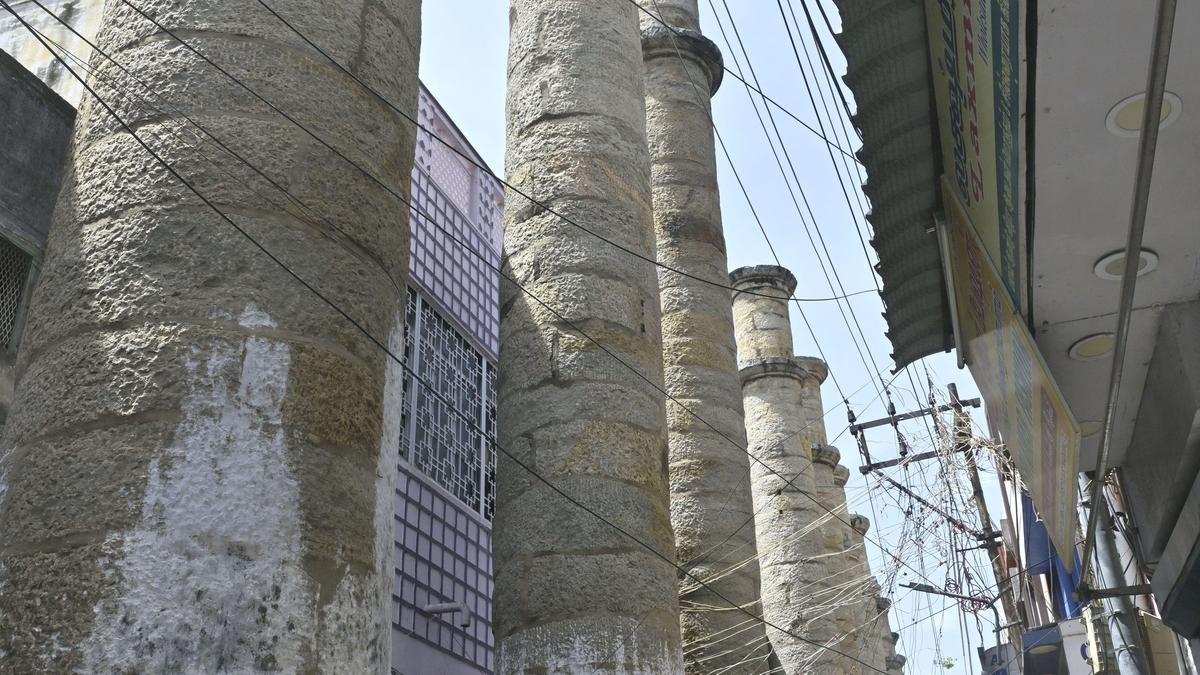
How often do we look up while walking through a busy market? ThePathu Thoon(ten pillars) street, one of Madurai’s lesser-known heritage places, tucked away in the heart of the city, gets its name from the huge pillars that have been there for over 300 years. While the pillars define the street’s history, the neighbourhood is equally known today for its bustling textile shops, where trade and history coexist in a space that blends the past with the present.For many people, the huge pillars are just a familiar landmark. But for archaeologists, they are like the pieces of a story that is still being put together.
A row of huge pillars stands in a narrow lane on 'Pathu thoon' street.
| Photo Credit:
G. MOORTHY
“There are no surviving records from the Nayak period about this structure,” says an official from the Department of Archaeology. “What we know today comes largely from British-era records and the work of historians.”Based on those records, historians believe the pillars were once part of an extended palace dating back to the Nayak period. “It is believed that this was a separate palace for Muthiyalu Nayak, the brother of Thirumalai Nayak,” the official says.He explains that while the Nayaks originally ruled from Tiruchi, Thirumalai Nayak shifted the capital to Madurai. Years later, his grandson Chokkanatha Nayak moved it back to Tiruchi. “Historians believe that when construction of a fort began in Tiruchi, stones from portions of the palace in Madurai were used. The huge pillars were left behind, and that is why they still stand here,” he says.The story does not end there. During the British period, Lord Napier oversaw the restoration of the palace. “The palace was repaired, but these pillars remained where they were. Over time, this street came to be called Pathu Thoon,” the official says.