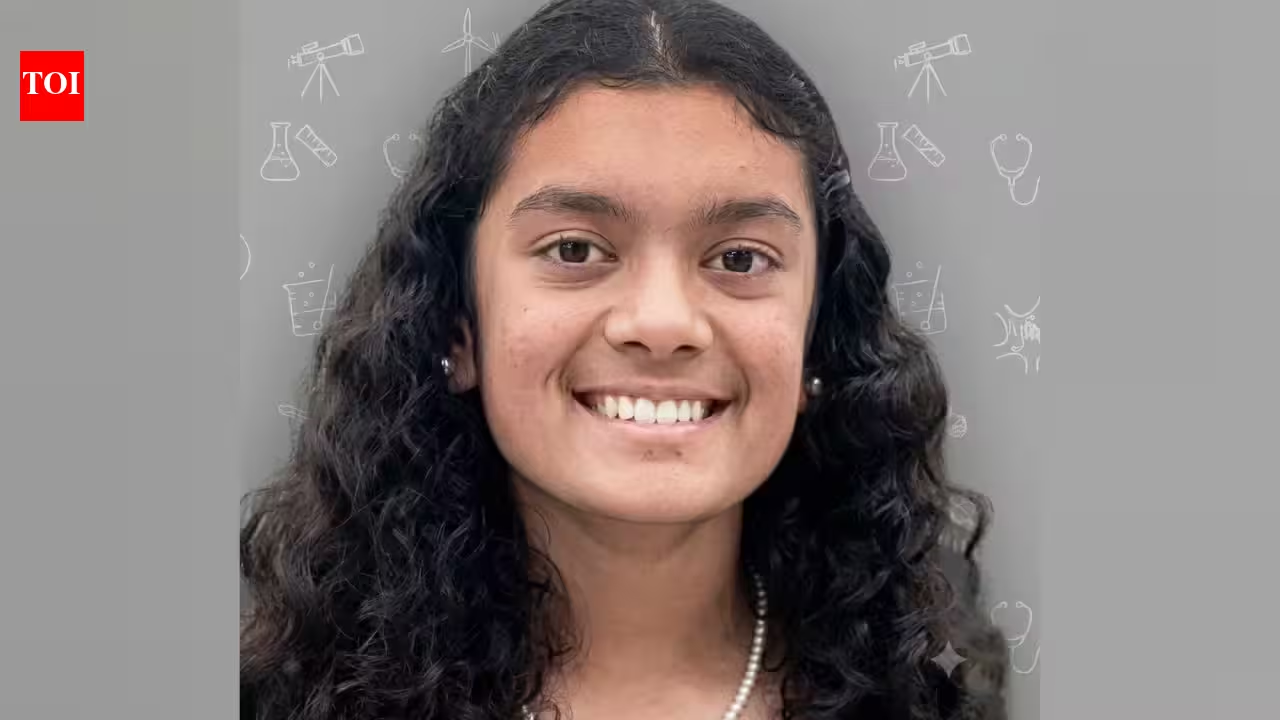
A 13-year-old Indian-American student from Minnesota, Arika Kundu, has created an innovative way to reduce pesticide residues on fresh fruits and vegetables using discarded peanut shells. A seventh-grade student at Minnetonka Middle School East, she developed a project titled “LIGNEX - A novel biosorption based approach that uses agricultural waste material to eliminate pesticide residues from fresh produce.” Her work has earned her a spot among the top 10 finalists in the 2026 3M Young Scientist Challenge.How the Method WorksFruits and vegetables often retain pesticide residues even after washing. Seeking a low-cost and practical solution, Arika turned to agricultural waste. She designed a process that transforms peanut shells into a material capable of trapping pesticide residues.Her method relies on biosorption, a process in which natural materials attract and hold chemicals. In this case, the treated peanut-shell material acts like a natural filter, capturing pesticide residues when produce comes into contact with it. This approach not only helps reduce harmful chemicals on food but also gives a second life to waste materials that would otherwise be discarded.Recognition at a National Science CompetitionThe 3M Young Scientist Challenge recognises middle school students who create science-based solutions to real-world problems. As a finalist, Arika will collaborate with a 3M scientist over the summer to refine her project before presenting it in the final round in October, where she will compete for the $25,000 grand prize and the title of “America's Top Young Scientist.”Motivation and Future GoalsArika shared that she joined the competition to sharpen her innovation skills and make her idea widely useful. "I entered the 3M Young Scientists Challenge to improve my innovation and turn it into a product that everyone can benefit from," she said.Looking ahead, she has ambitious plans. "In 15 years, I hope to be an astrobiologist, specifically in computational biology," she said. She aims to work on reducing radiation exposure during space travel, a challenge that could also contribute to advancements in cancer research, ageing, and other scientific fields.[With TOI inputs]
How a 13-year-old Indian-American student turns peanut shell waste into breakthrough solution to remove pesticides from fruits & vegetables
Arika Kundu, a young Indian-American student, has developed an innovative method for reducing pesticide residues. Her project utilizes discarded peanut shells to create a natural biosorbent material for produce. This groundbreaking work has secured her a place as a top finalist in a national science competition. She will collaborate with a scientist to refine her project for the final round.
332 words~2 min read