Summary
The 2026 World Cup generated $20 billion in prediction market volume and $24 million in digital collectible trades, with over 400,000 wallets participating in blockchain-based betting throughout the tournament.
While Chainalysis identified $5.4 million in flows from sanctioned sources (primarily Huobi/HTX), less than 1% of bettor wallets showed illicit ties, highlighting that the vast majority of on-chain activity was driven by legitimate fans.
FIFA’s official “FIFA Collect” platform demonstrated the practical utility of blockchain by allowing 100,000 fans to secure match tickets through digital assets; the platform’s strict KYC protocols resulted in negligible exposure to illicit funds compared to decentralized prediction markets.
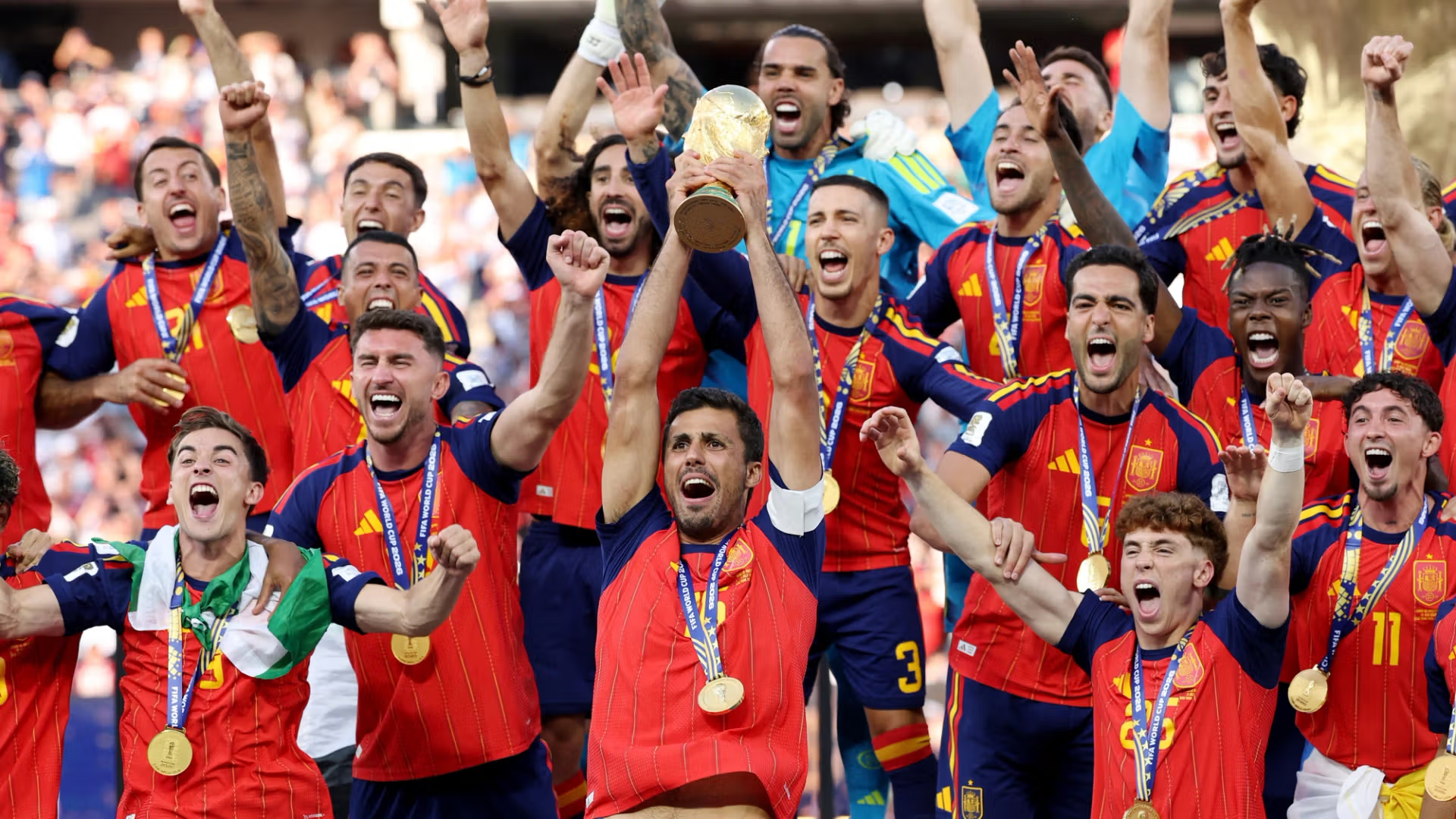
This year’s FIFA World Cup was the largest ever by many well-worn benchmarks: attendance (6.8 million), ad spend ($10.5 billion), and US TV viewership (66 million for the final alone). It was also one of the biggest-ever sporting events as measured by on-chain activity. Chainalysis’s research reveals the football tournament generated $20 billion in prediction market volume from January 2026 onward, and $24 million in collectable trading volume since May 2025.Close to 400k wallets interacted with blockchain-based prediction markets, generating $5.7B in volumes during the length of the tournament. Key storylines (for example: who will win the World Cup?) saw the most activity, but other niche questions attracted millions of dollars, too. One memorable market asked bettors whether they thought soon-to-retire Portuguese star Cristiano Ronaldo would cry at the end of his campaign. (he did, according to the market; it generated $49 million in volume along the way). Across all markets — novelty or no — 55% of bettors came out ahead. Of that group, 79% were experienced prediction market prognosticators.Beyond prediction markets, another on-chain enterprise capitalized on FIFA’s global reach: digital collectibles. An official FIFA program called “FIFA Collect” allowed fans to buy and sell digital moments commemorating the tournament’s biggest stars. It also acted as a less-discussed access path to the tournament itself. Collectors could turn their digital trinkets into real-world tickets, or buy access to the games from other collectors on secondary markets. This stablecoin-powered economy generated at least $24 million before and during the World Cup, according to our review. While the sum is hardly a show-stopper when compared to other major moneymakers, its modest success may hint at the shape of things to come.Understanding digital flows will become increasingly important as more of the world’s financial infrastructure moves on-chain. Our breakdown of the activity orbiting the World Cup traces where the money comes from, where it goes, and what it tells us about the state of on-chain finance. Even amid the tournament’s overwhelmingly legitimate activity, our analysis surfaced wallets with direct ties to illicit actors. The World Cup offers a microcosm of crypto’s expanding role in everyday life, and a preview of why the tools to follow the money will need to keep pace.Months of bets before the main eventThe five-week-long World Cup put a capstone on years of competition by national football teams — but also by bettors taking a chance on their fate. Our analysis of the 2026 campaign actually begins in January 2026, well before the tournament’s official start but in the final months of the qualification campaign.Prediction market users began 2026 generating nearly $50 million in daily on-chain volumes within FIFA World Cup markets, according to Chainalysis research. Spending their capital predominantly on match outcome markets, which included qualifying matches that ended in March 2026, along with group placement and tournament match outcomes. Participants maintained the $50 million level as a lower daily bound for the entire run-up to the tournament. But during especially active periods, they surpassed $100 million in daily activity.Volume began to soar as soon as the World Cup matches began. Shortly after the opening on June 11, daily volumes jumped to the $250 million range. They continued to trend higher through nearly the entirety of the tournament, tapering off only toward the end, when the dwindling number of teams left fewer matches to actively bet on and games were more spaced out. The tournament’s final more than made up for the drop-off. Bettors powered over $300 million in volumes on the final when Spain bested Argentina. During the tournaments, FIFA World Cup markets made up approximately 63% of total prediction market volume. During the tournaments, FIFA World Cup markets made up approximately 63% of total prediction market volume, our research shows.The tournament itself also saw an uptick in prediction markets for less headline-grabbing questions than simply the outcomes of matches. As shown by the orange and light blue areas of the chart, markets focused on statistics and general questions, such as will Cristiano Ronaldo cry, generated modest volumes during the meat of the action.Where in the worldChainalysis uses a variety of advanced tooling to understand where flows come from. On-chain prediction markets serve a global audience; by using proprietary geos methodology, we can gain insight into the country-level distribution of prediction market betting volume surrounding the World Cup.Our analysis of flows shows that the 2026 World Cup truly was a global phenomenon for prediction markets. Countries on every continent (minus Antarctica) contributed meaningfully to the topline volume numbers. But the US and China led the pack, along with Canada, Thailand, and the United Kingdom. Our Choropleth map (see above) visualizes attributable country-by-country volume flows on a log scale. The more vibrant orange a country appears, the higher their totals. Conversely, the more light blue a country is, the less their totals. Countries in gray are those for which we do not have data. (Country attribution is based on Chainalysis geolocation methodology and may carry uncertainty for wallets using VPNs, mixers, or other privacy tools that obscure true location.)Illicit interactionsThe tournament’s prediction market users were predominantly sports fans and other people who thought they had an edge in understanding what would come of their favored matchup. Not all of those fans had “clean” money, however. We looked at the counterparties that World Cup bettors transacted with before placing their wagers. Approximately 3,700 wallets (<1% of total) had illicit interaction histories that we could parse out on-chain.By volume, the single-largest source was Huobi/HTX. That major international crypto exchange was sanctioned in late May by UK and more recently EU authorities for allegedly facilitating Russian crypto flows. Its broad international user base inevitably overlapped with the tournament’s global audience. At least $5.4 million in volumes directly flowed from Huobi into wallets that bet on World Cup prediction markets.Many other illicit nexuses appear in the on-chain records: