See more This is Money on Google - save us as a Preferred SourceBy FREDA LEWIS-STEMPEL, SENIOR MOTORING REPORTER Updated: 15:14 BST, 30 July 2026
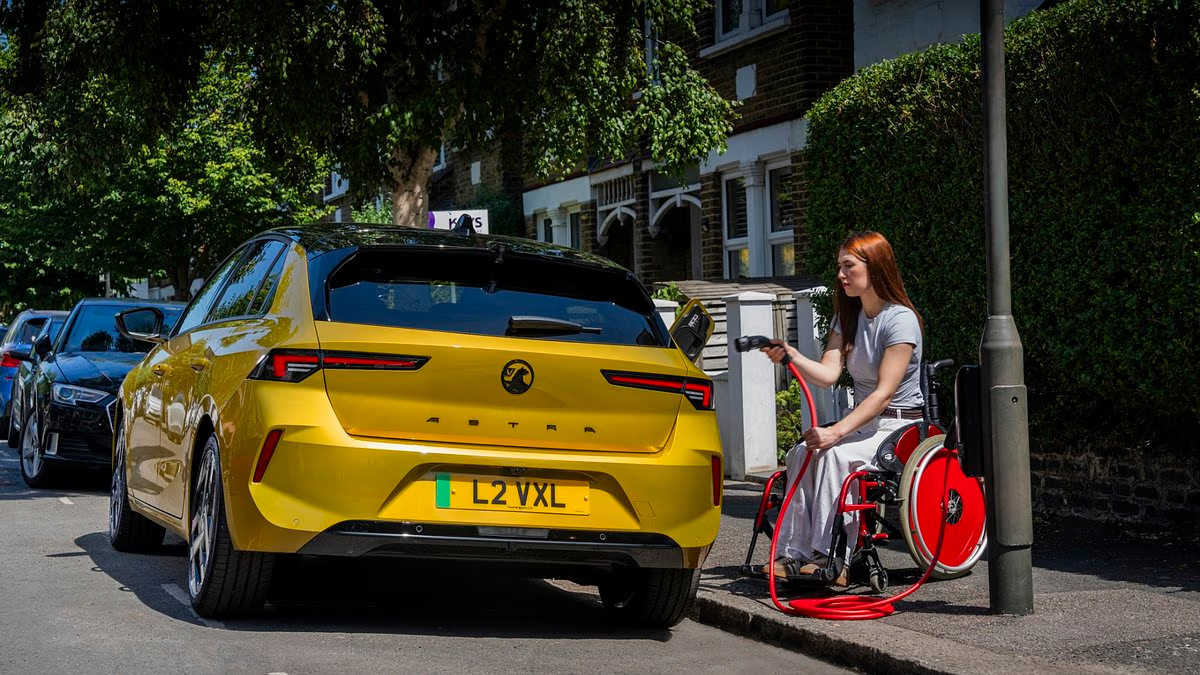
Most councils in Britain don't have accessible electric car charging points suitable for disabled people to use, despite a sharp rise in accessible on-street charging over the past year.Seventy-five per cent of councils currently don't have devices specifically adapted for drivers with accessibility needs and do not conform to recognised accessibility standards.This is the case even though the number of councils offering accessible on-street charging has doubled in the last year.The research, conducted by Vauxhall, found that 49 of the 194 councils that responded to a new Freedom of Information request said they now have on-street charge points that meet accessibility needs.In 2025, just 24 councils said they did, suggesting some progress is being made.These on-street charge points have either been specifically adapted for disabled drivers or conform to the British Standards Institution's PAS 1899:2022 accessible charging standard. Some 75% of councils currently don't have chargers specifically adapted for drivers with accessibility needs or that conform to recognised accessibility standards The number of on-street EV chargers located within disabled parking bays has more than doubled since 2024, rising from 105 to 245.An estimated 15 per cent of on-street chargers are now specifically adapted for disabled drivers, while 14 per cent conform to PAS 1899:2022 accessibility guidance.However, the findings show that this step forward is not enough, and more work needs to be done to ensure public charging is accessible for all drivers.While more than half of councils that responded to Vauxhall's FOI said their charging strategies include considerations for disabled and elderly residents, accessible charging provision remains uneven across the UK.Vauxhall's research found just 43 accessible on-street chargers in the North West and 14 in Scotland, compared with 2,131 in London. An estimated 15% of on-street chargers are now specifically adapted for disabled drivers, while 14% conform to PAS 1899:2022 accessibility guidance Eurig Druce, managing director of Vauxhall UK, said: 'It's encouraging to see the number of councils providing accessible on-street charging nearly double in the last year.'This shows growing recognition of the importance of ensuring disabled drivers can access public charging infrastructure.'However, our latest research shows there is still more work to do.'Three-quarters of councils still do not provide chargers that are specifically adapted for disabled drivers or conform to recognised accessibility standards.'As more drivers make the switch to electric vehicles, we need to ensure all motorists can easily find and access charge points if we are to bring everyone on the UK's electrification journey.' Dundee's Clepington Road charging hub is accessible for disabled users, with larger spaces, longer cables and level access. What accessible charging looks like: Dundee CouncilDundee Council is an impressive example for councils wanting to implement more accessible chargers and bays.We visited the Scottish city back in 2024, when just 2 per cent of on-street chargers in Britain met accessibility guidelines, and Dundee was a leader among that 2 per cent.Dundee's Clepington Road charging hub has been designed to meet BSI PAS 1899:2022 accessibility guidelines, with input from disabled drivers and disability charities.Dundee Council's partnership with Swarco E.Connect Smart Charging has allowed it to design the hub to be functional for those with accessibility requirements.It has longer cables, larger spaces and level access, with no raised plinths or bollards, making it accessible for disabled users.