Insider Brief
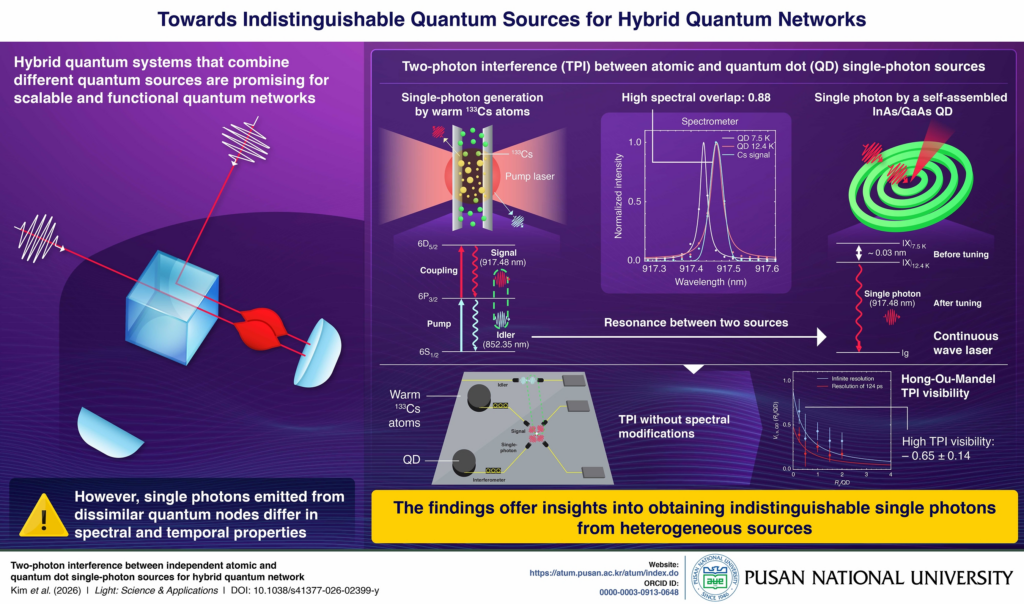
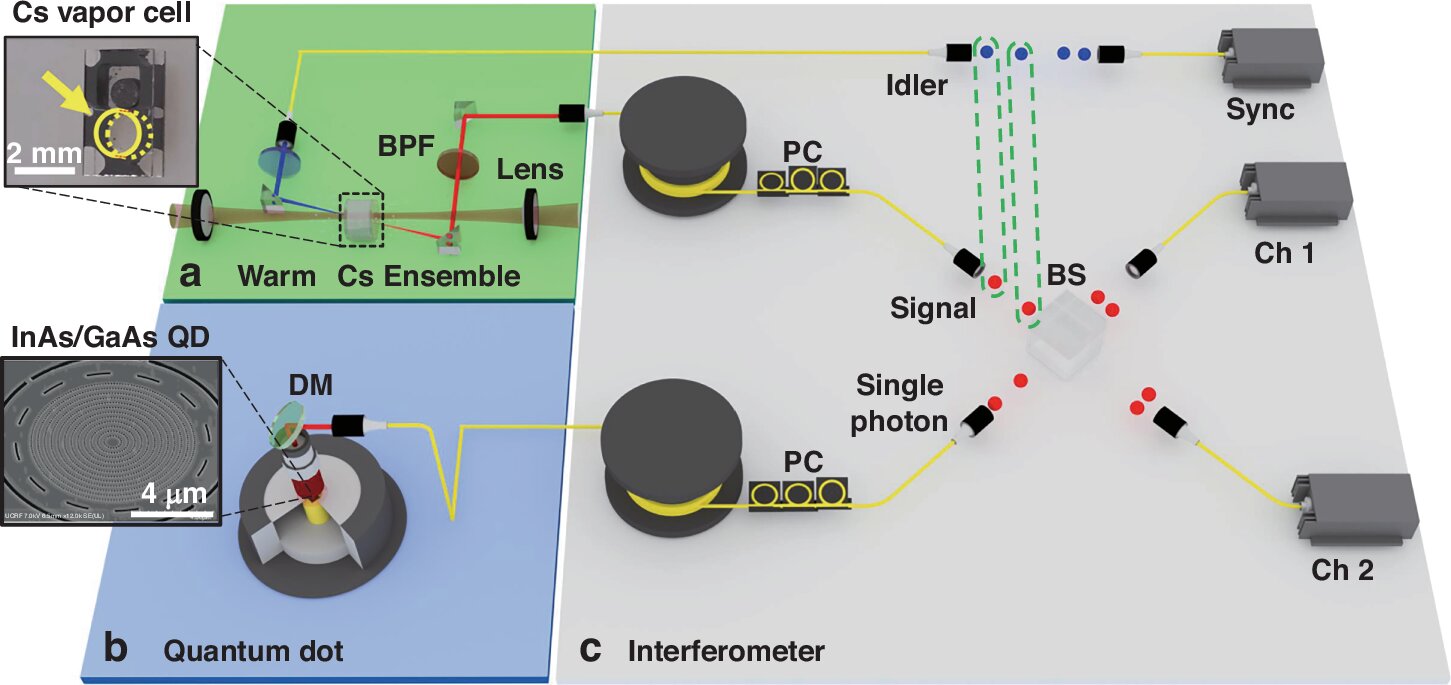
Researchers from Pusan National University and Ulsan National Institute of Science and Technology demonstrated photon interference between two different quantum light sources, a cesium atomic ensemble and a semiconductor quantum dot.
The experiment produced indistinguishable photons from separate quantum systems and achieved Hong–Ou–Mandel interference with a visibility of 0.65 ± 0.14 without spectral or temporal modification.
The hybrid architecture could support future quantum networks by combining quantum emitters with systems that provide photon storage and synchronization capabilities.
Press release – Large-scale quantum communication networks require both reliable quantum memories and coherent single-photon sources for efficient quantum information exchange. While various single photon sources have been developed recently, each has inherent limitations, making a scalable and functional quantum network challenging to achieve.