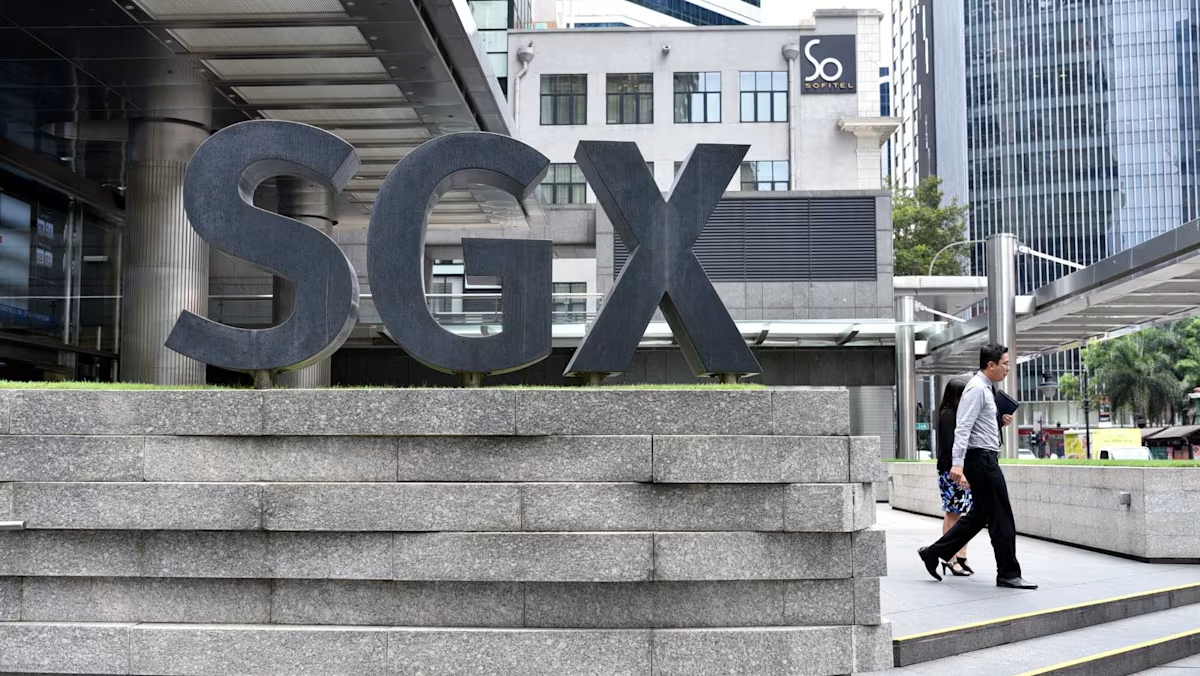
SINGAPORE – Singapore’s efforts to revive its stock market have yet to translate into gains for investors in this year’s biggest new listings.Seven companies had listed on the Singapore Exchange (SGX) as at late July, an average of one a month, compared with 15 IPOs in the whole of 2025. Three out of the four companies that debuted on the mainboard in 2026 – co-working space operator JustCo, Foundation Healthcare Holdings and UI Boustead Reit – are trading below their offer prices.Investors may have expected stock market measures introduced by the Monetary Authority of Singapore and SGX to produce a quick and visible revival in listings. But the performance so far shows that attracting companies to list is only one part of the equation. Their valuations must also be aligned with investor demand if the shares are to perform after listing, among other things.The lacklustre IPO performance so far does not mean interest in Singapore stocks is weak. SGX’s total securities trading value jumped 72 per cent year on year to $44.6 billion in June, while average daily trading value reached its highest level in 18 years for the financial year.The figures suggest that investors are active on the bourse, even if their appetite for recent IPOs has been more cautious. Here is why this year’s IPOs have struggled, and what investors should examine before subscribing to the next new listing.IPOs were overpricedOne key reason for the underperformance of 2026’s mainboard listings so far is their IPO prices, as the market might have deemed the valuations of these companies too expensive.For example, co-working space operator JustCo priced its IPO at 94 cents a share, but the counter closed 17.6 per cent lower on its first day of trading on May 22. Just over a month later, it had fallen 42.6 per cent below its offer price.“If an IPO trades below its issue price shortly after listing, it could suggest that the valuation was priced too aggressively and not aligned with market expectations,” said Tan Kian Tiong, chief operating officer at SAC Capital.Setting a lower IPO price does not guarantee that the stock will perform better after listing though.UOB Kay Hian’s director of wealth management Kenneth Goh noted that Foundation Healthcare, which is backed by Temasek, was priced “at the bottom of its range” and still closed its first day of trading below its IPO price.The healthcare provider’s share price began to climb only after stabilising manager UBS bought about 19.5 million shares across eight sessions in a span of two weeks.A stabilisation manager may buy shares in the market for a limited period after an IPO to absorb selling pressure and reduce sharp price swings.A weakening share price over time could also reflect concerns about growth prospects and the operating environment, as well as limited investor engagement or business updates.Despite having solid fundamentals and strong shareholders, some of these IPOs may have been priced at levels that already reflected their growth potential, thus leaving limited upside after listing, said Tay Hwee Ling, capital markets services leader at Deloitte South-east Asia.Rather than an issuer’s brand name or the size of the IPO deal alone, the market is increasingly focused on whether future growth can justify its valuation, she added.“The underperformance does not necessarily suggest these businesses are weak. Rather, it indicates that investors are reassessing whether the offer prices sufficiently compensated them for the risks and growth assumptions involved.”Heavy institutional allocationAnother factor that could affect the performance of IPOs post-listing is the proportion of shares allocated to institutional and retail investors.A higher share of shares allocated to institutional investors could mean a very limited free float available for public trading. This reduces trading activity and makes it harder for investors to buy or sell larger quantities of shares.This was the case with JustCo’s IPO, in which retail investors were allocated just 6.3 million shares, or 5.9 per cent of the 106.3 million shares offered.IPOs with large institutional allocations and small public floats could see sharper price swings, particularly when lock-up periods expire and more shares become available for sale, said UOB Kay Hian’s Goh.However, heavy retail participation without sufficient institutional support can also make share prices more volatile, particularly when investor sentiment turns negative, he noted.Issuers must therefore strike the right balance in allocating shares by bringing in credible institutional investors while maintaining a sufficiently large retail float to diversify the shareholder base and support active trading.While retail participation in the market has improved compared with the last few years, market depth and interest are still not sufficient to sustain trading momentum for some IPOs, said SAC Capital’s Tan.Prices can come under pressure once the initial buying interest cools, and eventually there will be no buyers for the issuer’s shares.Price discovery process can be improvedTo improve the pricing of upcoming IPOs, analysts said more attention must be paid to price discovery.This is the pre-listing process through which a company and its underwriters gauge investor demand and determine the final offer price, typically through roadshows and book building.During book building, investors indicate how many shares they are prepared to buy and at what price, helping the company assess demand.The price discovery process works best when issuers invest time in communicating their business fundamentals, growth strategy and financial outlook to both institutional and retail investors, said Tan.Singapore investors are generally cautious in their valuation expectations, and often seek a greater margin of safety, he noted.“It is important for the lead underwriter to manage owners’ valuation expectations upfront and ensure pricing is grounded in market realities rather than overly ambitious targets,” said Tan.An underwriter – typically an investment bank or brokerage – helps the company price, market and sell its shares to investors.David Smith, senior investment director for Asian equities at Aberdeen Investments, noted that several IPOs came to market within a short period, giving retail investors little time to assess each offering before the price was set.A longer offer period, with more shares allocated to retail investors when demand for the IPO is strong, would allow the price to reflect real public demand and not just early institutional interest, said Goh.Tan added that a disciplined book-building process that incorporates meaningful investor feedback can help establish a fair valuation, broaden investor participation and provide a stronger foundation for healthy post-listing performance.Investors can make better use of available informationKnowing what to look for in a company’s offer documents can help retail investors assess an IPO and decide for themselves whether the offer price is justified.An issuer’s preliminary prospectus, which is filed on SGX before the IPO is launched, is a comprehensive document that investors should not ignore if they want to better understand a company’s business model and reasons for listing.Investors can start with the sections on risk factors and the use of proceeds, as these will inform what the company’s management believes could go wrong and how disciplined they intend to be with investors’ capital.They should also pay close attention to related party transactions, customer and supplier concentration, and the track record and alignment of the management team, including their own financial commitment to the business, said RHB Singapore head of equity research Shekhar Jaiswal.The industry outlook is also critical, including whether structural challenges, competitive advantages and favourable market trends can support the company’s long-term growth prospects, said Foo Siang Sheng, Singapore head of investment banking at CGS International Securities Singapore.“Singapore IPOs should also be viewed with a longer-term investment mindset, rather than being compared with the short-term trading dynamics often seen in larger overseas markets, for example, the US market,” SAC Capital’s Tan said.“Ultimately, investors should assess whether the company has sustainable fundamentals and whether the IPO valuation appropriately reflects its long-term prospects.”Outlook for IPO marketAnalysts are still optimistic about Singapore’s IPO outlook, citing a healthy pipeline of potential listings and strong policy support, which is expected to broaden institutional participation in the market.SGX has said its IPO pipeline continues to be robust, with at least 30 companies preparing to list here.Foo noted that the price discovery process and IPO performance on the SGX should improve in the second half of 2026 as fund managers become increasingly discerning about investors’ demands.“With more IPOs competing for investors’ capital, issuers will need to articulate a clear and compelling investment proposition, supported by credible growth prospects and a well-defined use of proceeds.”If recent listings continue to trade below their offer prices, issuers and bookrunners are likely to price future IPOs more conservatively, which could give the shares more room to rise after listing, said RHB’s Jaiswal.Still, investors should expect the IPO market to be volatile in the current environment and be prepared for setbacks.A faltering AI investment cycle poses the most immediate risk, said Jaiswal.“The recent correction in global technology and semiconductor names shows how quickly sentiment can turn once investors start to question whether the enormous infrastructure spending is being matched by returns, and a deeper pullback would ripple through to risk appetite across the region.”Upcoming large AI-related IPOs in the US could also divert liquidity away from Singapore and other regional markets, noted SAC Capital’s Tan.The other critical factor that could adversely affect Singapore equities in the near term is a prolonged conflict in the Middle East, which could lead to higher inflation as a result of rising energy and transportation costs.This could cloud the outlook for US interest rates, which would in turn affect fund flows into Singapore.
Singapore IPOs: Why are they trading below offer price?
Explore the reasons behind Singapore's recent IPOs trading below their offer prices and what investors should consider before subscribing to new listings. Read more at straitstimes.com. Read more at straitstimes.com.
1,565 words~7 min read