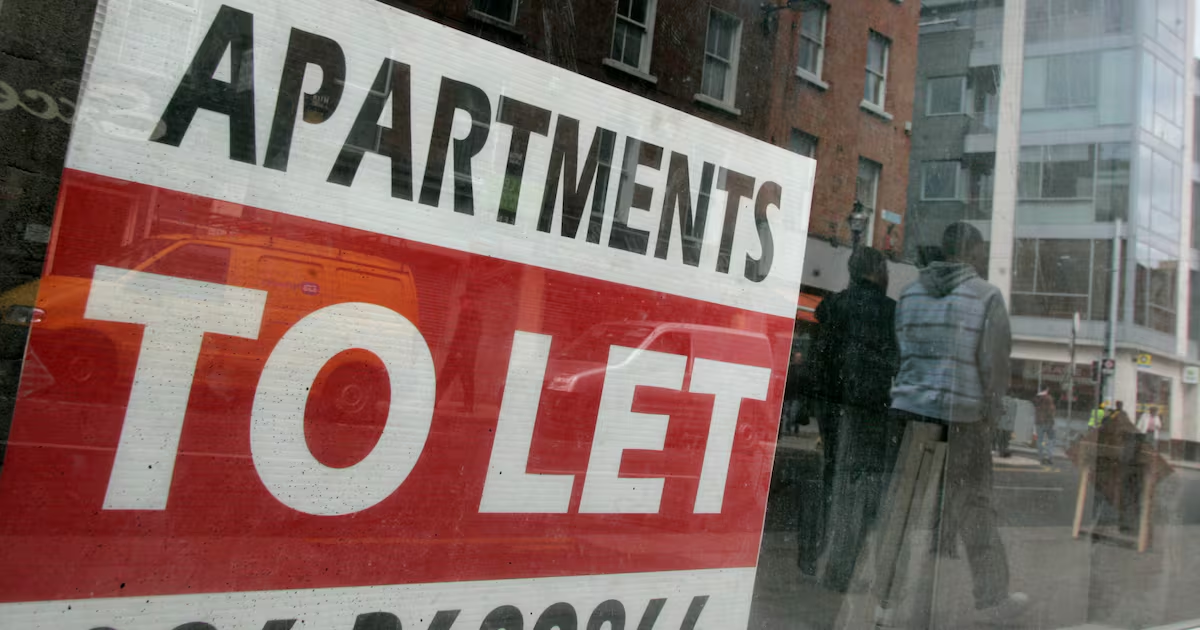
The number of new dwellings completed in the State fell by 3.6 per cent between April and June this year when compared to the same period of last year, new findings from the Central Statistics Office (CSO) reveal.The statistics agency recorded a 16.4 per cent drop in the number of new dwelling completions in the Dublin region from the second quarter of last year, as well as a 13.9 per cent decrease in the midwest region of counties Clare, Limerick and Tipperary.The border region, comprising counties Cavan, Donegal, Leitrim, Monaghan and Sligo saw a relative increase of 14.6 per cent – the largest growth in the country – while the southeast counties of Carlow, Kilkenny, Waterford and Wexford also witnessed an increase of 12 per cent, according to the CSO.In total, 8,823 new dwellings were completed in the second quarter of this year. 2,658 of these were apartments, a decrease of 12.2 per cent from last year’s equivalent period, with 1,427 “single dwellings” completed, defined as “one-off dwellings connected to the ESB network”. Up to 4,738 “scheme dwellings” were completed, accounting for 54 per cent of all dwellings completed in the second quarter of this year, an increase of 2 per cent in the last year’s figure. [ LDA to move beyond cities for sites capable of delivering 200-home schemesOpens in new window ]These are defined as “houses that form part of a multi-unit development of two or more houses connected to the ESB network.”The CSO uses new connections to the nation’s electricity network as the basis of its findings. Student accommodation is notably absent, as these buildings are generally connected to the ESB network as a commercial connection and are counted on a “bed space”, not dwelling, basis.Deloitte Ireland’s chief economist, Kate English, noted that 16,679 new dwellings have been completed in the first half of the year, the largest volume since 2008.What size does your pension actually need to be for a comfortable retirement? Listen | 31:47Recognising that the second half of the year typically sees more homes being built, she said “if this trend continues this year, it means the number of completions in 2026 will likely exceed the number of homes delivered last year and indeed any year over the past 18”.“That shows positive progress is being made to increase Ireland’s housing supply and we need to see that momentum continue from the policy changes made in 2025,” English continued.“However, it is also important to acknowledge that housing demand forecasts indicate that 50-60,000 homes are needed every year to meet demand. This means there is still some way to go to meet housing supply needs. Every year housing demand is not met, it adds further to the undersupply within the market,” she said.Trevor Grant, the chairperson of Irish Mortgage Advisors, said the 3.6 decrease in new dwelling completions from the second quarter of 2024 to 2025 “suggests that recent months have not been as promising for housing delivery as had been thought.”“This will be a particular blow for the many young people who are hoping to buy a home but consistently find that houses are out of their reach,” he said. “There is a huge pent-up demand for homes in Ireland, with record numbers of mortgage-ready buyers.”“This is further proof of the huge demand and need for Irish homes – and the huge responsibility on Government to deliver them,” he added. The Fianna Fáil-Fine Gael coalition’s programme for government, agreed upon in early 2025, pledged to deliver over 300,000 homes across the State by the end of 2030. Last year, 36,284 completions were achieved, down on a target of 41,000.
Number of new homes built from April to June down slightly from last year’s figure, CSO says
Central Statistics Office records a 16.4 per cent drop in the number of new dwelling completions in the Dublin area
604 words~3 min read