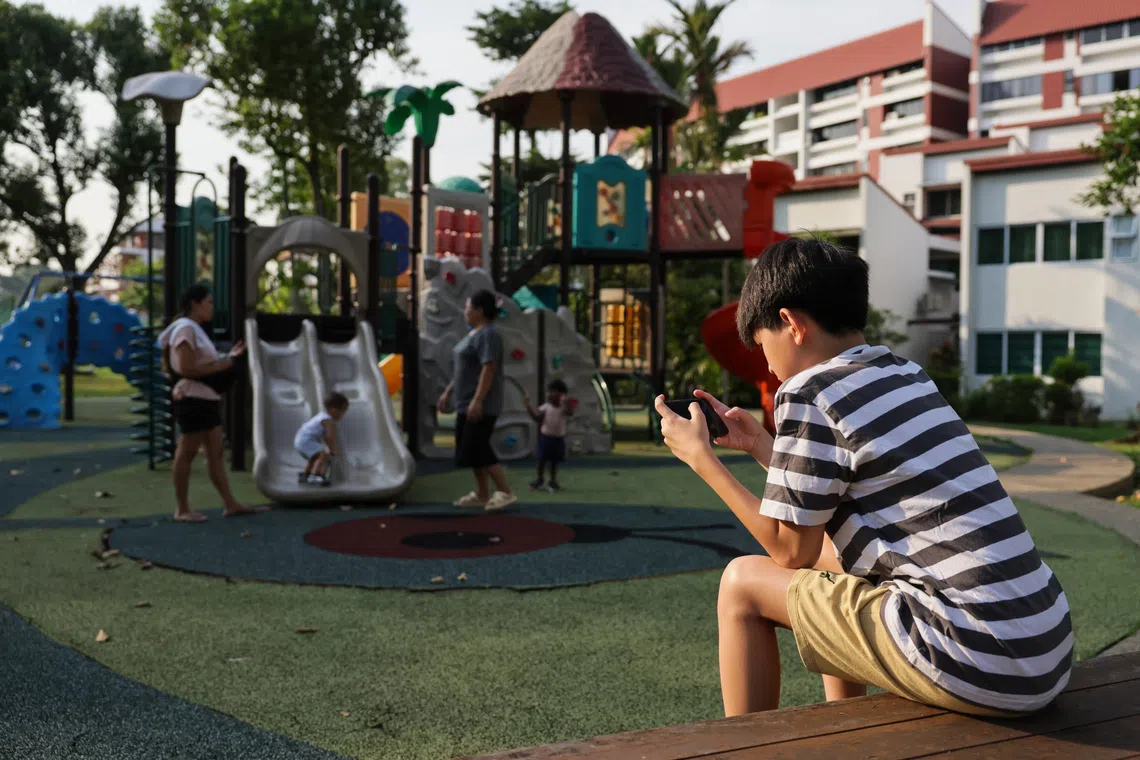
SINGAPORE – An expert panel formed by the Ministry of Health (MOH) is discouraging an age-based blanket ban on social media, citing the risk of it being counter-productive when young people circumvent the restriction and the lack of distinction between harmful and beneficial uses.Instead, the panel recommended tackling specific features that could expose users to safety risks, prolong usage or worsen mental health, as such a calibrated approach would be more durable and proportionate.It is one of the key recommendations the panel submitted to the Government, among other findings to support healthier and safer social media use among young people.“As far as possible, the panel prefers a more durable and proportionate response to make social media safer by design so that young people can navigate it safely, rather than simply deferring social media use,” said the panel in its report published on July 30.The latter approach was taken by jurisdictions in Australia, France, the United Kingdom, Malaysia and Indonesia, which have raised the minimum age for young people to access social media.The eight-member expert panel was formed in September to examine the impact of social media use on young people’s mental health.The members come from the Institute of Mental Health, National University of Singapore, Nanyang Technological University, MOH, Touch Community Services, and KK Women’s and Children’s Hospital.The panel is co-chaired by chief and senior consultant of IMH’s department of developmental psychiatry Lim Choon Guan and co-director of NUS’ Social Service Research Centre Jungup Lee.In the 20-page report submitted to the Government, the panel highlighted direct messaging functions that may expose young users to cyberbullying and harassment as a problematic feature. The existence of anonymous or pseudonymous accounts could worsen the issue.Other problematic features identified in the report included infinite scroll and autoplay functions, which encourage users to remain engaged for longer than they intended to. Such online engagements may displace physical activity and in-person interactions that are essential for healthy development in young users.Algorithmically curated feeds was another feature of concern as it could amplify exposure to distressing or harmful content.Meanwhile, social feedback mechanisms such as visible “like” counts and follower metrics encourage social comparison and validation-seeking, with potential negative effects on self-esteem and emotional well-being, according to the report.Indeed, the panel found that young people going through biological and psychological changes in their adolescence are more sensitive to social feedback and influences, and may not be well-equipped to manage social pressures online, critically evaluate online content or recognise manipulative design features.“As mental health conditions often emerge during adolescence, the negative impact of social media on young people’s mental health could potentially have lasting consequences,” said MOH in a media statement about the report on July 30.The panel’s recommendations are aligned with Singapore’s approach to push for safer social media platform designs to protect those under 18.Both Minister for Digital Development and Information Josephine Teo and Minister for Health Ong Ye Kung had spoken up against potentially problematic features such as algorithmic feeds, videos that play automatically and direct messaging by adults to young users.They had voiced Singapore’s preference for a more calibrated approach to tackle harm instead of implementing a blanket age-based ban.Apart from addressing potentially harmful features, the panel also called for the strengthening of age assurance measures.“Robust age assurance measures are a necessary foundation for regulating social media access for young users. Where platforms cannot reliably determine whether a user is a child or an adult, age-appropriate safeguards cannot be meaningfully applied or enforced,” according to the report.Mother of three children Lavina Daryanani, 56, agreed with the panel’s recommendations, noting that social media harms have become more pronounced over the years. Her youngest child is now 18.“Education starts from young,” she said, adding that this means having conversations on boundaries and harmful online content. She hopes the Government will have more public education campaigns, including catchy music videos, to inculcate healthy digital habits in children.The parent mentor at Temasek Secondary School said that some young people she has worked with had become so immersed in online activities that they struggled to cope offline.Daryanani, a director at a yarn and textile firm, said that parents also need to set good examples. “If the parents are using the phone 24/7, what do you expect from your own children?”She encourages parents to have open conversations with her children, rather than police or criticise them to build trust.Since April, app stores operating in Singapore have rolled out a range of age assurance measures such as facial scans and government identity verification, to control app downloads by those below 18. This is done to meet requirements in the Code of Practice for Online Safety for App Distribution Services enforced by the Infocomm Media Development Authority.The authority has plans to extend age assurance requirements to major social media services.Singapore’s approach also involves empowering young people to navigate the online environment in safe and healthy ways, and support their parents in guiding them to do so.This is outlined in the panel’s report, which also said that young people should be equipped with the judgment, critical thinking and healthy digital habits needed to navigate these spaces safely. The report, however, did not specify how this could be done.A whole-of-society response is also needed, recognising that no single intervention is sufficient on its own, according to the report.This means that families, schools, healthcare providers, community partners, platform operators and the Government need to work together to safeguard and support young people’s well-being.“Ultimately, protecting young people in the digital age is a shared responsibility, and will require sustained commitment from all parts of society,” said the report.
Tackle harmful social media features rather than impose total ban to protect the young: Expert panel
An expert panel recommends tackling harmful social media features rather than imposing a total ban to protect young people. Read more at straitstimes.com. Read more at straitstimes.com.
930 words~4 min read