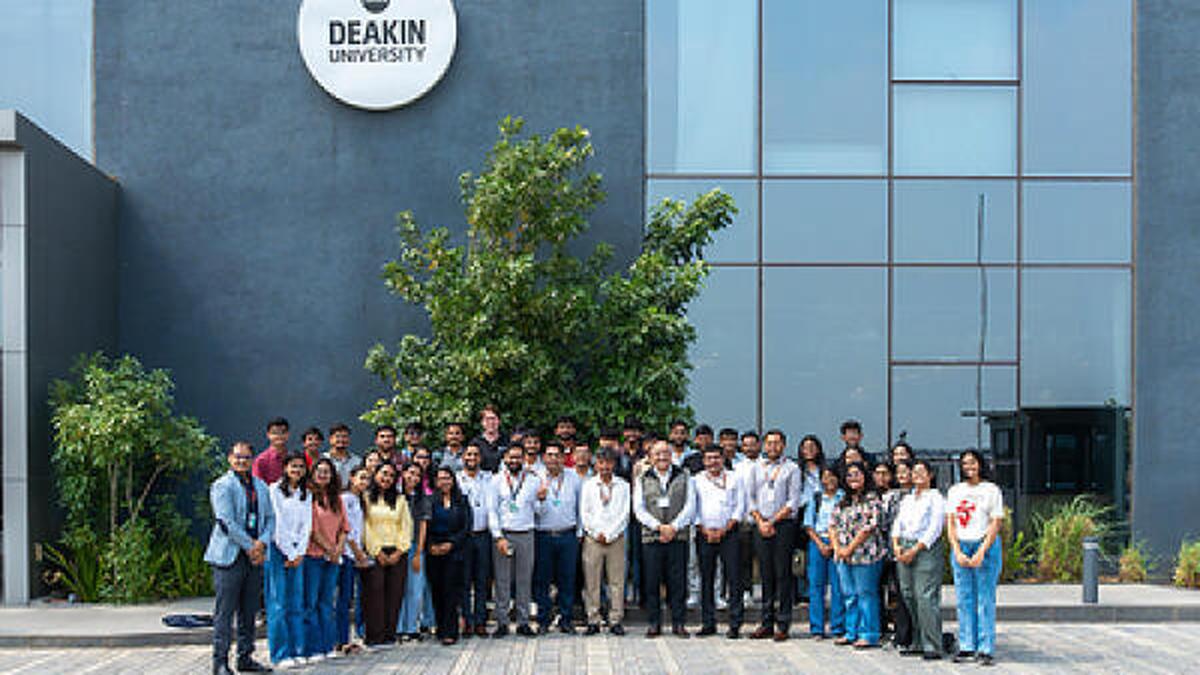
For months, Soliha had been preparing for graduate school in the United States. After two years of applications, she secured admission to Bard College in New York, won an almost full tuition waiver and an external fellowship to cover most of her living expenses. But weeks before classes were due to begin, one obstacle remained beyond her control: a U.S. student visa appointment.(Sign up for THEdge, The Hindu’s weekly education newsletter.)“I still haven’t gotten a visa slot,” she said. “Since the end of May I’ve been looking for a slot, but I haven’t been able to find a single one.”Join THEdge LinkedIn groupMs. Soliha is among a growing number of Indian students finding that getting admitted to a foreign university is no longer the hardest part of studying abroad. As visa delays, tighter immigration policies and shrinking pathways from student visas to employment reshape international education, India’s newest higher education experiment is gaining attention: foreign universities opening campuses on Indian soil.Under regulations introduced following the National Education Policy 2020, international universities have begun establishing campuses in India. Thirteen foreign universities operating across 14 campuses are admitting students this year, with several more expected to begin operations next year.The timing is hardly coincidental.Visa barriers growFor years, Indian students viewed studying abroad as a route not only to a globally recognised degree but also to international work experience and, for many, permanent residency. That equation has become increasingly uncertain as countries including the United States, Canada, the United Kingdom and Australia tighten immigration policies and post-study work pathways.“The bigger challenge is no longer getting a student visa,” said Rahul Choudaha, Managing Director at DrEducation Research, which recently analysed India’s emerging foreign university landscape. “The bigger challenge is the transition from a student visa to an employment visa. If that pathway is getting blocked, students start questioning whether the investment is worth it.”Mr. Choudaha describes the current moment as a “perfect storm.” India has finally created a regulatory framework allowing foreign universities to establish campuses, just as studying overseas has become more uncertain and expensive.“The regulatory enablement in India and the immigration barriers overseas have created a perfect opportunity for these universities,” he said.Not a substituteYet even as international campuses multiply, students interviewed for this story repeatedly stressed that they do not see them as replacing overseas education.For Ms. Soliha, whose academic interests span gender, climate change and technology, studying abroad is about much more than earning a foreign degree.She chose Bard because of its interdisciplinary curriculum, research opportunities and an integrated internship programme in New York City. Those experiences, she believes, cannot easily be replicated at an Indian campus.“It’s not just the professors,” she said. “It’s the environment. There is much more freedom to do research, to take courses across disciplines and to learn from people from different countries.”She said the flexibility offered by many American universities—allowing students to choose courses across departments, pursue independent research and work closely with faculty from the first year—remains a major draw.“If I could find a course like that in India, I would love to do it,” she said. “But the whole experience of studying abroad is still different.”That distinction also emerged in Mr. Choudaha’s research.International campuses, he argues, occupy a new space rather than replacing either Indian universities or overseas education. “They are sitting somewhere between a top private Indian university and studying abroad,” he said. “This category never existed before.”The cost equationThe economics partly explain why.According to DrEducation Research, average tuition fees at foreign university campuses in India are around ₹13.3 lakh for undergraduate programmes and ₹17.2 lakh for postgraduate programmes. While significantly higher than many leading private Indian universities, they remain substantially lower than the overall cost of studying overseas once living expenses are included.A four-year undergraduate degree in countries such as the United States can cost between ₹1.5 crore and ₹2 crore, Mr. Choudaha said, compared with roughly ₹50 lakh to ₹70 lakh at many international campuses in India.For students unable to afford overseas education or those unwilling to risk visa uncertainty, the proposition is attractive.Building Indian campusesForeign universities argue they are bringing more than an international brand.Ravneet Pawha, Vice President (Global Engagement) and CEO (South Asia), Deakin University, said the Australian institution established its campus in Gujarat’s GIFT City to contribute to India’s growing demand for globally trained professionals rather than simply expanding overseas.“We have to understand what we can add to the existing ecosystem,” she said. “It is not about simply bringing what works overseas and assuming it will work here.”Ms. Pawha said students receive the same curriculum offered in Australia, taught by a combination of faculty based in India and academics visiting from Deakin. Industry partnerships and practical learning form a core part of the model, she said.The university’s first graduating batch recorded placement rates of around 70 to 75 per cent, as per Pava with students joining multinational corporations, Australian firms and Indian companies. The second cohort, she said, secured internships for every student.For Raghav Agrawal, one of Deakin’s master’s students, the biggest difference has been the classroom itself.After completing his undergraduate degree at NMIMS University, he enrolled in Deakin’s Master of Business Analytics programme in GIFT City because he wanted a more practical education.“Indian universities focus more on theory,” he said. “Here we learn through projects that are aligned with industry.”He also sees a difference in faculty experience.“Many of the faculty have worked in industry themselves,” he said. “They know how these technologies are actually applied in the real world.”Mr. Agrawal has already secured a graduate position with National Australia Bank after completing his programme, beginning with a six-month internship before moving into a full-time role.He believes concerns over employability will ease as more students graduate.“If students make the most of the learning opportunities, they will get good jobs,” he said.Jobs remain uncertainEven so, employment outcomes remain one of the biggest unanswered questions.Mr. Choudaha cautions that employers are only beginning to evaluate graduates from these campuses.“Whether employers will give any premium to these degrees compared to IITs, IIMs or leading private universities is still unknown,” he said. “The placement outcomes are yet to be proven.”The missing experienceThere are other limitations that even supporters acknowledge.International campuses can replicate curriculum, faculty exchanges and, in some cases, semester-abroad opportunities. But they cannot recreate the broader experience of living overseas—building international networks, navigating a different culture or accessing local internship ecosystems in cities such as New York, London or Melbourne.For many students, those experiences remain central to the appeal of studying abroad.Ms. Soliha, who previously completed her bachelor’s degree at Georgetown University’s Qatar campus, said exposure to classmates and professors from across the world shaped her education as much as the coursework itself.“You learn from the country you’re studying in and from the people around you,” she said. “That cannot really be replicated.”She also warned that not every foreign university opening in India would necessarily provide value.“If good universities come, it can be a bridge,” she said. “But if lower-ranked universities come only because they can market themselves as foreign universities, students may just be paying for the label.”(Danish Pandit is a journalist and a documentary filmmaker based in Delhi. Hanan Zaffar is a journalist covering tech environment and AI. He is based in New Delhi.)
Can foreign campuses replace studying abroad?
Explore whether foreign university campuses in India can truly replace the unique experience of studying abroad amidst rising visa challenges.
1,205 words~5 min read