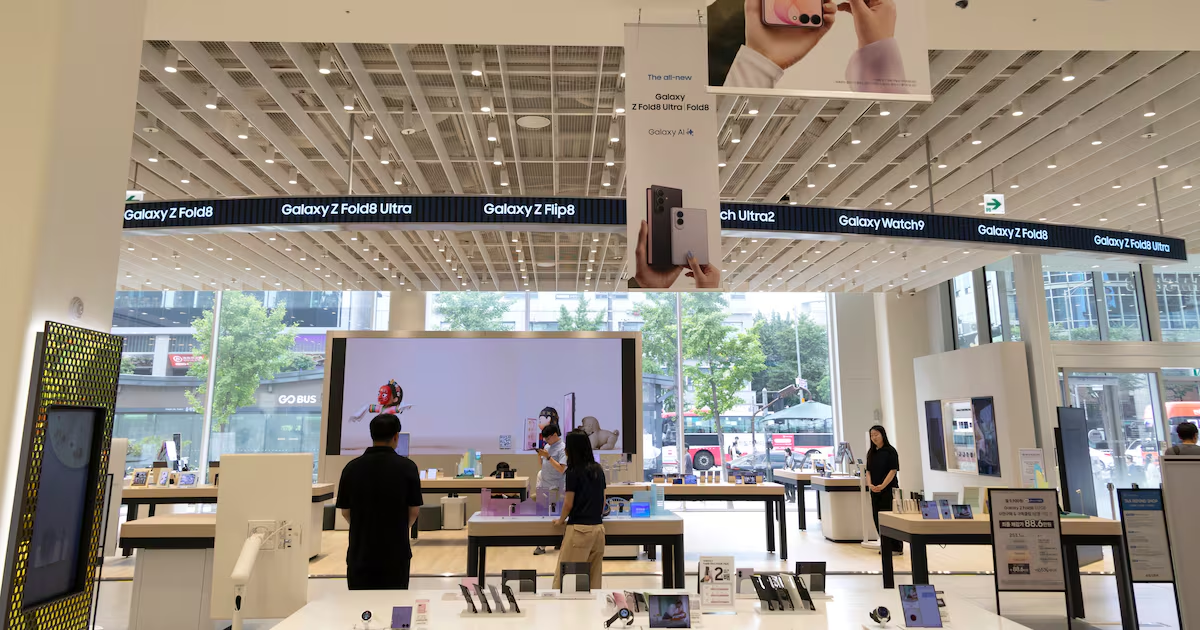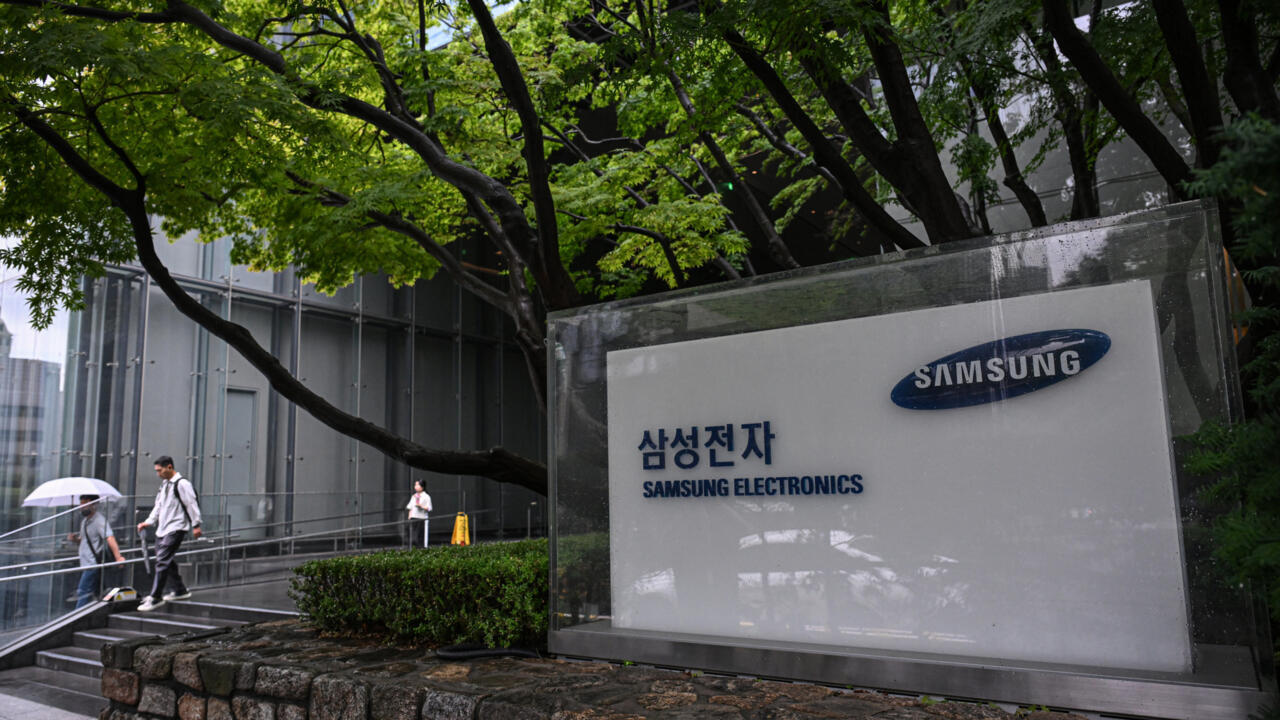
Tech giant looks to foundry recovery and premium mobile strategy to sustain AI momentum Samsung Electronics' Seocho office in southern Seoul (Yonhap) Samsung Electronics’ semiconductor business delivered its strongest-ever second-quarter performance, fueled by booming demand for artificial intelligence server memory that pushed revenue and operating profit to record highs, though the recovery remains uneven across the company’s broader businesses.While the memory business is benefiting from the AI boom, Samsung’s foundry operations continue to lag behind Taiwan Semiconductor Manufacturing Co. and its mobile business is facing pressure from rising component costs.Foundry recovery gains momentum, but TSMC gap remainsSamsung’s foundry business showed signs of improvement in the second quarter, driven by stronger demand for AI-related products, including high-bandwidth memory base dies and semiconductors supplied to North American customers.The company said higher utilization rates and growing demand for advanced process nodes also contributed to the improvement. It added that major customer projects, including those involving its 2-nanometer high-performance computing process technology, are progressing.Samsung did not disclose standalone foundry revenue or operating profit, but indicated that profitability could return soon as demand for advanced semiconductor solutions expands.“While it is difficult to specify the exact timing of a turnaround due to the nature of the foundry business, we expect profitability to return in the near future,” Samsung’s foundry division said during an earnings call on Thursday.The improvement marks a gradual recovery after a difficult period for Samsung’s foundry operations, which were hit by low yields and weak utilization rates in its 3-nanometer process last year.The company, however, still faces a steep challenge in closing the gap with TSMC, which controls more than 70 percent of the global foundry market, while Samsung remains a distant second with a single-digit share.Unlike TSMC, which focuses primarily on contract chip manufacturing, Samsung has sought to leverage its broader semiconductor ecosystem spanning memory, foundry and advanced packaging. Industry analysts say this strategy could become increasingly important as AI chips require closer integration between logic processors, HBM and packaging technologies.“Samsung’s combination of memory, foundry and advanced packaging capabilities could provide a potential advantage as AI chip demand grows,” said a securities analyst who requested anonymity. “However, improving 2-nanometer yields and securing major customers remain key challenges for a meaningful recovery in the foundry business.”Recent partnerships reflect that strategy. Samsung signed a semiconductor supply agreement with Tesla worth about $16.54 billion through 2033 and expanded cooperation with Broadcom covering memory, sub-2-nanometer foundry processes and advanced packaging.Samsung said it plans to further strengthen its foundry business by expanding AI and HPC orders, aiming to raise the share of AI-related customers in foundry sales from the high teens last year to more than 30 percent this year. Visitors check out Samsung Electronics’ latest Galaxy Z Fold8 Ultra, Galaxy Z Fold8 and Galaxy Z Flip8 smartphones at Samsung Gangnam in Seoul on Tuesday, as preorders for the Galaxy Z8 series began. (Yonhap) Mobile business faces the downside of memory boomSamsung’s mobile business is facing the other side of the semiconductor cycle: the same memory price surge that boosted its chip division has increased smartphone production costs.The Mobile eXperience and Networks division recorded 33.2 trillion won ($23.1 billion) in revenue in the second quarter, up 13.7 percent from a year earlier, supported by solid sales of the Galaxy S26 and Galaxy A series.Operating profit, however, fell from a 3.1 trillion won profit a year earlier to a 700 billion won loss, as rising component costs weighed on margins.Industry observers attributed the decline largely to higher memory prices and a global semiconductor supply shortage.According to Counterpoint Research, smartphone memory prices increased more than 80 percent in the second quarter from the previous quarter, while component costs for entry-level and premium smartphones rose 70 percent and 50 percent year-on-year, respectively.The pressure is expected to be greater for models equipped with higher-capacity NAND storage.The contrasting results highlight a new challenge for Samsung: The memory upcycle that is strengthening its semiconductor business is simultaneously putting pressure on its smartphone operations.To counter the pressure, Samsung is focusing on improving its premium product mix while accelerating the development of AI-powered user experiences across its device ecosystem.“By leveraging our strong partnership with Google, we are optimizing Galaxy AI to evolve into agentic AI, enabling the system to understand users’ contexts, automate tasks and make proactive suggestions,” said Daniel Araujo, vice president of the MX division.The company also said it plans to strengthen personalized experiences based on its personal data engine and expand AI capabilities across a broader ecosystem spanning smartphones, wearables, TVs and home appliances.Samsung plans to increase sales of flagship models, including the Galaxy S26 series and the newly unveiled Galaxy Z8 series, while entering the emerging AI device market through its intelligent eyewear product scheduled for release in the second half of the year.The Galaxy Z8 series, unveiled on July 22, showed early signs of strong demand in South Korea, with first-day live broadcast preorder sales more than doubling compared with the previous generation. The Galaxy Z Fold8, featuring a wider book-style design, led the initial sales momentum.Araujo attributed the pressure on profitability to rising mobile memory costs driven by surging AI server demand, which has pushed up component prices.“The massive demand for AI servers is creating shortages and driving up prices for mobile memory. We already saw this in the second quarter as memory prices rose quarter-on-quarter, leading to pressure on our profitability, and we expect that cost burden to continue through the second half of the year,” Araujo said.“We are tightening up how we allocate resources across areas like procurement, sales and research and development to minimize the impact on earnings."
Samsung’s AI boom lifts chips, tests foundry and mobile units
Samsung Electronics’ semiconductor business delivered its strongest-ever second-quarter performance, fueled by booming demand for artificial intelligence server
TL;DRAI
Samsung's record Q2 memory profit on AI server demand offsets foundry's TSMC gap and mobile's 80% rising component costs. Portfolio mismatch reveals foundry scalability and agentic AI differentiation as key to sustain margins across enterprise and premium markets.
933 words~4 min read