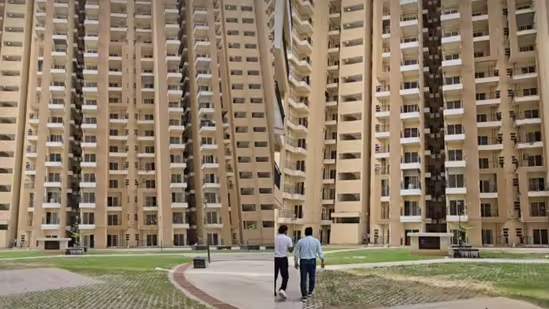
With the average price of a 3BHK apartment crossing ₹1.5 crore in several parts of Noida, Bengaluru, Mumbai, Gurugram, Hyderabad and Pune, many prospective homebuyers are asking the same question: Who is buying these homes? This sparked a debate on Reddit, with users discussing whether buyers are stretching themselves with hefty home loans or relying on parental wealth and family support. ₹1.5 crore apartments are being bought by salaried professionals, technology workers and young couples seeking their first homes, with some receiving financial support from their families. (Photo for representational purposes only) (Unsplash)Are dual income professionals buying these flats?One of the strongest themes to emerge from the discussion was that many buyers are dual-income professionals, particularly those working in the technology sector.One Redditor summed up what several described as a common homebuying template."Two IT people with salaries of 12 LPA and five years of experience each get married, ask their parents for ₹20-30 lakh and then take a ₹1.2 crore loan for a 3 BHK apartment."In many such households, one spouse's salary is used to meet monthly living expenses while the other's income goes largely towards servicing the home loan.While this results in EMIs of nearly ₹1 lakh per month, several users argued that the burden would reduce over time as salaries rise.Twenty-year loans rarely last 20 yearsAlthough banks typically sanction home loans for 20-30 years, many homeowners said they have no intention of servicing them for the full tenure.Several Redditors said borrowers often use annual bonuses, salary hikes and job switches to accelerate repayments.One user wrote:"Most of the home loans get paid in five to seven years. Twenty years is a myth."Others echoed the sentiment, saying that as careers progress, particularly in Bengaluru's IT sector, borrowers increase their monthly EMIs or make regular partial prepayments, enabling them to close loans within six to ten years.Renting versus buyingSeveral users argued that in Bengaluru's technology corridors, where rents for a good three-bedroom apartment often range between ₹50,000 and ₹60,000 a month, ownership can make financial sense despite the higher EMI."Their salaries increase with inflation but loan EMI remains the same. If you can afford it now, it gets easier later," one user commented.Parents continue to play a role in financing home purchaseAnother recurring theme was financial support from parents. Rather than financing the entire purchase, many families contribute towards the down payment, registration charges or interior work, significantly reducing the loan burden.One Redditor said that they bought a home in Gurugram for ₹2.4 crore and “my FIL has given us 1 cr. 40 we took out from our savings. 1 cr loan. We did this because we were paying 60k in rent. Chose to pay this amount as EMI instead.”One Redditor shared how a ₹1.3 crore under-construction apartment was financed:Parents contributed ₹30 lakh.The couple invested another ₹30 lakh from savings.Around ₹10 lakh was spent on registration and another ₹10 lakh was earmarked for interiors.The remaining ₹70 lakh was financed through a home loan.The buyer said the plan is to progressively increase the EMI from ₹70,000 to more than ₹1 lakh every month as salaries grow, reducing the effective loan tenure to around six years.Also Read: Should you buy a 1BHK while single and upgrade to a 2BHK after marriage? Bengaluru buyer's Reddit post goes viral"It all comes down to planning your budget carefully, preparing for four to six months without salary and increasing the EMI every year," the user wrote.Not everyone believes the risk is worth takingThe discussion also highlighted the widening affordability gap for single-income households.One Redditor explained how her family chose not to purchase a flat in Bengaluru over a decade ago despite having a good salary because they lacked financial support from parents and were dealing with medical expenses and a young child."My husband's salary has grown significantly over the last 13 years and is quite good today, yet we still live in a rented apartment," she wrote.She contrasted her experience with that of a relative who received financial assistance from family members for the down payment and registration costs, and eventually repaid the loan after moving overseas.Several users said that without parental support or a second income, buying a ₹1 crore-plus home remains extremely difficult for many middle-class families.Is it only NRIs and the wealthy?Opinions differed on who is driving demand. Some users argued that the market is dominated by NRIs, wealthy families and buyers backed by generational wealth. Others disagreed, saying India's technology sector has created a sizeable group of professionals in their 30s earning exceptionally high salaries."There are plenty of 30-something salaried professionals making crore-plus incomes. People underestimate how much some technology professionals earn," one Redditor commented.Changing homebuyer profileThe discussion suggests there is no single profile of India's ₹1.5 crore homebuyer.Instead, demand appears to be coming from a combination of:Dual-income couples.High-earning technology employees.Couples receiving financial assistance from parents.NRIs and globally mobile professionals.Existing homeowners upgrading by using equity from their current homes.Also Read: Bengaluru tenant alleges landlord hiked rent from ₹40,000 to ₹50,000 before lease renewal, sparks Reddit debateHowever, the debate also underscored that while premium housing demand remains strong, affordability continues to be a significant challenge for single-income households and buyers without family support.(Disclaimer: This report is based on user-generated content from social media. Hindustantimes.com has not independently verified the claims and does not endorse them)
₹1.5 crore homes becoming the norm, but who is buying them? Reddit post explores how homebuyers can afford them
Who can afford ₹1.5 crore homes? Reddit debate reveals homebuyers range from IT professionals and NRIs to young couples supported by parents
881 words~4 min read