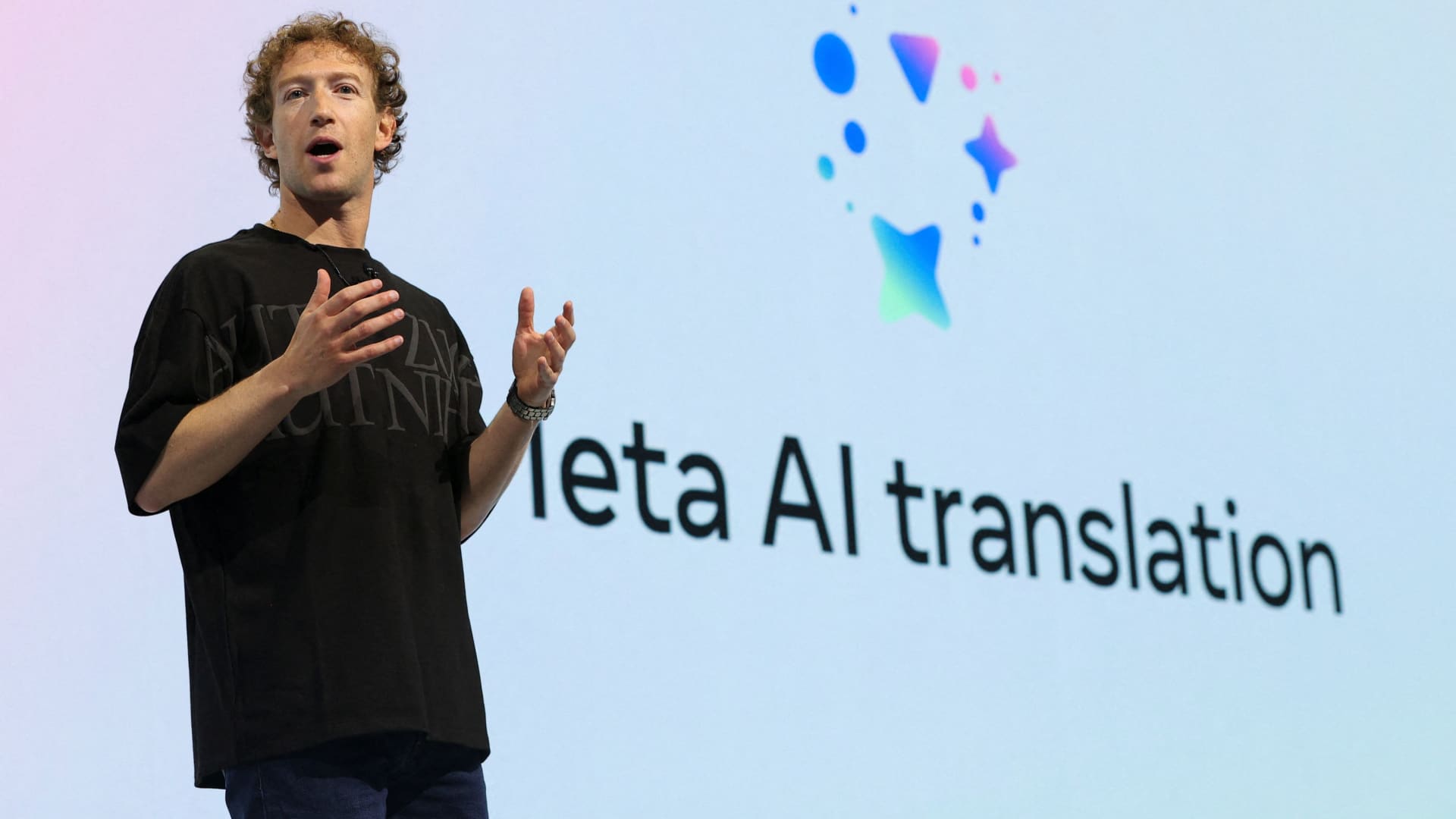
Meta shares fell 7.5 per cent on Wednesday on weak financial results and rising expenses, as chief executive Mark Zuckerberg defended his costly quest to make the company a leading contender in AI.The social media group forecast revenues of between $61 billion and $64 billion (€53.3 billion and €55.9 billion) in the current quarter, with a midpoint below Wall Street expectations of $63.1 billion. Meta’s sales in the second quarter were narrowly better than analysts’ estimates, but its costs and expenses jumped 55 per cent to $42 billion.Free cash flow in the three months to the end of June dropped by 91 per cent year on year to $784 million, down from $8.5 billion, driven by gargantuan spending on AI infrastructure.The stock fell in after-hours trading, set to wipe more than $100 billion from the company’s market capitalisation, as the weak earnings underscored investors’ fears about whether Zuckerberg’s AI spending binge will pay off.On Wednesday, he told analysts Meta was “at a point where our investments in AI are accelerating every major part of our core business”, pointing to improvements in its advertising and content recommendation systems.Zuckerberg laid out a vision focused on offering users sophisticated AI “agents” to autonomously carry out tasks on their behalf 24/7, helping with health, hobbies, personal finances or career goals.He said that personal agents for consumers, first reported by the FT in May, would “be the foundation for our next wave of products and revenue lines in the months and years ahead” and “an extremely important and massive market”.Zuckerberg also touted opportunities to sell products such as coding and advanced customer service agents to businesses. He added that he wanted to build towards “a business-in-a-box service that can help you start and run a whole business” on Meta.Meta has been pumping billions of dollars into building out a fleet of data centres and hiring top AI talent. In April, Meta raised its 2026 capital expenditure forecast to between $125 billion and $145 billion, from a previous range of $115 billion to $135 billion.The group on Wednesday narrowed that annual range to between $130 billion and $145 billion. Capital expenditure in the second quarter stood at about $31 billion, it said.Meta also raised the lower end of its expense outlook, citing $2.4 billion in charges related to legal proceedings recognised in the second quarter, with 2026 total expenses now forecast between $165 billion and $169 billion.On the call with analysts, Zuckerberg said he expected that “a significant portion” of Meta’s computing power would be used to power its own models and products.However, he said there was also an opportunity to sell data centre capacity directly, adding that Meta was “getting a lot of offers for compute at a significant premium over what we paid for it”.Meta is in early talks to rent its computing power to AI lab Anthropic in a deal that could be worth as much as $10 billion, entering a market currently dominated by cloud players such as Amazon and Google.“Meta believes AI infrastructure is now a strategic asset, but its bill is arriving faster than the pay-off,” said Mike Proulx, research director at Forrester. “What it generated in cash this quarter almost all got eaten by AI infrastructure spending. Investors now have to decide whether Meta’s growing list of AI initiatives represents company diversification or distraction.”Its progress on AI has been under intense scrutiny since its Llama large language models last year fell behind OpenAI, Anthropic and Google.In response, Zuckerberg completely refashioned Meta’s AI approach, paying hundreds of millions of dollars for top talent in a new team, TBD Lab, under Scale AI founder Alexandr Wang.In recent months, TBD has released several iterations of its new model, Muse Spark, which is widely regarded as promising.Despite the spending spree, however, its models still trail rivals such as OpenAI and Google in some capabilities.Zuckerberg hopes that future versions, including a model code-named Watermelon, will push the frontier. Meanwhile, Meta has started to test new monetisation strategies across the apps, such as subscriptions for more advanced features or complex AI tasks.Net income shrank 14 per cent to $15.8 billion, well below analysts’ estimates of $18.5 billion, squeezed by one-off costs related to legal proceedings and severance payouts. Earlier this year, Zuckerberg cut the workforce by about 10 per cent.The company acknowledged that it faced “scrutiny” over youth safety on its apps in several markets and multiple trials over harm to young people from using social media in the US this year, “which may ultimately result in a material loss”. -Copyright The Financial Times Limited 2026
Meta shares tumble as Mark Zuckerberg tries to sell his vision for AI ‘agents’
Social media chief defends strategy based on personalised bots as costs rise and revenue projections disappoint
TL;DRAI
Meta shares fell 7.5% as Q2 earnings disappointed with capex ballooning to $130-145B annually for AI agents; free cash flow sank 91% YoY. For tech leaders: massive capex spending precedes revenue gains, signaling that AI infrastructure bets lack ROI proof.
761 words~3 min read