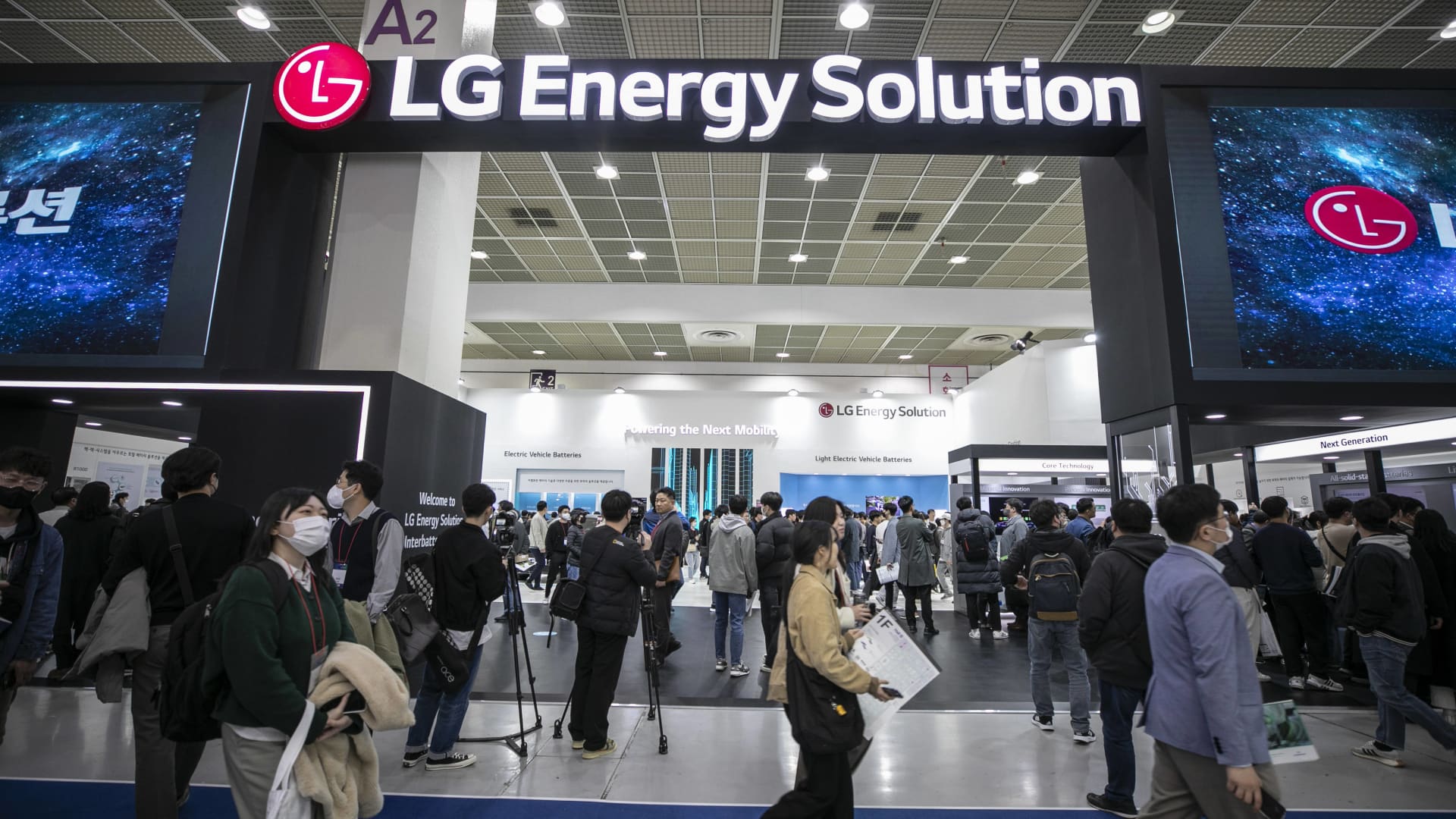
LG Energy Solution's booth at RE+ 2025, North America's largest renewable energy exhibition, held in Las Vegas in September 2025, where the battery-maker showcased grid-scale storage, AI data center and UPS batteries, as well as residential systems, under the theme "One Stop ESS Solutions" (LG Energy Solution) LG Energy Solution returned to an operating profit in the second quarter, snapping two consecutive quarterly losses as the conversion of idle electric-vehicle lines to energy storage systems gained traction.The company said Thursday that April-June revenue rose 24.8 percent from a year earlier to 7.56 trillion won ($5.19 billion) and 15.3 percent from the previous quarter. Operating profit came to 113.3 billion won, down 77 percent on-year, but reversing a 207.8 billion won loss in January-March.The figures matched preliminary numbers released July 7.The black ink depends on 241 billion won in US Advanced Manufacturing Production Credits. Excluding them, LG Energy Solution ran an operating loss of 127.7 billion won, a negative 1.7 percent margin, narrower by 269.9 billion won than the first quarter's 397.6 billion won subsidy-adjusted loss. Net loss for the quarter was 328.6 billion won.Storage did the heavy lifting. First-half ESS revenue grew 4.6-fold on-year and reached a high-20 percent share of total sales, against single digits a year earlier. Second-quarter ESS shipments rose more than 30 percent from the first quarter, led by North America and Europe. The company reported over 3 trillion won in new ESS orders in the first half, including an artificial intelligence data center project whose end customer is an unnamed hyperscaler.ESS lines started up at the second General Motors joint venture plant in May and at the Honda venture in June, with more than 50 gigawatt-hours of North American storage capacity targeted by year-end.In EV batteries, cylindrical shipments rose 1.5 times on-year as 46-series production stabilized. US demand remained weak, while European and Asian shipments increased for a third straight quarter."Utilization improved in Europe, high-margin cylindrical sales took a larger share, and expanded North American ESS output eased the fixed-cost burden," Chief Financial Officer Lee Chang-sil said on the earnings call.Lee guided for third-quarter revenue growth of more than 20 percent from the second quarter, with ESS shipments up at least 50 percent. Debt climbed 5.7 trillion won to 47.59 trillion won, lifting the debt-to-equity ratio to 157 percent from 140 percent.
LG Energy Solution swings back to profit as storage batteries fill EV gap
LG Energy Solution returned to an operating profit in the second quarter, snapping two consecutive quarterly losses as the conversion of idle electric-vehicle l
388 words~2 min read