When treating patients, Yale dermatologist Kathleen Suozzi can immediately spot the ravages of excessive sun exposure. “Almost every issue we see in skin aging is sun-related,” says Suozzi, an associate professor term of dermatology at Yale School of Medicine. “I am a skin cancer surgeon, but I’m also an aesthetic dermatologist, and there’s a big overlap between the two. Skin appearance and skin health are closely tied.”Ultraviolet rays beaming down from the sun pose the biggest threat on both fronts, according to experts. Sunscreens, ubiquitous on pharmacy shelves these days, are meant to combat these harmful effects, but there’s one caveat: You’ve got to use them consistently and correctly. And too many people still don’t, Suozzi says.But a powerful new chemical ingredient may offer an easier option. In June, the U.S. Food and Drug Administration approved bemotrizinol (BEMT), the first new active sunscreen ingredient cleared for use in the country since the late 1990s. Widely used in Europe and Asia for decades, BEMT offers superior UV protection and contributes to easy-to-wear and apply sunscreen formulations, experts say.
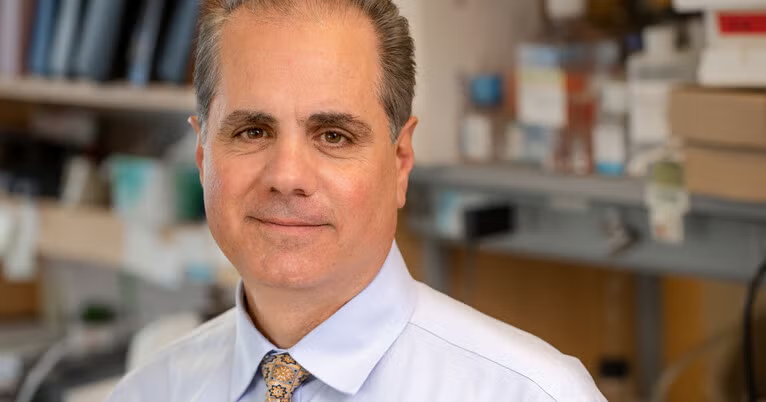
Kathleen Suozzi
Photo courtesy of Yale School of Medicine
In an interview, Suozzi discusses some of the health concerns and persistent myths that swirl around sunscreen products, why it took so long to get BEMT into the U.S. market, and why a dash of “cosmetic elegance” can go a long way when it comes to sun protection.The interview has been edited for length and clarity.So, bemotrizinol has a great track record already?Kathleen Suozzi: Yes, there’s nothing new about it. Sunscreen chemistry in Europe is way ahead of the U.S. Many other innovative ingredients have been included in European and Asian sunscreens since the early 2000s. In the U.S. we’ve been stuck with a fixed, approved list of ingredients from the FDA for decades. What makes bemotrizinol such a powerful, and convenient, sunscreen?Suozzi: First, it has very broad UV coverage. It covers both UVB and UVA rays. With our existing chemical sunscreens, you have to mix multiple chemicals to get a broad coverage range. The mineral screens — zinc oxide and titanium dioxide — offer good coverage, but they’re more difficult to wear. Minerals tend to give skin that whitish- hue, and they can rub off.Bemotrizinol is also very photostable. It maintains UV-blocking power without breaking down, so you don’t have to reapply it so often. And it also has what we call a ‘high skin-feel index” or cosmetic elegance. It’s less greasy and more transparent. Overall, it’s just easier to wear and easier to use.And it’s less irritating? Suozzi: Yes, data from Europe and Asia show very low potential for irritation. It’s a large molecule designed to sit on top of the skin rather than absorbing into it, contributing to less risk of irritation or allergic reactions like we can see with other chemical sunscreen ingredients. In addition, the large particle size means less absorption into the bloodstream, which has recently been highlighted as a concern for other chemical sunscreens. Why did it take so long for American consumers to gain access to this ingredient?Suozzi:The FDA classifies sunscreens as over-the-counter drugs rather than cosmetics. In the U.S., over-the-counter products undergo years of expensive, rigorous clinical and safety trials. In regions like the E.U., sunscreens are regulated as cosmetics, and there are a lot fewer regulatory hurdles.Haven’t there also been environmental concerns that have impacted the U.S. market?Suozzi: Yes, the chemical sunscreens, like oxybenzone, are known to damage coral reefs. So, in states like Hawaii, they banned them. There was a big call then for innovation in terms of sunscreen technology, which gave the FDA more incentive to look seriously at other compounds, including bemotrizinol.There are so many sunscreen products. What do people generally misunderstand about using sunscreen and their own risk factors?Suozzi: I think consumers get overwhelmed by sunscreen formulations. If you break them down into categories, there are mineral and chemical screens. Minerals are a physical blocker. They reflect the UV rays off the skin. Chemical screens absorb UV at a specific range of wavelengths based on their chemical structure and convert the energy to heat. So, it’s two different mechanisms.The American Academy of Dermatology recommends a shot-glass size amount of sunscreen for your entire body, and we usually advise that people use a ½ teaspoon or quarter-size amount for the head and neck and then reapply every two hours. What if you’re not outside much during the day?Suozzi: I’ll often get asked, “If I’m in my office at work, do I have to reapply my facial sunscreen every two hours?” And the answer is no. I tell patients, use a mineral sunscreen on your face because it should not come off until you wash it or rub it off. If you’re running, swimming, sweating — then yes, you need to reapply. The advice I give my patients is: Apply a facial sunscreen year-round, every morning. New formulations that contain bemotrizinol may make it easier to build into your routine.How can people assess their own personal risk for sun? Suozzi: We’re all at risk from sun exposure. But the main risk factor is how much endogenous melanin people have in their skin — so, brown and black skin is going to age less quickly than very light skin, because the extra melanin is protective. And then, what is their degree of lifetime UV exposure? You might be familiar with the classic example where you’ll see two people of the same age, but they look decades apart in age. Varying degrees of sun exposure is often to blame.Is bemotrizinol available in the U.S. now?Suozzi: The FDA started signaling back last December that they were going to approve it, and it took them until June to officially do it. I hope to see it surfacing this summer in products on the market. The message for patients is that while this is new to Americans, there’s over 25 years of safety data in Europe and Asia. It’s going to give you broader UV coverage in a more wearable formulation, and hopefully all of this will increase compliance.