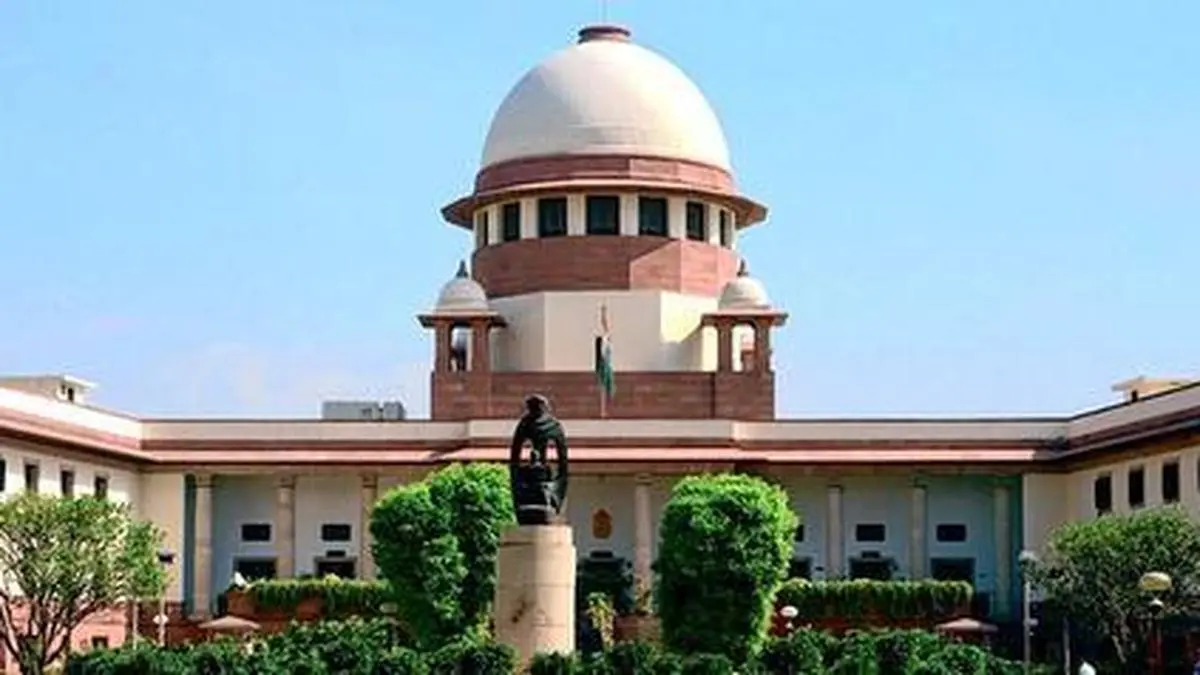
The court held that an amnesty-regularisation scheme was not a right.
| Photo Credit:
The Supreme Court on Wednesday quashed, with prospective effect, a 2021 Office Memorandum (OM) granting ex post facto environmental clearances to infrastructure projects, holding that the Central government cannot substantially alter protective environmental checks by issuing mere administrative instructions.“The 2021 OM is an administrative order and envisages a perpetual regime for grant of environmental clearance to projects undertaken without prior environmental clearance. It substantially alters the nature of enquiry and criteria for grant of environmental clearance under the 2006 notification. It supplants an earlier delegated legislation [2006 notification] through an administrative instruction, which is impermissible in law,” the court noted in an 80-page judgment.Amnesty CurbedAn ‘amnesty’ measure cannot become a permanent, parallel route which circumvents the prior environmental clearance (EC) regime under the 2006 notification of the Environment Ministry. A valid amnesty measure should be used as a rare exception, must be finite in duration and confined to its class, a Bench headed by Chief Justice of India Surya Kant observed.The court said the prior EC regime of the 2006 government notification, spanning across various sectors like highways, airports, real estate and township developments, ports, mining and resource extraction, energy and heavy industry, was mandatory in nature.The 2006 notification’s mandate could have only been amended through a subsequent and appropriate amnesty notification for select, deserving projects whose continuation was of “supervening public interest,” Justice Joymalya Bagchi, who authored the judgment, held.“The 2021 OM, as a perpetual amnesty scheme applicable to all permissive projects, failed to lay down an intelligible differentia for selection of projects for grant of post facto environmental clearance having rational nexus with supervening public interest, and is thereby ultra vires of the objectives of the Environmental Protection Act of 1986, namely preservation of the environment through a balanced approach through precautionary principle and sustainable development… The OM does not satisfy the threshold of reasonableness and proportionality and is violative of Articles 14 and 21,” Justice Bagchi said.Ecology FirstThe court held that an amnesty-regularisation scheme was not a right. A project proponent who had built in breach stood upon no footing of entitlement. The 2021 OM had indiscriminately allowed every permissible industry to be regularised for meagre compensation. It had yielded to a principle of ‘pollute and then pay’, rather than to sustainable development.The decriminalisation of the offence of breaching the prior clearance regime through the Jan Vishwas (Amendment of Provisions) Act of 2023 did not help matters either. Before the 2023 Act altered the offence into a civil liability, violators faced imprisonment of up to five years, or a fine of up to ₹1 lakh, or both.“A lax implementation regime, coupled with a regularisation scheme unlimited in time and subject to capped environmental compensation at a flea-bite level, rendered the prior EC regime otiose both in fact and in law,” Justice Bagchi wrote.The court said there were cases in which the state, the preserver of the rule of law, had violated the law of the prior EC regime.“Future amnesty schemes, if any, should provide effective deterrent measures against individual public servants, including disciplinary action and personal liability for environmental damage, wherever the state or its instrumentalities, as project proponents, violate the prior EC regime,” the Bench ordered.The apex court quashed the 2021 OM prospectively to not upset ongoing projects, including the AIIMS Medical College and Hospital building in Odisha, the Centre of Excellence for Cancer Diseases in Tamil Nadu, Vijayapura Airport in Karnataka, medical colleges, slum rehabilitation and irrigation projects intended for drought-prone areas.It said retrospective clearances given under the 2017 notification, which provided a ‘one-time amnesty’ for undertakings started without prior clearance, and the 2021 OM would remain valid unless individually assailed in accordance with law. The 2021 OM was derived from the 2017 notification, and institutionalised ex post facto clearances.The court barred the Centre from passing administrative orders to grant ex post facto clearances in the future. Justice Bagchi added that the present judgment would not, however, stand in the way of the Supreme Court granting ex post facto clearances in exercise of its plenary powers under Article 142 of the Constitution.The case has had a roller coaster ride with a Division Bench of the apex court declaring such retrospective clearances a gross illegality and an anathema to the environment in a May 2025 judgment.In November last year, a larger Bench had diluted the judgment, reasoning that doing away with the retrospective clearance regime would have a “devastating effect” on ongoing public projects worth “thousands of crores of Rupees”.Published on July 29, 2026