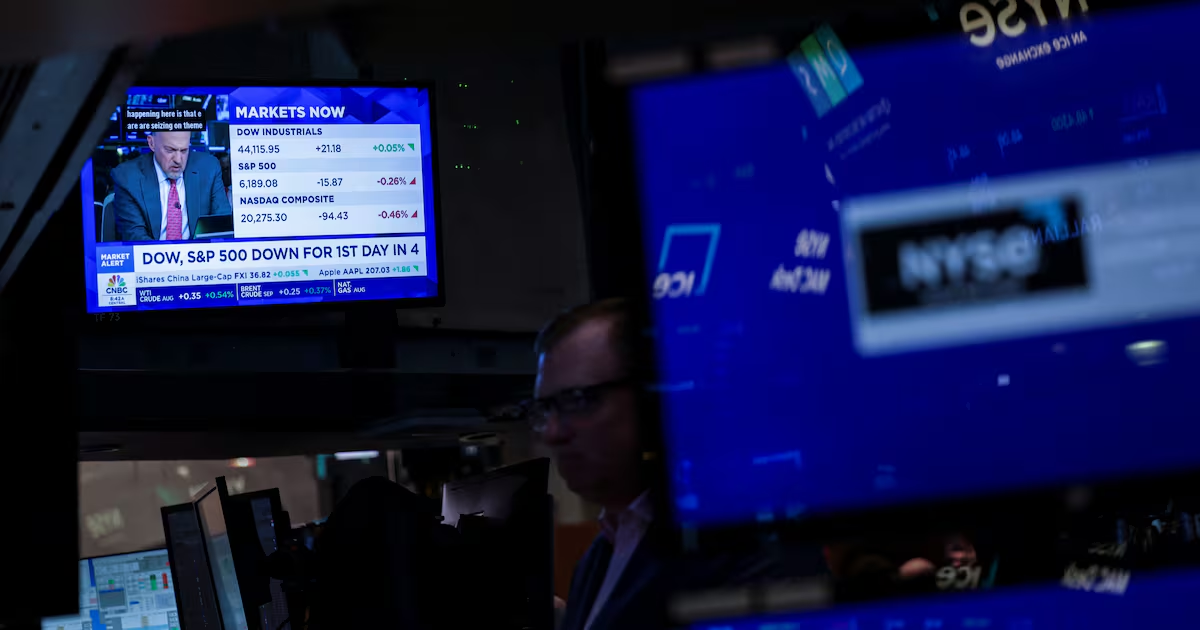
By Lewis KrauskopfNew York — The S&P 500 has struggled to make further headway since its early June record peak, but that tepid performance belies churning beneath the market’s surface that could take on greater importance with this week’s megacap earnings reports.The few technology and other heavyweight stocks at the heart of the AI trade that have been driving the bull market are faltering. The Roundhill Magnificent Seven exchange traded fund, which tracks the seven biggest technology stocks, has declined more than 8% since the June peak, while the Philadelphia SE Semiconductor index, which soared on AI-related optimism earlier in the year, has pulled back more than 19%.That has acted as a drag on the S&P 500, which has dipped more than 2% since June 2. At the same time, though, other parts of the market have perked up. About two-thirds of the benchmark’s components have gained since the June record high, and eight of its 11 sectors are higher.That market broadening is a tradeoff many investors can stomach, as long as the major tech-heavy indices used as market gauges avoid deeper declines. Broader gains could usher in a more durable phase of the bull market that is less reliant on the heavyweight stocks.“It would be incredibly hard for us to outrun a bear market in the Magnificent Seven,” said Mark Hackett, chief market strategist for Nationwide, the UK bank. “But the fact that we’ve seen such an aggressive pullback in this group and the market has been flat-ish during that period, I view that as incredibly healthy.”TradeoffThis tradeoff could be tested this week, when four of the Magnificent Seven report quarterly results: Microsoft and Meta report after the closing bell on Wednesday, and Apple and Amazon report on Thursday.Two others, Alphabet and Tesla, kicked off results for the group last week, with both companies’ shares sliding after their respective results.Along with Microsoft, Amazon and Meta, Alphabet is one of the so-called hyperscalers — a clutch of tech companies whose massive capital spending on AI data centres has underpinned this year’s AI rally, boosting semiconductors and other companies involved.Alphabet further increased its spending plans last week, but that raised concerns whether it would reap sufficient returns on its investments.The market can absorb a “bad day for one of the names,” Hackett said. However, he added: “I don’t think the S&P can ... even remain kind of where it is if there’s a flushing of the AI story.”RotationSince the June 2 high, healthcare and financials have been the best-performing sectors, rising 14% and 12% respectively.“There’s a rotation that has been going on out of the momentum-based trades like technology, and it has shifted, especially since the end of the quarter, to other areas of the market that are perceived as less expensive or having underperformed,” said Robert Pavlik, senior portfolio manager at Dakota Wealth Management.In another sign of broadening, the equal-weight version of the S&P 500, which is a gauge of the average stock in the index, has gained nearly 4% since June 2, compared with the 2.4% decline in the more heavyweight-influenced standard S&P 500.“We’re not seeing selling. We’re just seeing money move from one area of the market to another,” said Jack Janasiewicz, lead portfolio strategist at Natixis Investment Managers Solutions. “That’s pretty healthy, right? That’s what a bull market is based on.”Beyond megacapsFor 2026 overall, the equal-weight S&P 500 has climbed more than 13% against an 8.5% rise for the standard S&P 500, closing some of the latter’s performance advantage during the bull run that started in October 2022.Indices representing mid- and small-cap stocks have gained about 15% and 19%, respectively, this year, another sign of investors gravitating beyond megacap stocks.One reason for that rotation is that while Magnificent Seven companies’ profit growth has outpaced the rest of the S&P 500 in recent years, that gap has closed.“Leadership is broadening beneath the surface, even though that strength isn’t fully reflected in the headline index,” said King Lip, chief strategist at BakerAvenue Wealth Management. “These moves make sense from a fundamental perspective — earnings growth in the broader market is forecast to have higher earnings growth than the megacap tech stocks by year-end.”Magnificent Seven stocks have experienced mixed performances in 2026, with only Apple’s 25% year-to-date gain surpassing the increase for the S&P 500.Still, the stocks retain huge influence, together accounting for about one-third of the weighting of the overall index.“You’re talking about some serious market cap,” said Chuck Carlson, CEO at Horizon Investment Services in Hammond, Indiana. “They’re going to have an impact on the S&P 500 one way or the other.”Reuters
Wavering Magnificent Seven set to test depth of Wall Street’s bull run
Equal-weight S&P 500 outpaces traditional index since June as investors opt out of AI
TL;DRAI
Magnificent Seven fell 8% since June; two-thirds of S&P 500 gained, signaling market rotation from AI megacap concentration. For tech leaders: mid-cap earnings forecast to outpace megacap tech by year-end, reducing single-vendor risk and reshaping M&A strategy.
764 words~3 min read