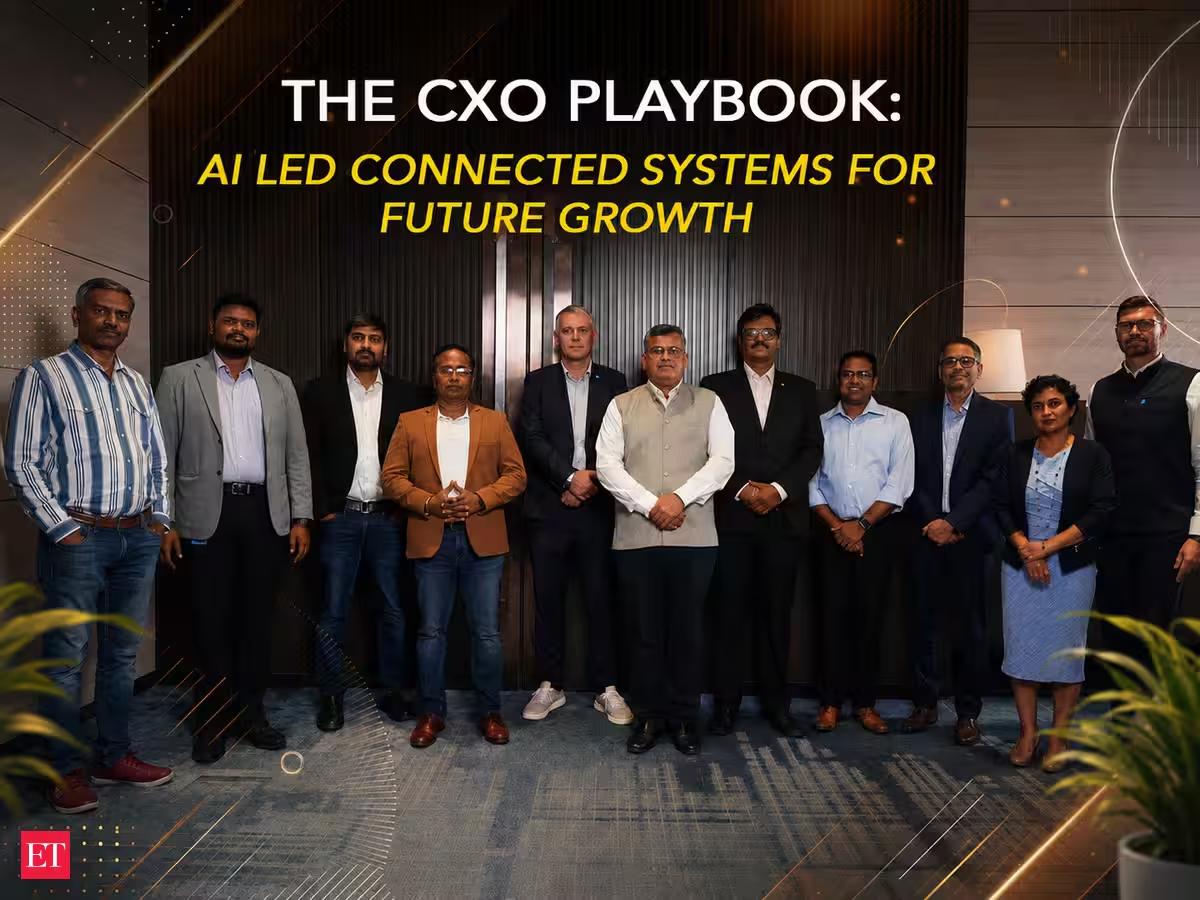
A recently-concluded roundtable, The CXO Playbook: AI-led Connected Systems for Future Growth, a Bosch x Economic Times initiative, began with a sobering admission that the enterprise artificial intelligence (AI) boom has often been seen through rose-tinted glasses, heralding lofty ambitions but not necessarily translating into enduring value. What perhaps separates the few that succeed from the many that remain stuck in the fancy laboratory stage, the speakers argued, is not necessarily access to smarter models, but the patience to do the unglamorous work of building through data discipline, business alignment, and organisational change.Beyond the hype: What leaders say turns AI pilots into business valueThe shift from pilot projects to real-world impact defines the current shift in enterprise AI. And the organisations reaping the biggest benefits in this shifting landscape are those that have laid foundations for scalable deployment. At a Bosch x Economic Times roundtable, senior leaders from Bosch SDS, Ashok Leyland, Supreme Industries, Raymond, Crompton Greaves, Jio Platforms, Yokohama Off Highway Tires, SKF India, and Metro Brands discussed how to translate AI pilots into enterprise-wide value. They moved past the buzz to emphasise practical priorities: integrated systems, reliable data, clear business ownership, responsible rollout, sustainability, and trust. The consensus was that durable AI success depends on investing in fundamentals. When technology, people, and business goals are aligned, AI projects stop being isolated experiments and transition into measurable, business-changing outcomes. The advantage will go to organisations that link these elements to build practical, trusted AI with long-term impact. Watch the video for full insights from the discussion.Moderator Miloni Bhatt framed AI not through the lens of dazzling innovation alone, but as a question of execution, reminding the audience that the winners are usually those that do “the dull, the boring, the simple things very well”. Those simple tasks pertain to cleaning data, maintaining a clear sight of ownership, and the ability to integrate people on the factory floor into the journey rather than leaving them behind.Rakesh Kumar Murugan, Global Head – Digital Transformation and Industry 4.0, Bosch SDS, took that point and expanded it into a broader argument about change management. “The last topic, whenever you think about it, is change management. That’s supposed to be the first topic,” he said, making clear that the problem is rarely the software in isolation. According to Murugan, technology may be the visible layer, but the real barrier is organisational. If businesses have not identified the right problem, if they have not contextualised the data, if they have not aligned leadership around a business-first objective, then even the most advanced system will remain inert. Too often, companies blame the tool when the failure lies in the business problem. The deeper question is whether companies have understood the business problem well enough to solve it.Murugan described how, even before the current wave of generative AI, Bosch had already been working on what he called “Semantic Stacker”, a structure that resembles today’s data-product architecture. The logic behind it, he explained, was simple: gather the right data, contextualise it, and ensure that feedback from service stations, customers, and production systems flows into one space rather than remaining fragmented. The larger point is not to impress people with the sophistication of the model, but to make the model useful. “We never felt technology sets you,” he said, arguing instead that the real differentiator is whether the company understands its own processes well enough to decide where AI can make a difference.He was particularly emphatic about the fact that many valuable use cases come from the shop floor, even if companies often assume that innovation must always originate at the top. “Shop-floor people may not know the digital black belt, six-sigma term,” he said with a laugh, but that does not mean they do not know where the pain points are. In fact, he suggested, “a good amount of problem statements that can be solved through AI are actually rising from the bottom to the top.” That, he said, is why AI adoption must be tied to productivity, transparency, and operational value rather than to abstract enthusiasm.In one case, he said, a customer was facing “30 to 35 days of unplanned downtime” affecting production, and the team had to go “seven to eight levels down” to identify whether the issue lay with machines, operators, or raw materials. The result, he said, was a substantial improvement in production. Elsewhere, he pointed to use cases in energy efficiency, first-pass yield, and maintenance cost reduction, arguing that the strongest return on investment (ROI) appears when AI is deployed against problems that are both visible and expensive. “It’s always return on investment first,” he said, stressing that critical problems must be tackled before companies chase secondary or decorative use cases.The problem of information silosFrom there, the conversation moved naturally to the question of whether companies are solving genuine problems or simply buying AI in fragments. A company may have automation in one department, analytics in another, and a chatbot somewhere else, but if those systems do not know each other, they cannot produce intelligence in any meaningful sense. Dimitri Baumtrok, Head of International Sales, CONTACT Software, argued that organisations often do not begin with the most important question, namely what AI means for the business as a whole. Instead, they chase isolated tools, individual team fixes, or the fashionable language of the moment. “We love PowerPoints, we love reading about it, but do we really love generally doing something practical about it,” he asked.Companies, Baumtrok suggested, have spent years creating point solutions, systems that function like separate organs or limbs, but have failed to build the nervous system that would allow those parts to work together. The real opportunity, in his view, lies in connecting systems so that they know of each other, rather than merely pushing information around in silos. “You need to build a nervous system and connect the different body parts so that they know of each other,” he said, describing AI as a kind of digital reintegration rather than a collection of isolated experiments.The question of silos dominates internal company discussions on AI and workflows. More tools, more models, and more data streams can create the illusion of progress while deepening dependency on disconnected systems. And that is why critics say that the AI era has not abolished organisational fragmentation; in many ways, it has intensified it. Globally, enterprises are discovering that digital maturity cannot be measured by the number of technologies they can name, but by the degree to which those technologies are integrated into a coherent operational logic. In India, where many companies are simultaneously modernising, expanding, and managing legacy infrastructure, this challenge is even more acute.Gopi Sankar, Senior Vice President and Chief Engineer – Global Trucks and Buses, Ashok Leyland, offered a pragmatic view when he said, “We start in silos and then integrate it over a period of time.” Not every transformation begins with a perfect system, and not every company can wait for an ideal architecture before beginning. But it is important to remain cognisant of the danger of fragmentation, especially if the goal is to move from small pockets of innovation to something more durable. His observation that there should be “a single brain across silos” captured the aspiration, where departments need not be abolished, but organisations must find a way for them to stop clashing and begin cooperating.Sudhir Kanvinde, Chief Information Officer, Supreme Industries, took that further by warning that fragmented adoption can create “shadow IT” and, worse, “shadow AI” if it is allowed to proliferate without governance. He argued that the first step is not model deployment but visibility: “You need to have visibility of your data.” In manufacturing environments with old machines, partial connectivity, and large numbers of moving parts, the first task is not to add intelligence on top of confusion. It is to understand what data exists, where it resides, what it can support, and what gaps must be closed. Kanvinde’s message for organisations was clear: AI cannot be a side project owned by the IT team alone. “If we continue with only insights, we’ll not be able to go to production,” he warned. The decisive shift happens when business users own the use case, when plant heads and operational leaders see that the system can save time and improve performance in ways that matter to them directly. The move from pilot to production is not primarily technical; it is cultural, as it requires organisational readiness.That readiness also depends on ownership. Dr Biswajit Rath, Group Chief Data & AI Officer, Raymond Ltd, then brought the discussion back to first principles. He reminded the room that it is too easy to reduce the AI conversation to large language models (LLMs), small language models (SLMs), and cloud infrastructure, when in fact AI is a much larger family. “We are not talking about the AI family,” he said, arguing that machine learning (ML), deep learning, and natural language processing (NLP) remain central to industrial automation and manufacturing.The ethical guardrailsAnita Pansare, CTO and ESG Leader, Crompton Greaves Consumer Electricals, steered the discussion into the terrain of responsibility, product safety, and customer value. She made it clear that in product development, AI cannot simply be thrown in because the industry is excited about it. “It’s a stage gate process,” she said, explaining that teams must first ask whether the design is technically robust, whether the failure modes have been considered, and whether the feature could affect safety or reliability. She was especially cautious about sectors such as healthcare, where an autonomous decision made by a model can have serious consequences if the system has not been properly validated.At the same time, Pansare insisted that responsible AI is not only about limiting risk, but also about creating practical value. She described how AI-enabled products can help consumers save energy, reduce carbon footprint, and make smarter decisions about electricity usage. In one example, she referred to connected appliances and smart dashboards that tell consumers how much energy they can save, and whether they want to switch something off. “It’s at a cost,” she acknowledged, returning to a recurring tension in the discussion: the willingness to pay often lags behind the promise of the technology.For farmers, she said, convenience can begin with something as simple as an SMS command to turn a pump on or off. The point is not novelty for its own sake, but practical relief for users who cannot afford to spend time travelling back and forth to the field. She described how weather data and scheduling can be combined so that a pump makes the right decision on behalf of the farmer. “We learn and we say, how about really we give you a smart decision,” she said, illustrating how AI becomes meaningful only when it reduces friction in ordinary life.The debate between LLMs and SLMsAcross the world, industries are being pushed to do more with less: fewer resources, tighter margins, more regulation, more competition and more uncertainty. In India, that challenge is intensified by the complexity of the industrial landscape. The country’s manufacturing sector includes large legacy operations, export-oriented firms, consumer businesses, agricultural systems, and rapidly digitising service companies. Any technology that hopes to matter here must work across uneven contexts, multiple languages, varied skill levels and severe cost constraints.Murugan’s warning about cloud dependence was especially pointed. He noted that some companies have spent millions moving data to cloud providers, only to discover that the cost outweighed the benefit. “Business pays for it but business doesn’t get any impact out of it,” he said. That, in his view, is precisely why the next phase of enterprise AI will be shaped not by broad, indiscriminate deployment, but by careful contextualisation and tighter control over data, language models, and knowledge repositories. Smaller models, he suggested, may prove more useful than giant external systems because they preserve tacit knowledge and reduce hallucination while remaining specific to the company’s way of working.That idea resonated with Sanoj Somasundar, Chief Technology Officer India, Director – Technology Development, SKF India, who said the startup ecosystem is increasingly shifting towards “specific data” and “specific needs” that can create competitive leverage and customer value. The broader point, which several speakers reinforced, is that AI is becoming less about generic capability and more about specificity. In other words, the companies that succeed will be the ones that know which tools belong inside the business and which ones do not.Sanjay Bharkatiya, Vice President and Head of Engineering - CIAM, Jio Platforms Limited, highlighted the risks of dependence on a small number of external AI providers. “We are actually dependent on a handful of companies now, as we speak today,” he said, pointing to the vulnerability created by concentrated platforms. Businesses, he suggested, need to work on their own use cases and build some of that intelligence in-house. If a company’s processes, data, and decisions rely too heavily on outside systems, it may gain convenience but lose resilience.“Localised content, you know, the language of a company has to be in that LLM,” said Sankar, noting that a large external model will take longer to adapt to a firm’s internal vocabulary.The ROI of AIOne of the strongest thematic threads in the roundtable was the tension between the old corporate habit of measuring everything through classic ROI and the newer requirement to judge AI differently. Jitendra Mangave, CIO and CTO, Metro Brands, noted: “AI is a real value and we should have different frameworks to find the value. Traditional ROI methods will never work for AI. That’s the biggest learning.” The real value of AI may appear in faster decisions, improved trust, less waste, more adoption or better behaviour over time.“AI will succeed when your user will have trust in it and you embed it in their regular journey, in their daily life, in their workloads,” added Mangave.The speakers, in different ways, all returned to the same lesson: the future will not be built by those who merely adopt technology, but by those who learn how to organise themselves around it.
Why connected systems and a new ROI lens are required for enterprise AI to work
A Bosch roundtable offered a reckoning with how organisations learn, how they change, and how they decide whether innovation is a performance or a practice in the context of AI.
TL;DRAI
AI adoption shifts from isolated pilots to integrated systems solving costly problems via data discipline and ROI metrics. Tech managers: organizational change and shop-floor collaboration beat algorithms; measurable outcomes separate AI winners from stalled experiments.
2,356 words~11 min read