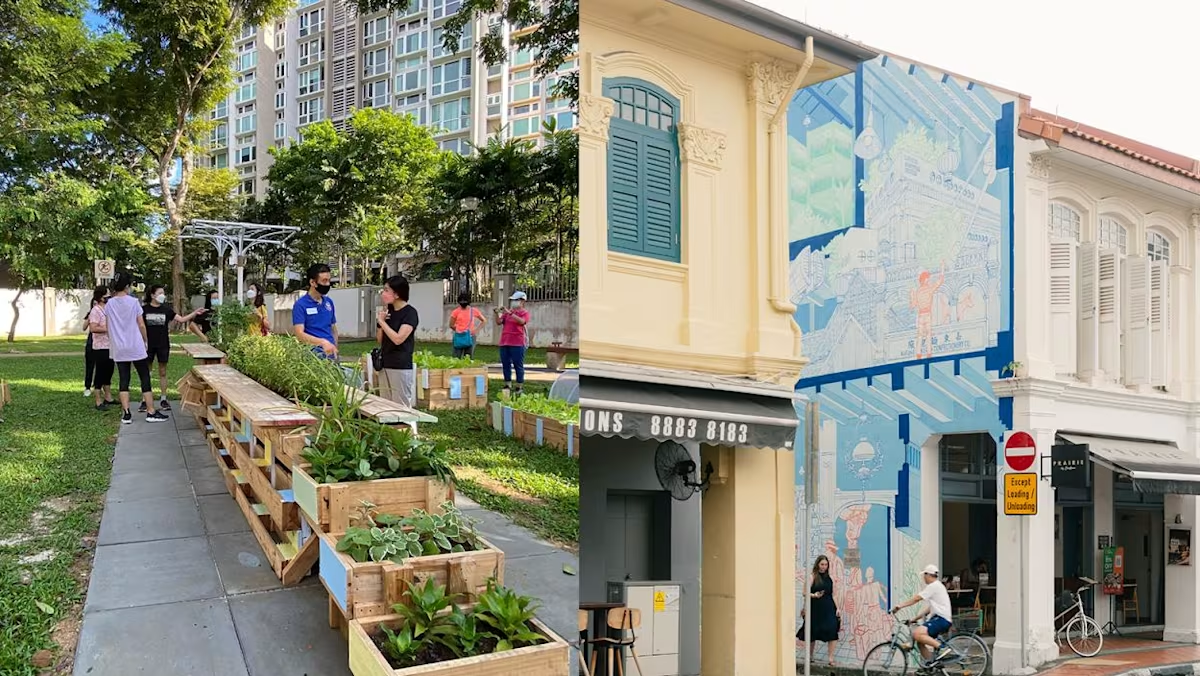
A group is gathered in a bustling kopitiam; a coolie hauls a heavy sack down the stairs; a woman hangs a laundered blouse on a bamboo pole. These scenes form part of a collage painted on the gable wall of 462 Joo Chiat Road. Titled Blueprint of a Shophouse, the mural was completed in November 2025 and depicts past, present and future vignettes of the neighbourhood, framed within a life-sized sectional representation of these distinctive buildings.Leading the project from conception to completion was Lee Hui Lian, principal architect of OMG Atelier. While projects like this are not typically part of her day job creating homes, she readily takes on work that extends beyond building design.“Buildings and infrastructure are the framework that enables meaningful experiences. I'm interested in how people relate to spaces emotionally and how design can create moments of pause, curiosity and connection. A mural is another way of practising architecture, just at a different scale and through a different medium,” said Lee.
Jerome Ng Xin Hao, Lim Pin Jie (seated left to right), Lucas Goh and Lee Hui Lian (standing left to right) in front of Blueprint of a Shophouse. (Photo: Ong Chan Hao)
Put this way, Blueprint offers a simple but striking example of how design can shape not just how a city looks, but how it is experienced. Public art projects like this are one of the ways to make cities more liveable. Interestingly, the conversation no longer only centres on economic, financial and sustainability metrics. Instead, built environment practitioners are increasingly concerned about matters such as how to enhance well-being, creativity and joy. “A city can be environmentally efficient yet emotionally exhausting, or economically successful yet socially fragmented. The next evolution of city-making is to move beyond asking whether a city is productive or sustainable, and begin asking whether it enables people to flourish,” said Chong Keng Hua, a co-founder of COLOURS: Collectively Ours, a design consultancy specialising in collaborative public space design.EMOTIONS CAN SIGNAL SUCCESS OR FAILUREThis call to rethink what cities should offer was also at the heart of the Art of Citymaking, held in Singapore in June. Its festival director, Anupam Yog, pointed to the rise of “city quitting” movements and the normalisation of urban loneliness as signs that something deeper needs to change. “I feel like we really need to radically reimagine these places. The city has to be something more, it needs to inspire us.”How cities achieve this matters. Daniel Liu, managing director of urban advisory firm MORROW, summed up why: “We want people who live in cities to have better lives. Understanding how urban dwellers can experience them – the challenges of daily routine, the access to amenities and entertainment – these all matter.”