By RUGERO Tesla (@404saint)
If you approach DNP3 (Distributed Network Protocol 3) from a background in Modbus/TCP or EtherNet/IP (CIP), your mental model of industrial communications will immediately break.
In Modbus or CIP, state management is largely cyclic and stateless at the application layer. A Master polls a slave’s memory registers (e.g., Read Holding Registers 0x03), receives a snapshot of current values, and repeats the process on a fixed timer loop. If the network link drops for 10 seconds, every intermediate state change during that window is permanently lost.
DNP3 was explicitly engineered for wide-area networks (WANs) such as electrical distribution grids and water systems, where telemetry channels (serial radios, cellular, high-latency links) are prone to latency, low bandwidth, and intermittent dropouts.
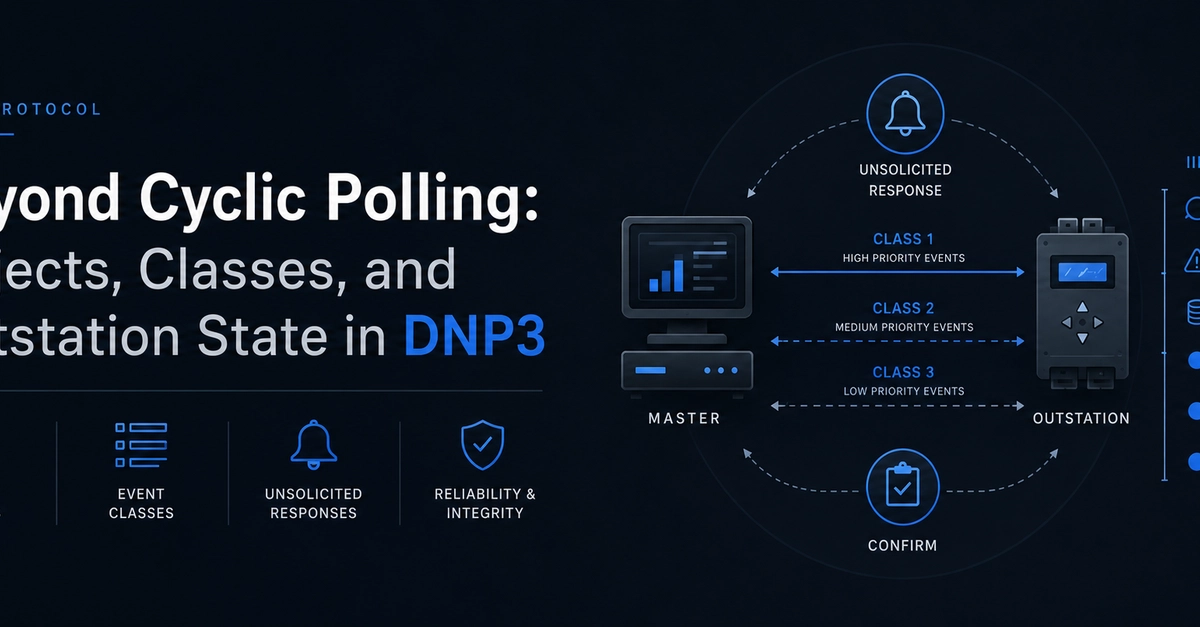
To survive these harsh environments, DNP3 flips the operational model from cyclic polling to event-driven, buffered telemetry.