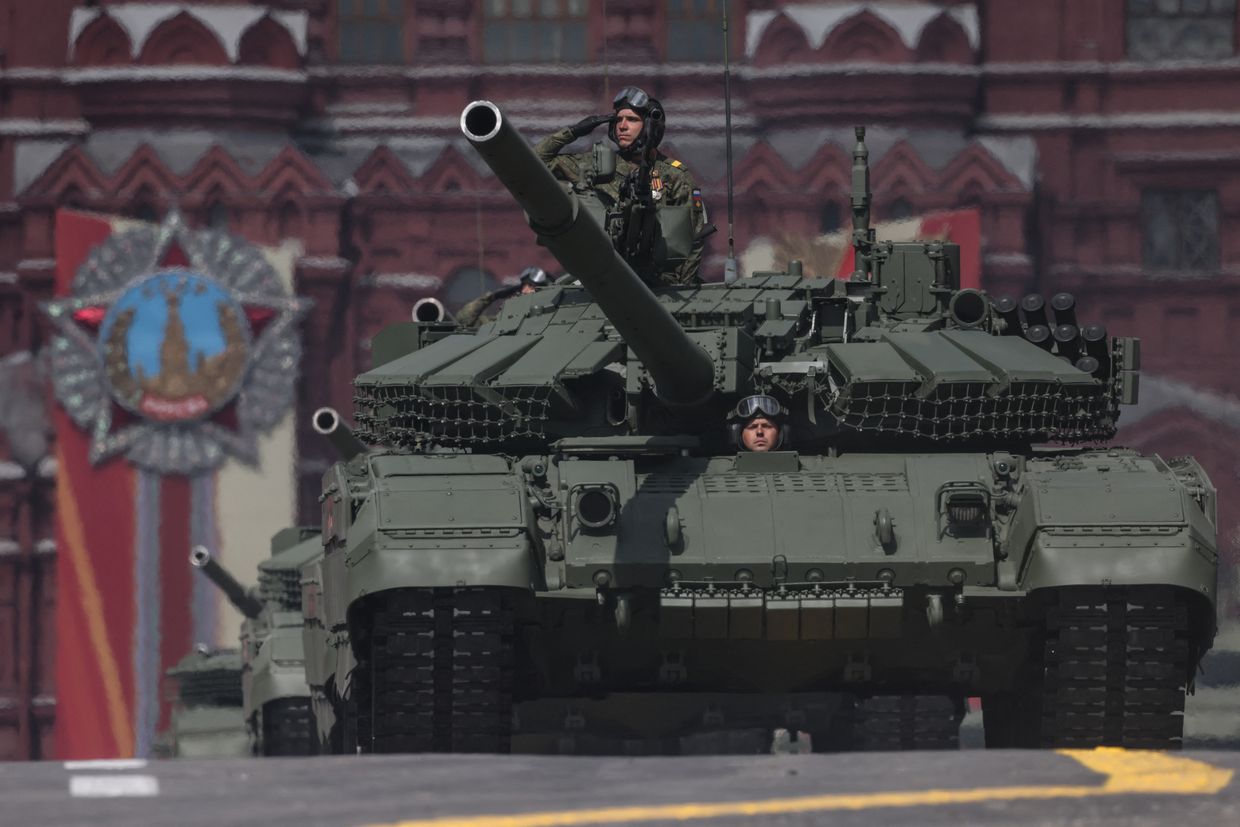
Russian tanks roll across Red Square during the Victory Day military parade in Moscow, Russia, on May 9, 2025. (Stringer / AFP)Russia's war on Ukraine has yet to end because Russia keeps waging it.It is shocking, though regrettably unsurprising, that in the fifth summer since the 2022 escalation by the aggressor, and 12 years since Russia first invaded Ukraine, pundits, scholars, and unscrupulous politicians still offer "solutions" to resolve a "conflict," pointing up and calling it down while ignoring basic facts and laundering the Kremlin's lies in plain sight.To offer blood, sweat, and tears would be decidedly out of fashion and no way to make friends these days, so why not call for "diplomacy," always a safe choice? Is not talking better than killing?This rhetorical misdirection invites agreement with a claim no one disputes while quietly smuggling in insidious manipulations.Moscow plants false premises in seemingly innocuous language, and these enter public debate through either careless repetition or deliberate amplification. Russia's invasion becomes a "war in Ukraine." Moscow's neo-imperial bid for a sphere of influence, where neighbors are to be murdered until they give up sovereignty, becomes "security interests." Ukraine's refusal to be massacred morphs into an obstacle to peace. A few carefully chosen narrative threads can make Russian occupation, torture chambers, and mass graves sound humane, and self-defense appear reckless.Two recent examples stand out.A Russian oligarch, Andrey Melnichenko, whose ammonia plants feed the aggressor's military-industrial complex – a supply chain culminating with Russian missiles hitting Ukrainian homes – is presented to us by The Economist as an "industrialist." A calculated choice for everyone knows that an oligarch in today's Russia is a billionaire who is allowed to keep his fortune at Vladimir Putin's pleasure.Melnichenko's guest essay is full of "fresh" ideas; The Economist bills it as an act of courage to speak up. But engage with the four scenarios he lays out: humiliation, Chinese vassalage, fragmentation, and permanent siege, and you will have tacitly legitimized the premise-setting fraud. To contest Melnichenko's asinine take on sovereignty comes at the cost of giving credence to the big lies on which the whole argument rests.'Moscow's war of choice, an attempt to recolonize Ukraine, is surreptitiously repainted as a struggle between "the West" and Russia. Neither Ukraine's suffering, as the only country spilling blood in defense of freedom, nor the agency of the Ukrainians, embodied in the valor of the bravest nation on Earth, resisting its destruction, gets a mention. In fact, both are dismissed in absentia.Russian billionaire Andrey Melnichenko in Moscow, Russia, on April 16, 2026. (Contributor / Getty Images)The proxy-war sleight of hand is nearly invisible, yet it undergirds the Melnichenko "info op," with The Economist cast as a patsy.The tired fabrication "Russia under siege" is deployed to justify the unjustifiable. In 1942, Joseph Goebbels addressed a crowd in Berlin beneath a giant banner that read, "Never forget that England forced the war on us." In an eerie echo of that logic, Putin, and now Melnichenko, blame Russia's war of choice on NATO.
When righteous calls to end the war become warmongering
Russia's war on Ukraine has yet to end because Russia keeps waging it. It is shocking, though regrettably unsurprising, that in the fifth summer since the 2022 escalation by the aggressor, and 12 years since Russia first invaded Ukraine, pundits, scholars, and unscrupulous politicians still offer "solutions" to resolve a "conflict," pointing up and calling it down while ignoring basic facts and laundering the Kremlin's lies in plain sight. To offer blood, sweat, and tears would be decidedly ou
1,158 words~5 min read