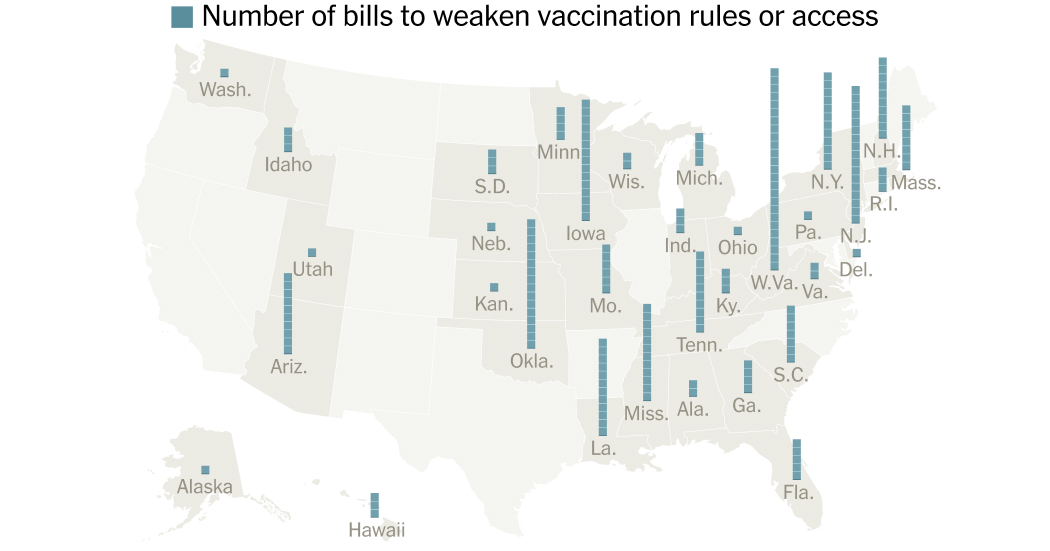
Number of bills to weaken vaccination rules or access By Amy Schoenfeld Walker and Lily Boyce The reporters examined hundreds of bills related to vaccines that were introduced in statehouses this year. July 28, 2026 Lawmakers flooded statehouses this year with bills seeking to dismantle vaccination rules or raise questions about vaccine safety, introducing more than 200 measures in 34 states.The bills challenged every part of the system that states rely on to vaccinate the public, from the pamphlets patients receive before getting a shot to the requirements schools, day care centers and employers can implement. A proposal in Wisconsin would have designated October as “Immunization Injury Awareness Month.” A bill in Iowa would have eliminated all vaccination requirements for elementary and secondary schools.All told, at least 400 bills related to vaccines were introduced this year. Many were intended to bolster or protect the public’s access to the shots. But 209 aimed to weaken vaccination rules or systems or to undermine public trust in vaccines, a New York Times analysis shows.Although only a handful of these became law, leaders of the movement behind the legislative push plan to return next session with a raft of new proposals.This session’s bills fell into five broad categories:Bills to weaken vaccination rules or access, by category Each rectangle represents one bill. Enacted Passed two chambers Passed one chamber Introduced Source: New York Times analysis of vaccine-related state legislation introduced since Aug. 1, 2025. The New York TimesHad all the bills passed, public health experts say, they would have led to a vast reduction in vaccine confidence and uptake, and eventually would have led to more outbreaks of disease.Just nine became law, but advocates for the measures say their campaign was a success because many others got closer to the finish line this year. And some policy observers agreed that the movement made gains.“Bills that would have died in committee in previous sessions are now passing one chamber, sometimes two,” said Jack McClure, who leads state policy efforts at the Association for Immunization Managers. “They may not be law yet, but legislators are taking them seriously.” Bills to weaken vaccination rules or access, by state Enacted Passed two chambers Passed one chamber Introduced The New York TimesPro-vaccine lawmakers found themselves playing defense. They proposed a slew of bills to make it easier to get vaccines or to emphasize their safety record. A dozen states passed laws to preserve childhood vaccination recommendations after federal health officials moved to limit them.Lawmakers and others who believe vaccines are dangerous and should never be required were emboldened by Health Secretary Robert F. Kennedy Jr.’s efforts to oppose vaccines. The details of their latest proposals offer a window into the modern movement against vaccines, which has recently turned its focus to broader messages of health freedom and personal liberty.What the bills sayVaccine critics saw this year as an opportunity to upend a system that states have long relied on to vaccinate the public. They had built momentum after the coronavirus pandemic, capitalizing on anger over Covid vaccine mandates and questions about the safety of Covid vaccines. Bills to remove or loosen vaccination requirements 1 / 62 Passed two chambersProhibits all vaccination and mask requirements by employers. The New York TimesMany of the bills proposed this year aimed to drastically alter longstanding rules to immunize enough people to keep diseases like measles and polio at bay. No state enacted one of these proposals, though Arizona and New Hampshire came close.At least a dozen proposals would have removed some or all state requirements for children to be immunized before starting day care or school. Public health experts said that without requirements in place, some people would not vaccinate their children — not because they oppose vaccines, but because it takes time, effort and money to do so. Bills that would establish protections for unvaccinated people 1 / 40 Passed two chambersProhibits mandated medical interventions, including vaccination requirements by employers and schools, and prohibits discrimination against workers who refuse vaccination for religious reasons. The New York TimesSome lawmakers tried expanding legal protections for people who forgo some or all vaccines. Several states proposed a “bill of rights” for those who are not vaccinated, while other proposals would have established anti-discrimination safeguards for the unvaccinated.Lawmaker support for these measures was high in some states as officials prepared for their 2026 legislative sessions. Florida officials vowed to remove all vaccine mandates for children in the state. But their proposals failed to advance, and broader momentum stalled early this year after the White House pressured Mr. Kennedy to pull back on his vaccine agenda, worried that it could alienate voters in the midterms.Vaccine advocates pushing against these bills said they found success reminding lawmakers that most of the public wanted to maintain childhood vaccine rules.“One of our biggest calls to action is to let lawmakers know that their constituents want their schools to remain safe places to go,” said Jennifer Herricks, director of advocacy at American Families for Vaccines. Bills that promote claims of vaccine dangers 1 / 30 EnactedRequires autopsy reports for children who die suddenly to list any immunizations administered within 90 days of death, and for the reports to be submitted to a C.D.C. registry. The New York TimesA few bills that passed echoed longstanding claims by Mr. Kennedy and the broader movement that vaccines are dangerous. For example, laws enacted in Louisiana, Mississippi and Oklahoma will require recent vaccines to be listed on the death reports of infants and children, which policy observers say is connected to a debunked claim that certain shots cause sudden infant death syndrome. Scientific research does not show a link between vaccinations and infant death.Vaccine proponents say these bills are intended to sow doubt and may lead parents to second-guess vaccines, when scientists and doctors say they are safe.“If you see a bill like that, you might think: We must not know enough,” said Dr. Herricks. “But vaccines are in large part responsible for babies and children living into adulthood.” Bills that target mRNA or Covid vaccines 1 / 35 IntroducedRequires meat and food products derived from mRNA-vaccinated animals to be labeled as such. The New York TimesOther bills continued a yearslong push to ban Covid shots specifically. Some would have labeled any vaccine developed using mRNA technology as a “weapon of mass destruction.” Another proposed labeling blood donations from those who have received vaccines containing mRNA. (Few vaccines using the technology are on the market, though mRNA vaccines designed to fight cancer and infectious diseases are in development.)Even though these bills did not pass, medical experts say the proposals spread false information that could prevent people from getting the health care they need. Bills that alter vaccination systems 1 / 42 EnactedRequires the approval of a parent or guardian for minors to receive vaccinations for sexually transmitted infections or diseases (such as the H.P.V. vaccine). The New York TimesAnother category of bills would change the way states vaccinate the public, sometimes adding more steps to the process, such as requiring parental consent for certain vaccinations or requiring new layers of approval before health officials can distribute vaccines.Other bills would change how health insurers cover the cost of vaccination, or how officials and vaccine manufacturers deal with claims of vaccine injury. (Severe side effects from vaccines are rare.)Looking aheadMost of this year’s vaccine legislation found support or opposition along partisan lines. The bills assailing vaccination systems were primarily backed by Republicans and only passed in states where they held a legislative majority. In Arizona, where Republican majorities in both chambers of the Legislature approved proposals to prohibit vaccine mandates, the Democratic governor vetoed the bills.Although few of the hundreds of bills backed by vaccine critics became law, supporters of the measures say they are already planning to bring more proposals across the country next session.“It used to be that the medical freedom movement was just in a defensive position,” said Del Bigtree, the founder of the Informed Consent Action Network, which has developed more than a dozen model bills aiming to limit vaccine mandates.“We’re moving the needle in several states,” he added. About the data The Times examined over 400 vaccine-related bills tracked by the Association of Immunization Managers and consulted about their effects with several organizations: advocacy groups including American Families for Vaccines and the Informed Consent Action Network, as well as academics at the International Vaccine Access Center at Johns Hopkins Bloomberg School of Public Health.The bill information is from Aug. 1, 2025, through July 1, 2026, when nearly all states had finished their legislative sessions for the year. In cases where legislators introduced similar proposals, bill icons may represent multiple bills.
Vaccine Laws Were Under Debate in Dozens of States. Here’s How Those Bills Fared.
Lawmakers have introduced hundreds of bills related to vaccines this year. Their proposals offer a window into the modern movement against the shots.
1,447 words~7 min read