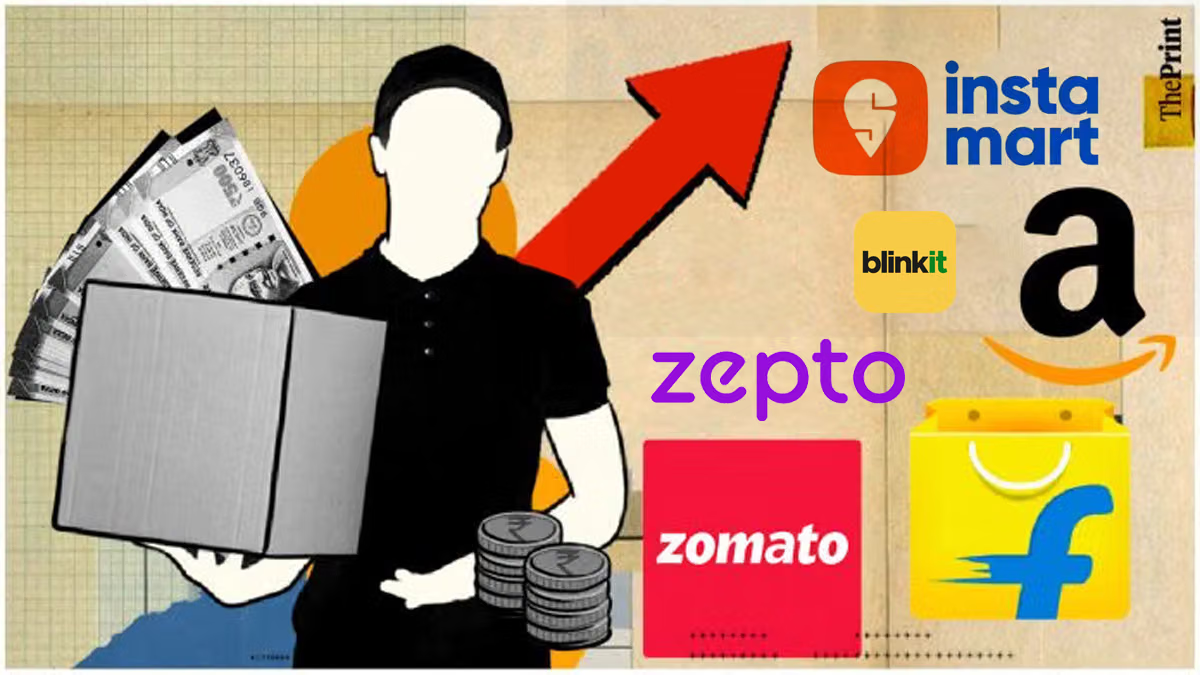
New Delhi: India’s e-commerce sector is on course to more than double in value by the end of the decade, and its biggest challenge is no longer market dominance by Amazon and Flipkart. According to the latest report by Delhi-based policy think-tank the Centre for Social and Economic Progress (CSEP), the industry’s biggest challenge is its inability to make profit.
The report, ‘India E-Commerce Report 2026 – Innovation in the Merchandise Space,’ argues that policy around India’s online retail sector has focused excessively on tackling market concentration—a few dominant players controlling too much of the market— while overlooking structural reasons why most e-commerce firms remain unprofitable despite years of rapid expansion.According to the report, India’s merchandise e-commerce market expanded from about $14 billion in 2014 to $120-130 billion in 2024, and is expected to reach $300-350 billion by 2030, growing at an annual rate of 20-25 percent.
However, while the sector has grown exponentially, profitability remains elusive.The report notes that Indian e-commerce platforms generate gross margins—the percentage of revenue a company keeps after paying the direct costs of selling its product or service—of around 40-43 percent, comparable to global peers, but fail to translate these into net profits.In contrast, China’s Alibaba reports a net margin of about 9 percent, while Latin American giant Mercado Libre posts a net margin of 6.9 percent, despite continuing investments in logistics and fintech.“The challenge is less about market concentration and more about cost economics,” the report stated.It attributes the profitability problem to several structural factors unique to India. The average revenue per user is only $107, far below $1,330 in China, $514 in Mexico and $350 in Brazil. Indian consumers also spend less per order particularly in Tier-2 and Tier-3 cities where average order values range between Rs 500 and Rs 700, compared to around Rs 900 or more in Tier-1 cities.The report says nearly half of all online orders in India are still paid through cash-on-delivery, which increases costs for e-commerce firms. Logistics and warehousing remain the biggest expenses for e-commerce companies with last-mile delivery accounting for around 60 percent of delivery costs.The high return rates of 25-40 percent, much higher than the global average of 17-25 percent, also add to expenses through reverse logistics, restocking and losses in product value, especially in fashion and electronics.The report comes at a time when policymakers continue to debate the growing dominance of large online marketplaces—Amazon and Flipkart, and their affiliates such as Myntra and Shopsy—which together account for 55-65 percent of India’s e-commerce market and about 87 percent of monthly web traffic.However, the CSEP report argues that such concentration is not unusual. Similar patterns exist globally, with top two platforms controlling 97 percent of the traffic in China, 78 percent in Brazil and 67 percent in Mexico.According to the report, this is because larger platforms naturally benefit from their size, wider customer base and stronger delivery networks.The authors caution that high concentration should not automatically be seen as a lack of competition, arguing that niche platforms continue to enter the market with differentiated business models.Instead of imposing blanket restrictions on platform size or foreign investment, the report says policymakers should focus on proven anti-competitive practices such as predatory pricing, exclusive seller deals, self-preferencing, and abuse of dominance.The report identifies three key policy gaps – lack of standardised data to accurately assess the sector, weak enforcement of existing regulations, and inadequate policy attention to gig workers. It says issues such as income volatility, working conditions and social security remain unresolved even as quick commerce continues to expand.