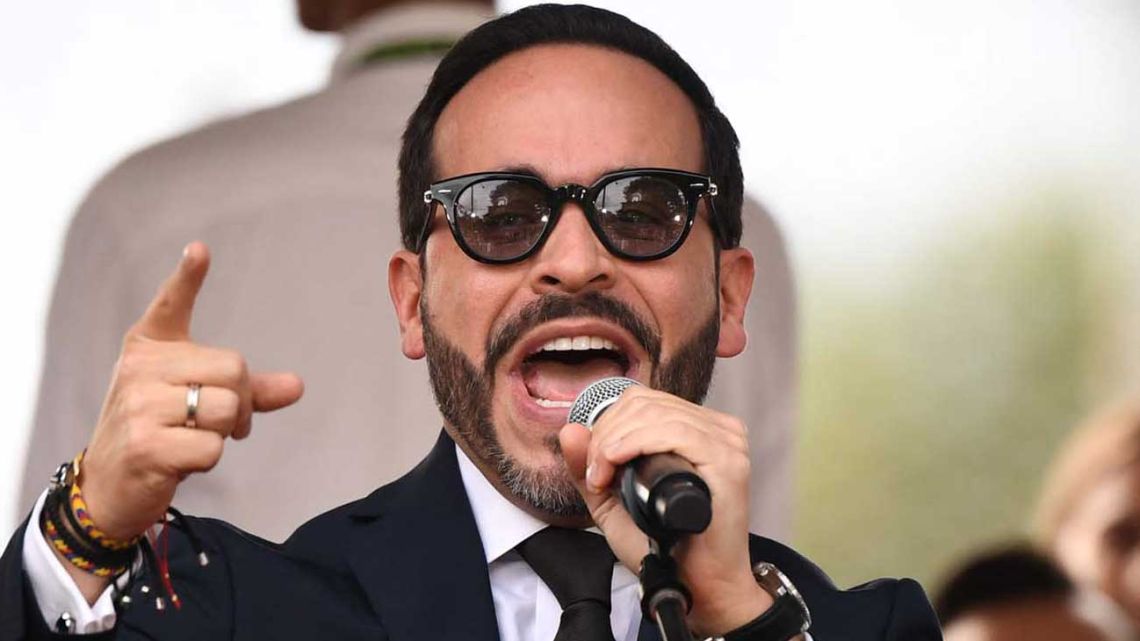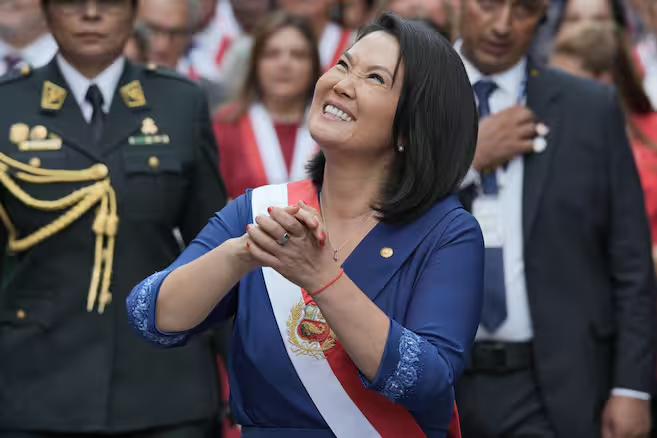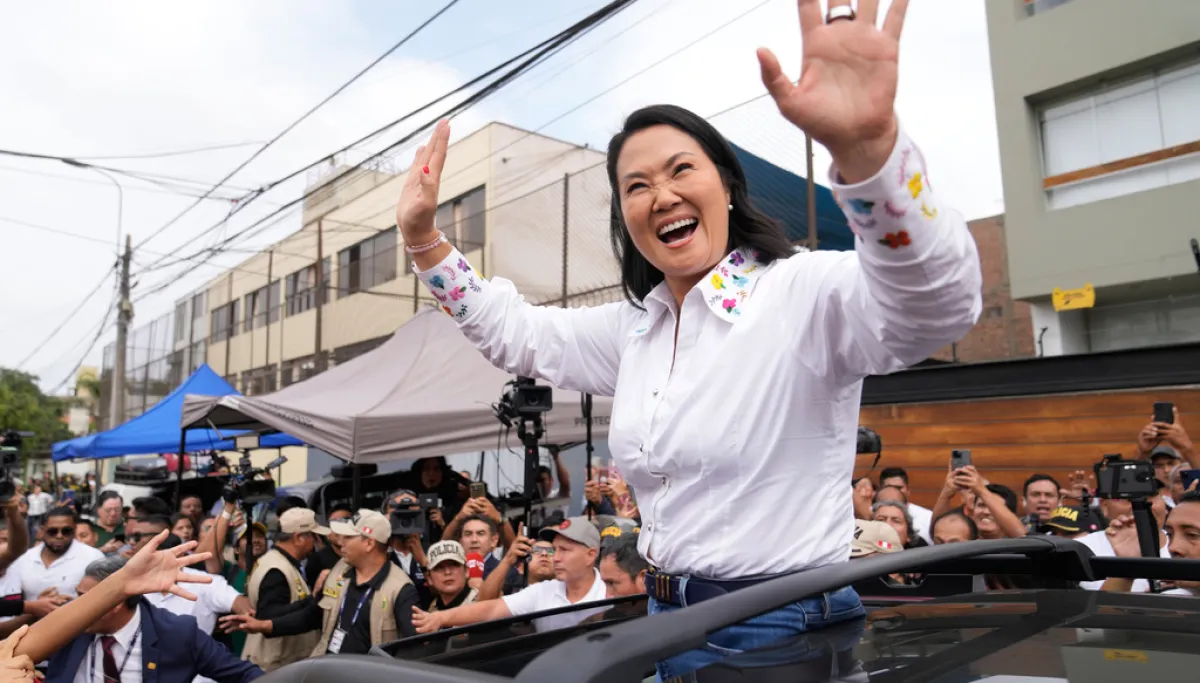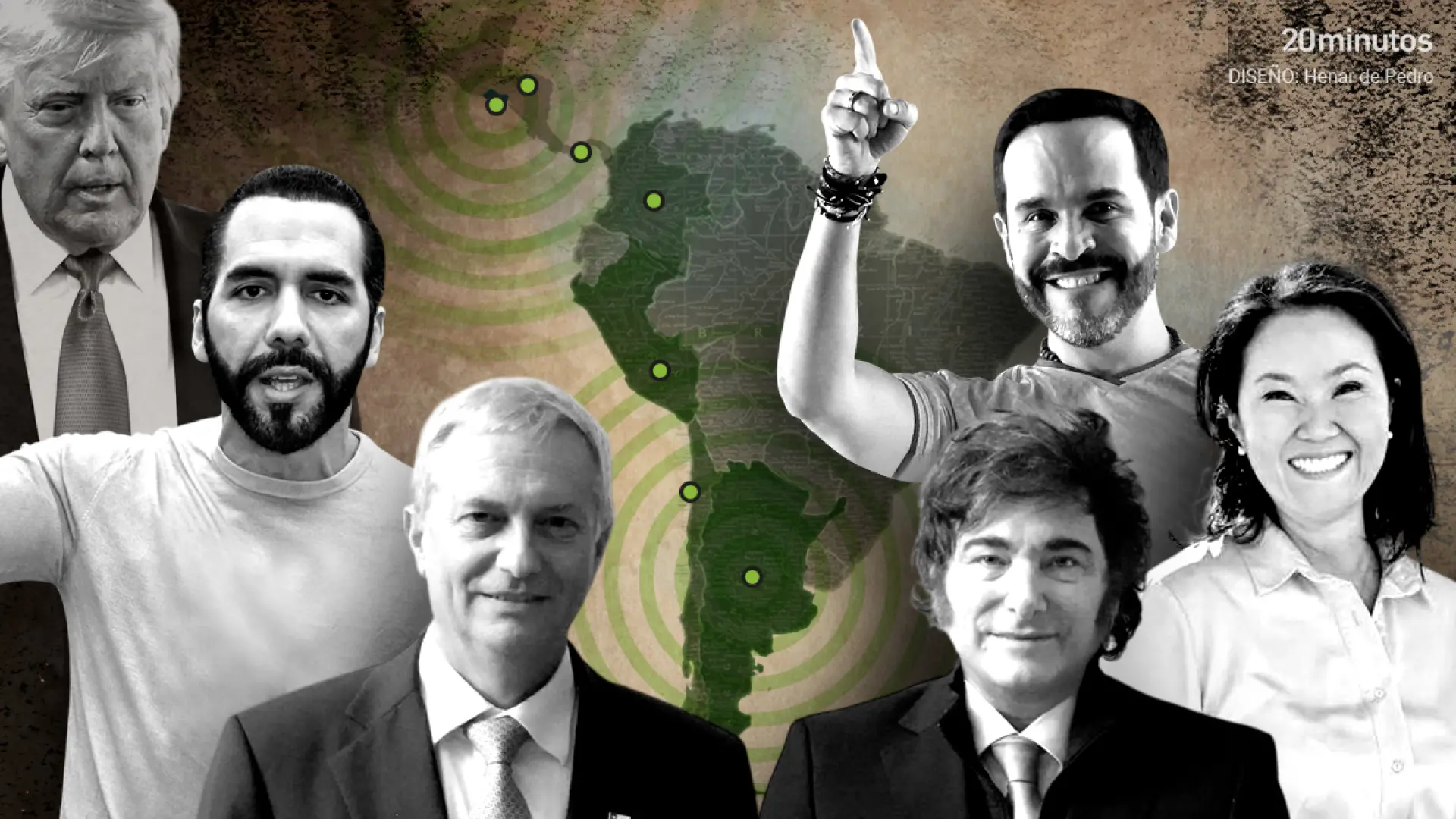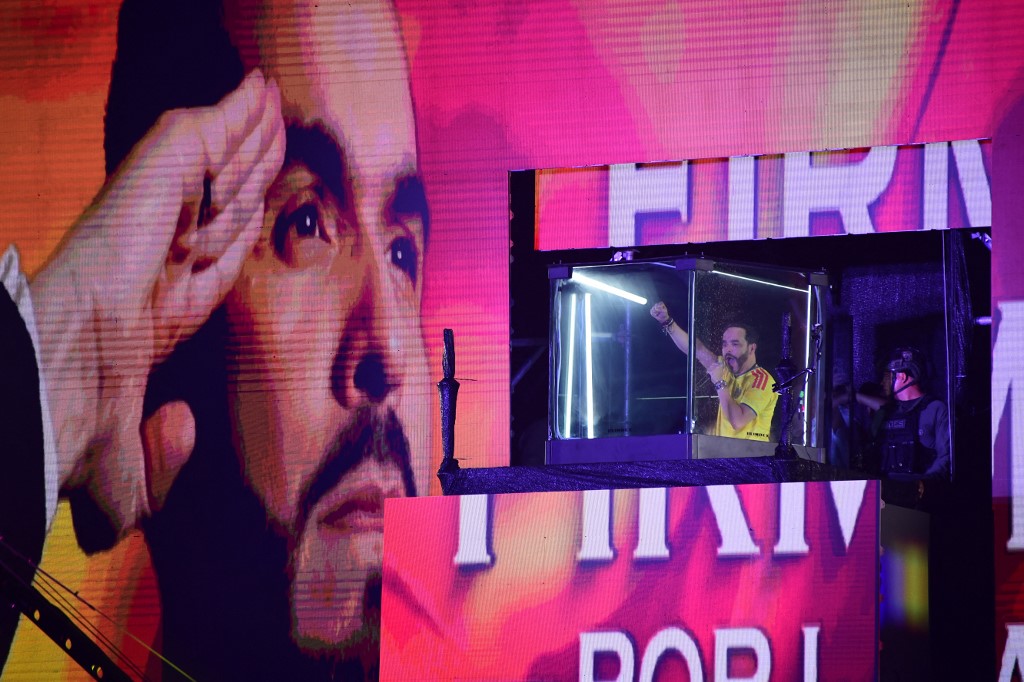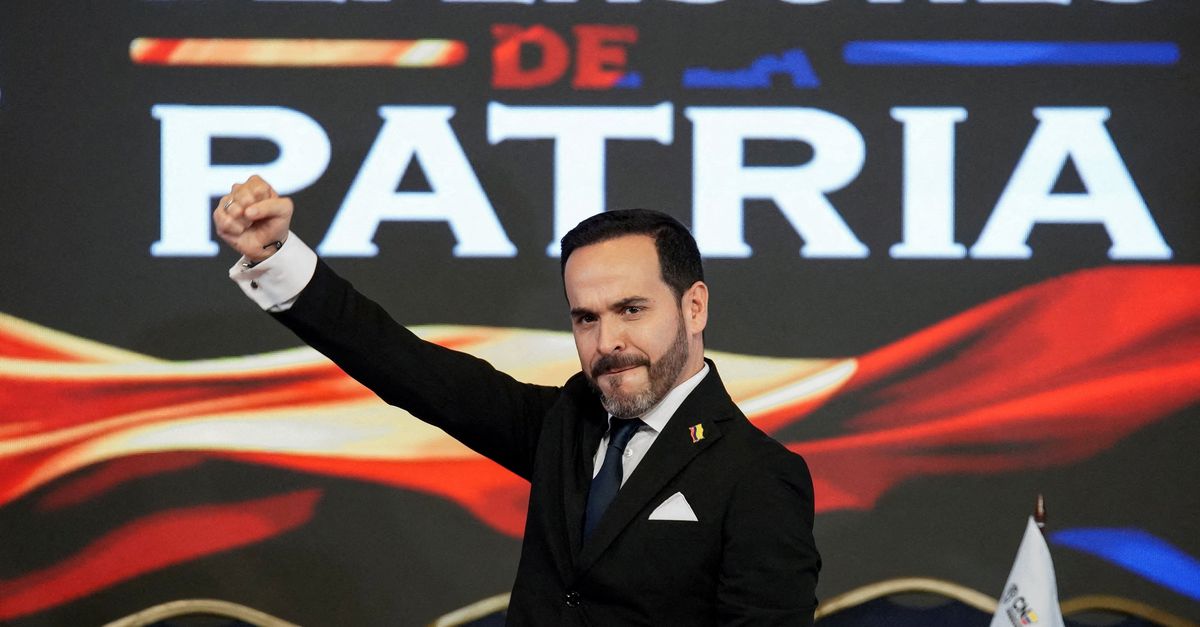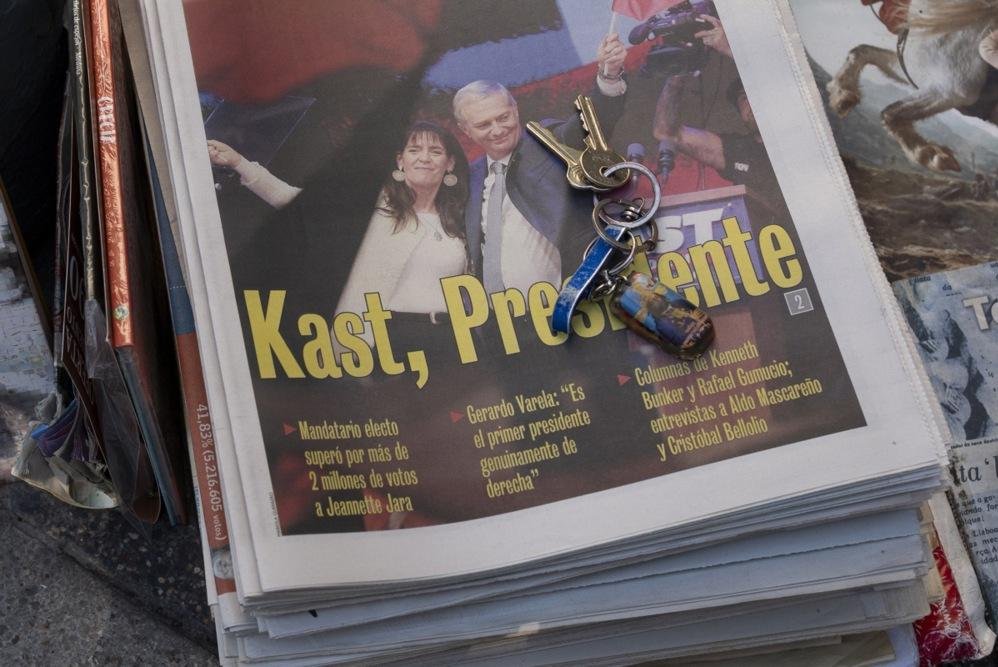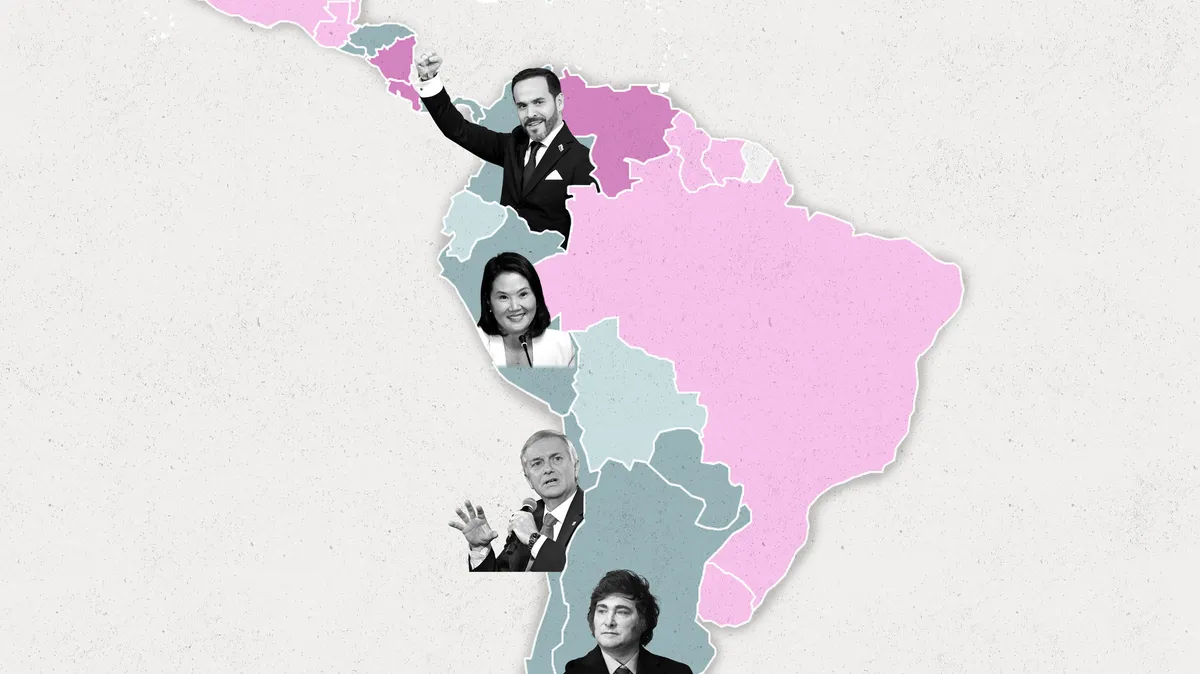
Latin America has seen a broad political shift to the right since President Donald Trump began his second term in January 2025.Razor-thin elections in Colombia and Peru are redrawing Latin America's political map, reversing the "pink tide" of left-leaning governments that defined the region in the early 2020s. The term “pink” implies a softer form of communism than “red."The political shift is primarily driven by disappointment with leftist governments that led to more organized crime and economic inflation. Leaders are now drawing voters to the right with promises of security and economic reform.Both elections were finalized in late June, and each right-wing candidate − Abelardo de la Espriella of Colombia and Keiko Fujimori of Peru − won by extremely narrow margins.Fujimori, daughter of former Peruvian President Alberto Fujimori, is set to be inaugurated July 28, and Trump is sending a presidential delegation to attend the ceremony. De la Espriella will be inaugurated Aug. 7.The Trump administration didn't directly officially support Fujimori during her campaign, but it did endorse these victorious right-wing candidates:De la Espriella of Colombia in June 2026.José Antonio Kast of Chile in December 2025.Daniel Noboa, incumbent president of Ecuador, who was reelected in April 2025.Trump has publicly endorsed six other current leaders in Latin America and launched a "Shield of the Americas" Summit in March to unite right-wing leaders across Latin America and the Caribbean in combating issues facing the region such as organized crime and illegal immigration.Political leadership in nine of 23 Latin American countries now belongs to a party that identifies as right, while three identify as left. The others identify as either right- or left-centrist, according to the Chapel Hill Expert Survey analysis of party positions and analysis of their parties' platforms in national electoral courts.This differs from previous leadership, when leaders of eight countries identified as left-wing and four as right-wing.Haiti doesn't have a president; its last elected president, Jovenel Moïse, was assassinated in 2021. Haiti hasn't held elections since then because it has been plagued by an increase in crime, corruption and instability, though it is tentatively set to hold an election in August.Crime and economics largely drive the shift"The [first] reason why people are voting for the right is because the left did very bad governments with corruption and inflation," said Alejandro Peña Esclusa, a former Venezuelan presidential candidate who is now a political analyst and consultant. "Second, [the left-wing governments] are related to organized crime."U.S. officials have accused some Latin American leaders of connections to organized crime, including former Venezuelan President Nicolás Maduro, who was accused of heading a suspected drug trafficking operation. Venezuela's government rejected the claims, calling it a "ridiculous" move to designate a "non-existent" group as a terrorist organization, according to Reuters. Maduro was captured by U.S. forces in January and brought to New York, where he and his wife are awaiting trial on charges of narcoterrorism and weapons and drug trafficking.The U.S. Drug Enforcement Administration has accused outgoing Colombian President Gustavo Petro and current Mexican President Claudia Sheinbaum of ties to drug cartels. Both have denied the allegations.The United States also has imposed sanctions on Nicaraguan leaders Daniel Ortega and Rosario Murillo, accusing him of violent repression, arbitrary detentions, persecution of civil society and the church, and constitutional manipulation.Many Latin American governments also were experiencing severe economic inflation. A prime example was Argentina, where its currency was depreciating before right-wing Javier Milei took office in December 2023. Inflation topped 200% at the time.Milei, whom Trump enthusiastically endorsed, cut government spending and regulations to ease the debt. He also accepted a $20 billion bailout from the U.S. Treasury in October 2025. Argentina was able to pay back the United States in full a few months later, in January 2026.Why is Trump interested in Latin American elections?The United States has remained publicly neutral during most democratic elections abroad since the Cold War ended in 1989. U.S. officials who were asked about candidates in foreign elections typically responded by saying the United States was focused on promoting democratic elections.This practice changed with Trump's second term, when his 2025 National Security Strategy outlined an intent to "reassert and enforce the Monroe Doctrine to restore American preeminence in the Western Hemisphere."The Monroe Doctrine, a stance outlined in a congressional address from President James Monroe in 1823 − says "the American continents, by the free and independent condition which they have assumed and maintain, are henceforth not to be considered as subjects for future colonization by any European powers."It adds that the United States "should consider any attempt on their part to extend their system to any portion of this hemisphere as dangerous to our peace and safety."The United States is not as concerned with European powers now as they are with China, which has been building dominance in the region. China has been investing heavily in critical infrastructure throughout the South American continent, including telecommunications networks and modern subway lines in major cities.Trump's National Security Strategy states: "We want other [Western Hemisphere] nations to see us as their partner of first choice, and we will (through various means) discourage their collaboration with others."Most left-wing governments in Latin America are part of the Sao Paulo Forum, founded in 1990 by Brazilian and Cuban leaders to unite leftist movements in the region. Along with coordinating strategies to win elections, it also promotes ties with countries like Iran, Russia and China, which are not aligned with the United States."This is not common. Trump is doing it without blushing," Esclusa said, referring to Trump's public endorsement of candidates. "The left helps each other publicly, but the right doesn't. Trump began a new era with the new national strategy of the U.S."
Maps show right-wing shift in Latin America since Trump's inauguration
From Keiko Fujimori of Peru to Abelardo de la Espriella of Colombia, right-wing victories reflect voter frustration as Trump expands his influence.
948 words~4 min read