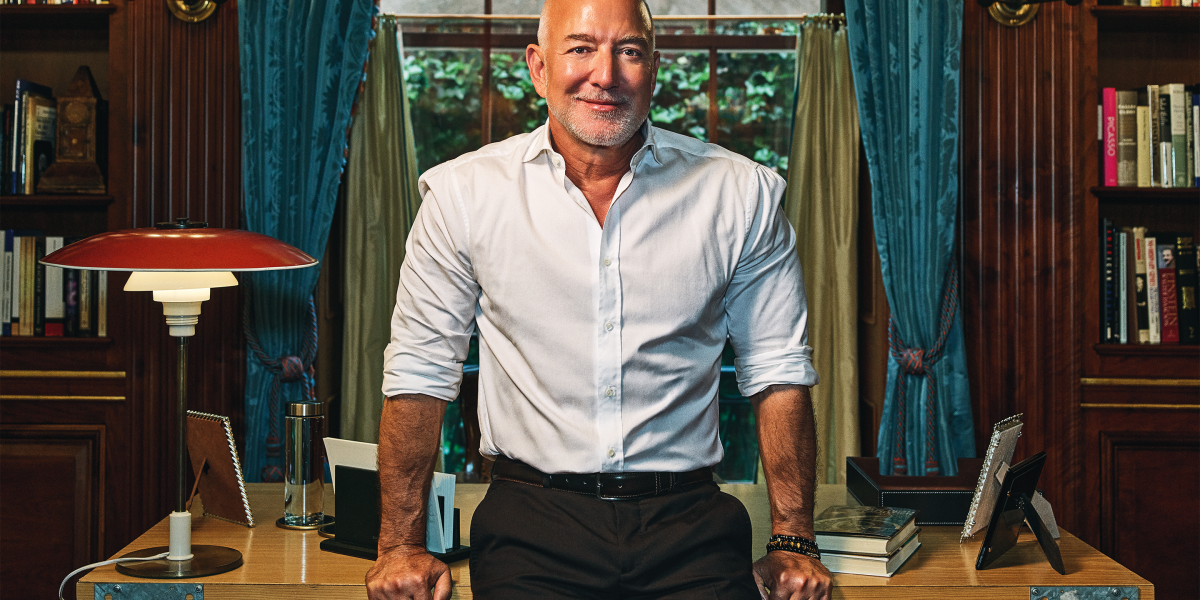
Jeff Bezos won’t pretend he didn’t see this day coming. Sure, when he was sitting in his Bellevue, Wash., garage in 1995, at a makeshift desk made from a wooden door slab, he probably wasn’t imagining that his nascent online bookshop would grow into the largest company in the world. Instead, he may have been puzzling over how to set up extension cords to keep his computers and servers running without tripping his home’s circuit breakers. Or he may have been mulling over changing the name of his tiny startup, then called Cadabra, to Amazon.
But three decades later, now that his startup has become an “everything company” that reportedly delivers as many packages as the U.S. Postal Service; now that the Amazon Web Services (AWS) cloud business powers a third of the internet; and now that Amazon has topped the Fortune 500 and ascended to the No. 1 spot in the Global 500—making it the biggest company in the world—Bezos admitted to Fortune: “It’s not like it’s a complete surprise.”
And anyhow, Bezos added in April, sitting at that original door-desk in his study in Washington, D.C., bigness was never the point. “I don’t want us to take pride in being big,” Bezos said. “I want us to take pride in servicing customers. And it turns out, if you service customers really well, that will drive growth.”