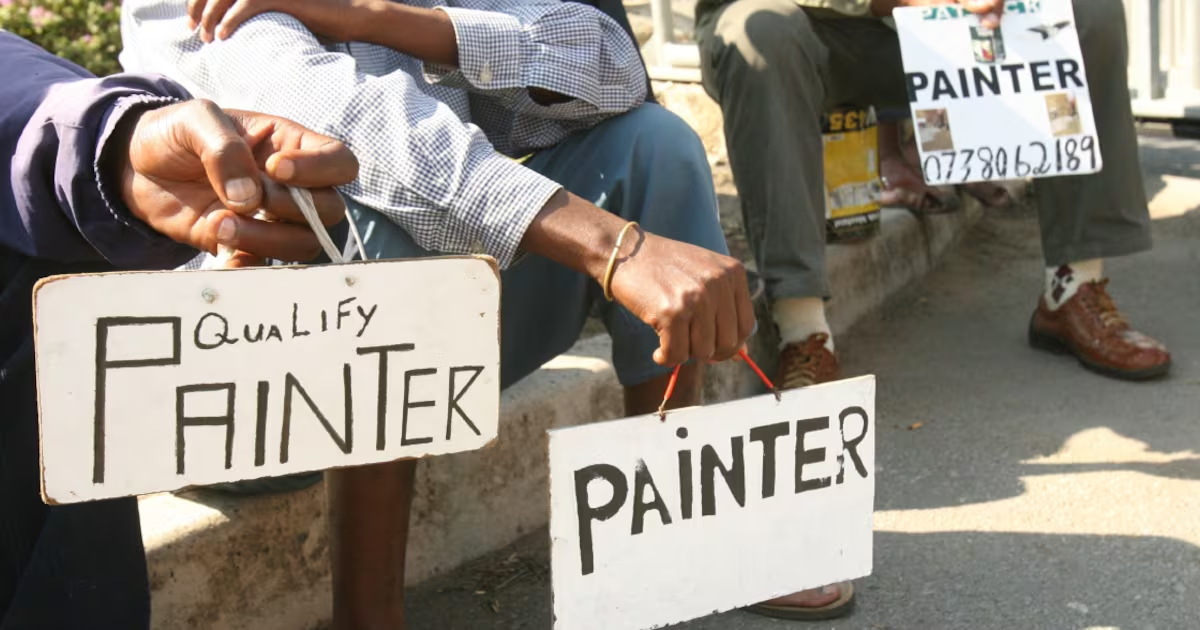
When it comes to job creation, South Africa’s government has a distracted boyfriend problem. Sure, we’re committed to it. But when it comes to economic targets and policies we end up pursuing every other priority instead, from GDP growth to exports to investment and technological progress. Somehow we never get around to economic projects that aim mostly to generate livelihoods on a really large scale. Scaling up job creation is critical because the country remains an outlier on joblessness. Internationally, South Africa invariably ranks among the three or four countries with the lowest percentage of adults that have income-generating employment. Since the 1980s only about 40% of working-aged people in South Africa have been employed; the international average is at 60%. The gap is largely due to depressed business ownership. In South Africa 5% of adults are employers or self-employed; in other upper middle-income economies the figure is closer to 20%. The reason is obvious: apartheid eliminated most African farms and businesses, together with their support systems. As a result the termination of discriminatory laws alone could not bring them back. South Africa’s extraordinarily high level of joblessness has severe economic, social and political consequences. It excludes talent and labour on a mass scale; depresses sales of consumer goods and services; reduces households’ ability to pay for government services; underpins high levels of inequality; and undermines social solidarity. In the absence of visible progress it fuels xenophobia. Government economic policy documents invariably point to the importance of job creation. Yet they provide remarkably little in the way of specific projects to deal with it on the necessary scale. This more or less benign neglect means job creation has essentially mirrored GDP growth. It accelerated when the economy prospered during the international commodity boom of the 2010s, but then slowed down with only limited recovery from the sharp fall during the Covid-19 pandemic in 2020/21. From 1994 to 2025 GDP expanded by 84%, employment by 86% and the working-aged population by 75%. The share of adults with employment climbed from 39% in 1996 to the modest peak of 45% in 2008 but then fell back to 40% in 2025. The recently released industrial development strategy illustrates the difficulty of prioritising job creation. Its five outcomes incorporate nine economic variables. It sets quantified targets for 2025-29 for just three of the variables, namely annual GDP growth at 3% a year, manufacturing value added at 1% a year and manufactured exports at 4.1%. It mentions productive employment without specifying a target, in company with export diversification, regional integration, investment, localisation, competitiveness and resilience. If employment matched GDP growth at 3% a year through to 2029, South Africa would end up with 2.6-million more jobs, compared with 1.3-million if growth continued at the present rate, approaching 1.5% a year. Since the working aged population would also grow, by 2029 the share of adults with employment would reach just 44%, still well below the global norm. The employment ratio would only catch up with the rest of the world by 2040. Interventions to promote more labour-intensive growth would help. However, the new industrial strategy largely emphasises heavy industry ― notably metals beneficiation, including steel and auto ― and seems more concerned with saving existing jobs than establishing new ones. Formally, it prioritises tourism and global business services as relatively jobs friendly, but only tourism features in the implementation plan. The apparent inability to scale up measures to accelerate employment creation results, in part, from structural challenges within the government. No department is mandated with employment creation as a top priority. The department of trade, industry & competition is tasked primarily with promoting manufacturing and serving formal businesses through trade policy, standards setting and company registration. There is no authority in the government that is solely mandated to maximise employment. In these circumstances, distraction is a feature, not a bug.• Makgetla is a senior researcher with Trade & Industrial Policy Strategies.
NEVA MAKGETLA | Making employment a priority
SA’s jobless rate remains among the world’s highest despite policy promises
655 words~3 min read