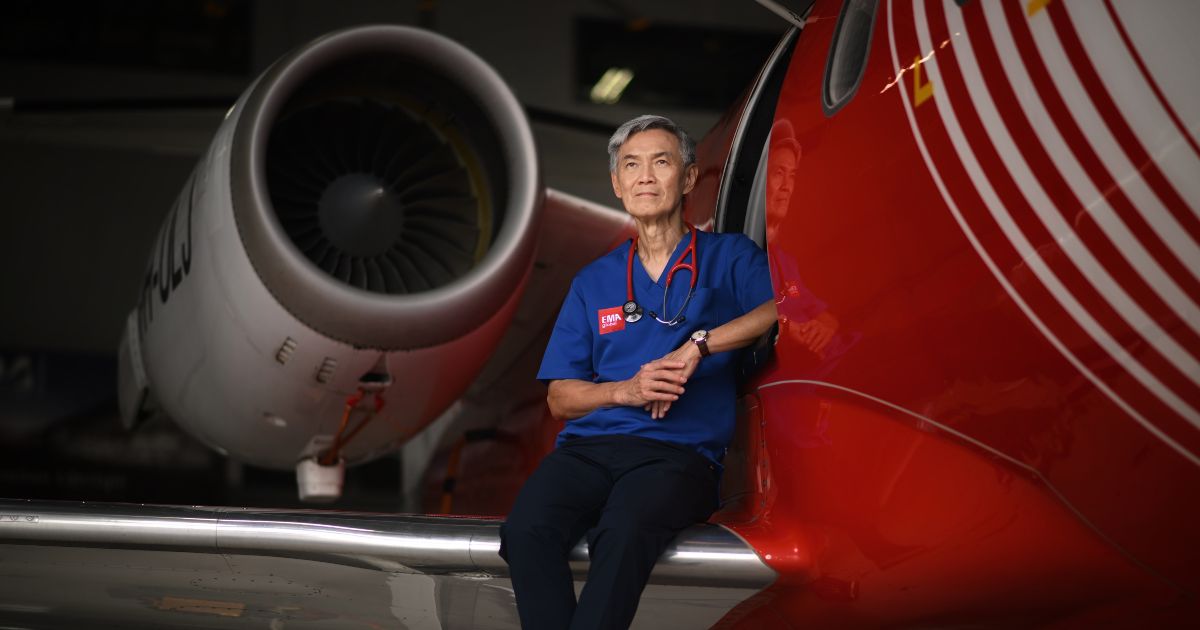
In this series, people from all walks of life offer an inside – often unfiltered – take on their livelihoods and what keeps them going in their jobs. In this instalment, hear from medical flight physician Winston Jong as he takes us through the highs and lows of providing intensive care to patients 40,000ft in the air, as told to The Straits Times.I am 70 and a flight physician. I am currently also a consultant anaesthetist in private practice.Back in the 1990s, when I was a specialist working in the intensive care unit (ICU) in a private hospital, I noticed that some patients who had flown in to come to our hospital were in a very bad shape. They were poorly taken care of, and I said to myself, I can do something about this.So I started getting equipment, putting together a medical team and making connections with hospitals and aircraft, and founded EMA Global in 1991. We offered medical evacuation at a time when aeromedicine was not widely practised yet.We bring patients from hospital to hospital, country to country, and continent to continent – whether it is to get home or to a hospital with better capabilities.We escort them in an air ambulance – a private jet configured for medical missions, such as to accommodate stretchers – or on commercial flights, keeping them alive and comfortable until they reach the next hospital where treatment can resume. Flight doctors like Jong and his colleague Giju Gnanadhas are accustomed to working in a small, enclosed space while caring for patients. With our network, we can pick you up from any corner of the earth. Even if you’re on a cruise, we can send a helicopter if the ship has a helipad.It’s a very exciting job as it can take you to places you’ve never been, including some exotic places. Once, we flew a patient from Port Moresby, in Papua New Guinea, to Shenzhen, in China. We then went to Qingdao to pick up another patient and bring him back to Kuala Lumpur. From there, the plane and crew flew straight to the Maldives and Bangkok.This also means you need to be apart from your family. Rescue missions often require back-to-back flights around the globe, keeping us away from home for a week to ten days. Sometimes we don’t know our next mission until we get to the first destination. Senior base captain Zaw Thi Ha (right) and first officer Chua Kean Chaye (left) from Avcair Singapore readying the plane as an ambulance arrives with a patient. Avcair, a chartered private jet service, is one of the accredited air operators EMA Global works with. There are two types of medivac: A taxi flight for non-urgent cases and an urgent air ambulance service for life-threatening rescues.Let’s say you are in a remote place in Indonesia, and you broke a leg. Even if you already got treatment, being in a cast and on crutches can make catching a domestic flight to Jakarta challenging. So for convenience, you may want a plane to pick you up, just like a taxi.Life-threatening conditions are urgent. In the case of a stroke, bad pneumonia or heart attack, we can take you to a hospital with better facilities that will improve your chance of survival. We've picked up a honeymooner from the exotic Micronesia, where a coconut fell from a tree and hit his head, resulting in a serious head injury. ‘Every case involves a life’Our patients vary from babies to elderly people on the verge of death. Every case is unique. Every case involves a life. Every case is memorable.We once escorted a 250kg man from Samoa island to Sydney. He was the heaviest patient we’ve had. No air ambulances or commercial airlines would take him as his shoulders were too wide to fit through their plane doors.We were able to accurately and remotely assess if he could fit through the door. But there were several other considerations: Is your stretcher designed for such a heavyweight? How are you going to lift him to the aircraft? How will you bring the patient in and out safely?We found ways to do this, and successfully transported him home. A 250kg patient who was transferred from a hospital on Samoa island to a hospital in Sydney. PHOTO: EMA GLOBAL We’ve also ferried neonates, including a four-week-old baby with a traumatic brain injury after an accident while on holiday in South Korea with his family. A scan confirmed a bleed in his brain, which needed surgery. Giju at a hospital in South Korea preparing the baby for transfer. PHOTO: EMA GLOBAL The team meticulously transferred the baby, who weighed just 800g, back to Singapore to continue treatment. He was discharged from hospital 23 days later. PHOTO: EMA GLOBAL About 15 years ago, we took a young Englishman from Bangkok to London for a heart transplant. He had suffered a massive heart attack, causing his heart to fail, and needed an ECMO (extracorporeal membrane oxygenation) machine to keep him alive.Such cases are more challenging. The ECMO, or “heart-lung machine”, circulates blood through a machine outside the body to oxygenate it. Flight doctors have to look after both the ECMO and the ventilator or respirator, which helps patients to breathe. Flight doctors need stamina and mental alertness to care for critically ill patients during flights. We also transport patients with psychiatric illnesses. Pre-flight assessment is very important. We need to know whether the person is in acute psychosis or is calm and well but could have an episode when triggered.When they become very violent, they can throw things around. They may damage the plane or even open the emergency door. So a proper assessment to determine if they’re ready for flight is crucial.We also handle the repatriation of mortal remains. We had a 34-year-old who went to Cambodia and was found dead in a hotel room. It was very sudden and very sad. It’s a different type of rescue work, and often involves supporting family members with procedural matters.We also offer what we call hospice flights, where we fulfil a client’s last wishes to die in their homeland. How the business took offSetting up an air ambulance company was quite costly because of the equipment. For example, a medical-grade mobile ventilator cost me $40,000. But it is very accurate and works wonders.Our equipment now is a far cry from what it was like before. For example, ventilators today have different modes to support patients with different needs. The infusion pumps and defibrillators are very different too.Over the years, certain standards of care set up by various governing bodies have improved tremendously. These include improving the safety of patients during transfer and how they are secured in the plane. Patients are often loaded with medical equipment attached to them, which must also be secured before take-off. Giju operating a portable patient vitals monitor. We used to own a Learjet 35A and Learjet 36. Now, we charter the Learjet 60, Gulfstream G100, Gulfstream G150 and Challenger 604. Some of the newer aircraft have bigger cabins and longer ranges.We also tap a global network of accredited air ambulance operators so that we can precisely match an aircraft type and flight routing to the specific clinical requirements of each medevac. One of Avcair’s Singapore-based jets, a Learjet 60, is mainly reserved for medical missions, though it can be used flexibly. The pilots can reconfigure the cabin into a normal passenger layout or fit in two stretchers if needed. Our fees depend more on where you are than the complexity of your case. Ninety per cent of the total cost is for the air ambulance. If you are flying from Tokyo to Singapore, it’s typically about US$100,000 (S$129,000). From Jakarta to Singapore, it’s typically about US$25,000.If you’re insured, insurance will pay for it. But if you are not, then you have to pay out of pocket.To help clients manage costs, we escort and repatriate patients with less severe conditions on commercial flights, which would typically cost about 20 per cent of an air ambulance charter. Specialised training for the crewFor us, a basic principle is not to do any medical procedures on a plane, if possible. Our job is to keep patients stable and comfortable till they get to the hospital, where the medical teams have the space, right assistance, lights and other resources to treat the patient.But when looking after patients outside the hospital environment, you need to know what to do if the condition changes.Or if there’s a fire on the plane, what do you do?The crew’s mental capability and medical expertise are very important.Putting a doctor or a nurse outside a hospital environment is never the same. Winston Jong Flight doctors and nurses must have a background in emergency medicine, intensive care or anaesthetics, as they often have to manage vital functions like blood pressure and oxygenation. The doctors and nurses we hire need to have several years of ICU experience. For instance, Giju Gnanadhas, a flight doctor and our associate medical director, was trained as an anaesthetist before joining EMA Global in 2021.Even then, we usually have to teach them flight physiology on the job. You need to understand how the body reacts when flying, such as when the ambient pressure changes.If you are sitting up when the plane takes off, you don’t feel much. But if the plane takes off when you are lying down, there’s a sudden surge in blood pressure. And when you land, the blood will surge to the legs.Medevac staff must be able to anticipate things that might go wrong, and be prepared for it.In the hospital, it’s different.Here, it’s just you, your equipment and God. That’s all. Nobody else can help you. Winston Jong This is why the groundwork is very important.Very often, the patients are not in Singapore. From here, we may assess the condition of someone in Ho Chi Minh City. What will he require there? Will he have trouble in the few hours it takes to get to the next hospital? Making that judgment is the most challenging but it comes with experience, medical knowledge and skills.Inadequate remote assessment and preparation before you take off with a patient would be a mistake, because you may not be prepared or have the equipment to keep the patient in an optimal state. You cannot go in blind or think that you are God and you can handle it.On a typical mission, we carry oxygen tanks ranging from 5kg to 60kg, and multiple equipment bags containing infusion pumps and ventilators. Fitness is very underrated. You also need base-level strength to carry patients on a stretcher up onto the plane.We also bring headlights for when the plane makes a stop to refuel in the middle of the night. With the engine off, there are no cabin lights or air-conditioning, and we make sure to bring backup batteries to keep our machines running. Sometimes, there is no electric loading and unloading system to move the patient in and out of the plane. In such instances, it can take six staff members, including the medevac pilots and the ambulance driver, to lift the patient onto the plane’s stretcher loading ramp, which may be over 1m tall. While we often have short-haul flights that are between three and five hours, there are also long-haul flights such as from San Francisco to Hong Kong. We have a fatigue management system, as required by international standards, to make sure that the escorts are well rested. If need be, there may be an additional escort to rotate care duties and rest.There is no body or law governing how aeromedicine is practised 40,000ft up in the sky, but we are accredited by the European Aero-Medical Institute and the Commission on Accreditation of Medical Transport Systems.These international standards bodies evaluate our equipment, pharmaceutical bag and safety culture. Are they updated? Have we tested them out? Are there expired drugs? What is the first thing we tell the next caretaker? For example, a patient may need blood when he arrives in the hospital. Jong finds immense satisfaction in knowing that his work has brought relief to people in distress, wherever it is in the world. Accreditation is voluntary, but we do it to hold ourselves to the highest standards of service and care to ensure patients’ safety.At the end of the day, if we can make a guy with a broken leg comfortable and you can reassure him, he’ll be very grateful for life. There’s nothing more gratifying than knowing that I’ve brought someone home safely, and in a condition that is as good as – or even better – than when he left the hospital.Got an interesting job to share? Write in to us at ssharon@sph.com.sg. Catch up on the rest of our On The Job series here.Industry: AeromedicalSalary range: Flight doctors can earn a basic salary of $5,000 to $15,000 a month, depending on experience and operational requirements. EMA also pays a commission for each case, based on mission duration, mission complexity, level of responsibility and other assignment-specific considerations.Prerequisites:Intensive care and anaesthetics background. “The principle of intensive care medicine and anaesthesiology is to keep people alive and comfortable for as long and safely as possible. This applies on flights as well,” says flight doctor Winston Jong.Hidden reality: You must be physically healthy and fit. “Carrying medical bags and equipment can wear you down if you’re not in good shape. A full oxygen cylinder tank alone weighs 5kg to 7kg,” says Jong.
‘We keep people alive’: His flying ICU rescued 800g baby, 250kg man
In this series, people from all walks of life offer an inside – often unfiltered – take on their livelihoods and what keeps them going in their jobs. In this instalment, hear from medical flight physician Winston Jong as he takes us through the highs and lows of providing intensive care to patients 40,000ft in the air, as told to The Straits Times.
2,254 words~10 min read