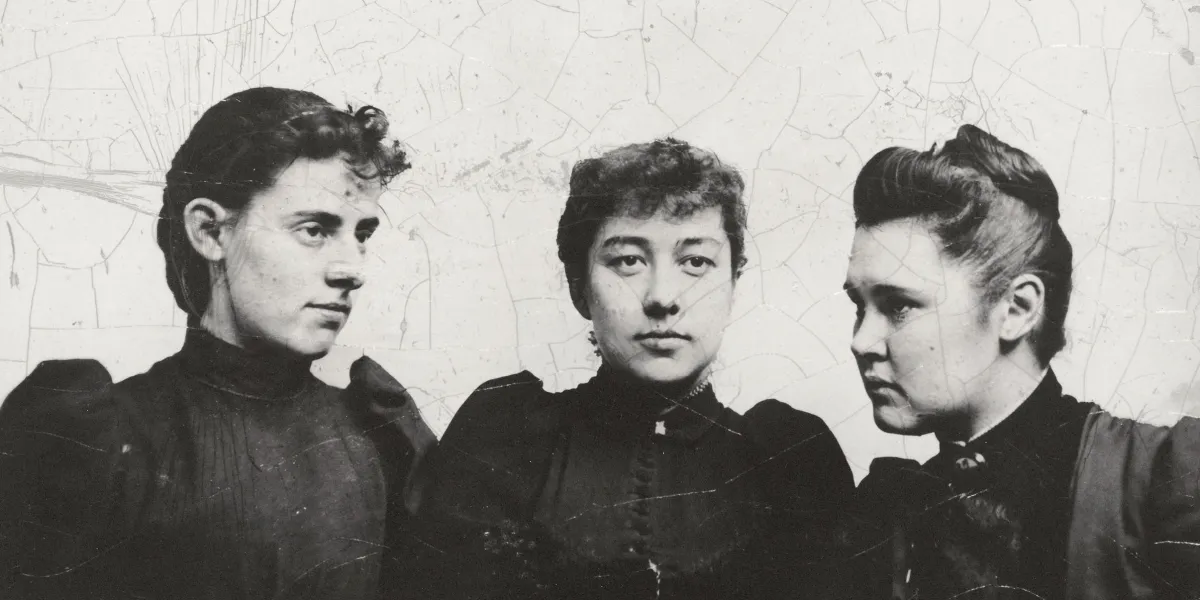
In an 1894 studio portrait that’s cracked with age, three MIT students sit close together against a pale backdrop: Sarah Hall faces the camera head-on, flanked by Marion Mahony at left and Harriet Gallup on the right. It captures an early moment in a friendship that endured nearly 50 years. For decades after graduation, the three women exchanged a round-robin letter that carried news of laboratory jobs, architectural studios, civic work, marriages, and long-distance travel. Though their professional paths diverged and they rarely saw one another in person, their correspondence served as a lifeline, fostering an ongoing dialogue as they navigated and built lasting legacies in challenging fields. At the time, the Institute’s expectations for women were limited. In 1888, President Francis A. Walker wrote that the number of women enrolled was “never likely to be large, considering the nature of the professions to which our courses lead.” MIT’s classrooms and laboratories were open to women, he noted, but the Institute anticipated that few would pursue its scientific and technical pathways. Walker wasn’t wrong about the relative scarcity of female students at MIT. The 1894 Technique lists only two additional women alongside Hall, Mahony, and Gallup in the Class of 1894: Florence Marion Laighton and Alice Beardslee Prescott. Laighton and Prescott spent multiple years at the Institute, in biology and physics respectively, but did not graduate. Their incomplete records illustrate how students in the 1890s could arrive as degree candidates, enroll as “special students,” shift categories, or leave before completing a degree, with the archives rarely indicating the specific route each individual took. But the three women in the photo did earn degrees—Mahony in architecture, Gallup in chemistry, and Hall in physics. And despite Walker’s low expectations for the career prospects of alumnae, four of the five women of the Class of 1894 went on to make notable contributions in their fields.
The coeds of 1894
In the 1890s, MIT alumnae weren’t expected to have meaningful careers. The women of the Class of 1894 proved that assumption wrong.
1,974 words~9 min read