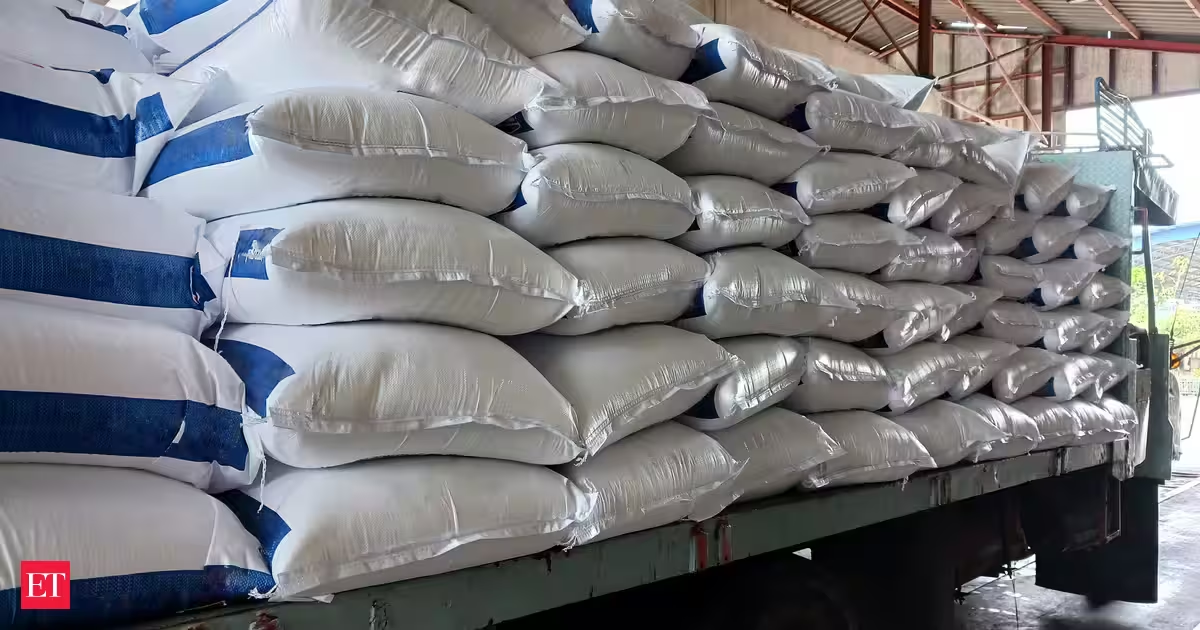
DIPAM had turned down these requests of DoF, arguing that Central Public Sector Enterprises (CPSEs) contribute only 25 per cent and 11 per cent of the country’s urea and non-urea fertilizer production, respectively
| Photo Credit:
iThe Department of Investment and Public Asset Management (DIPAM) has turned down requests to declare the fertilizer sector ‘strategic’ under the New PSE Policy. Following the rejection, a parliamentary standing committee has now urged the government to establish interim safeguards to protect the interests of state-owned fertilizer companies.A parliamentary panel on fertilizers commended the Department of Fertilizers (DoF) for taking up the “strategic" tag issue again with DIPAM and DPE in late 2025. However, in its report tabled on Monday, the committee cautioned that until the reclassification is finalised, state-owned fertilizer companies remain subject to the existing disinvestment policy.“In this context, the Committee reiterate their earlier recommendation that DoF furnish an updated status of the matter, including responses received from the concerned authorities (DIPAM), the proposed course of action in the event of delays, and any interim measures being considered to safeguard the interests of fertilizer PSUs pending a final decision on reclassification,” the panel said.DIPAM argumentsAccording to the New PSE Policy of 2021, all the PSUs “in non-strategic sectors shall be considered for privatisation, where feasible, otherwise such enterprises shall be considered for closure.” Only Atomic Energy, Space and Defence, Transport and Telecommunication, Power, Petroleum, Coal and other minerals, Banking, Insurance and Financial Services have been classified under the strategic sectors while all others fall under non-strategic category.The report also said that DIPAM had turned down these requests of DoF, arguing that Central Public Sector Enterprises (CPSEs) contribute only 25 per cent and 11 per cent of the country’s urea and non-urea fertilizer production, respectively. Besides, many operate at a loss and that their continued existence is inconsistent with fiscal prudence and the criteria for strategic classification, as approved by the Cabinet Committee on Economic Affairs (CCEA) under the new policy.But the panel said: “The Committee find this reasoning incongruent with the Government’s Atmanirbhar Bharat agenda. Contrary to DIPAM’s claim, several fertilizer PSUs have shown remarkable turnaround, notably FACT, which has transitioned from a loss-making entity to a consistently profitable enterprise.‘Need for balanced policy’“Additionally, the revival of closed units at Gorakhpur, Sindri, Barauni (under HURL) and Ramagundam (under RFCL) through CPSE-led joint ventures, has added over 76.2 lakh tonnes (lt) to India’s annual urea production capacity. This clearly demonstrates the strategic value of leveraging PSU assets to meet national goals. In light of rising global fertiliser prices and India’s continued reliance on imports for over 90 per cent of its potash and phosphate needs (procured under the Open General License), the sustained operation and strengthening of fertilizer PSUs is crucial—not only for domestic production but also for price stabilization, disaster resilience, and long-term food sovereignty.”The panel has also urged the government to continue efforts to revitalise the fertiliser sector by ensuring adequate support for modernisation, technology upgradation, and capacity expansion of these PSUs. Further, it emphasised the need for a balanced policy approach that strengthens domestic production capabilities while reducing over-dependence on imports of vital raw materials such as potash and phosphates.Published on July 27, 2026