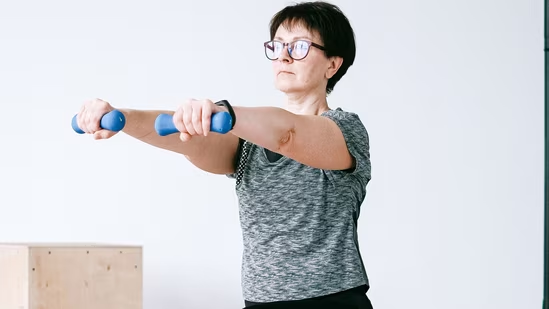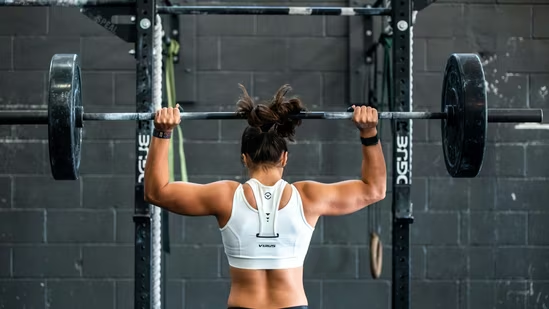
Strength training lowers the risk of many ailments in your 50s and 60s. (Picture credit: Unsplash) Take it from an expert on why the first step of long-term spinal protection is maintaining muscle health. As one grows older, weight management becomes an indispensable part of health conversations, as it is essential for mobility and spinal health. However, after 50, the gradual loss of muscle mass and strength may also affect one's ability to move. What potential health problems can this cause? Let's hear from a specialist.ALSO READ: Nerve pain vs muscle pain: Spine surgeon shares how to tell the differenceDr Vuppu Ravikanth, consultant in neuro and spine surgery at Manipal Hospitals, Vijayawada, warned that preserving muscle mass after 50 may be even more important than managing weight.“Spine doctors who work on treating spinal conditions now identify muscle atrophy as the major factor which creates more serious consequences for spine health compared to their primary medical focus,” the surgeon said. His observation highlights the medical community's growing recognition of muscle loss as a significant threat to spinal health.Why is muscle loss a threat to spinal health?First, let's understand why muscles are necessary for spinal support. The surgeon broke down the reason behind this: "The muscles that exist around the spine function as essential elements which help people sustain their standing position while they keep their body balanced and their backbone in proper alignment. The spinal structure requires muscle mass and strength to function as its essential support system, which decreases in capacity when people reach advanced age.”This weakening of the spine's muscular support may worsen scoliosis, an abnormal curvature of the spine. Dr Ravikanth also stated that sarcopenia, the age-related loss of muscle mass, strength and function, may contribute to disability and reduced mobility.“People who experience lower muscle mass develop more severe spinal curvature problems and chronic back pain, and their ability to move decreases more than people who maintain their muscle strength,” he added.So people who suffer muscle loss may end up experiencing worse spinal curvature, and even greater back pain and mobility trouble. Meanwhile, those who preserve their muscle strength may be able to have better spinal health with mobility intact as they age.How to maintain good muscle health?Eat protein to maintain your muscle mass. (Picture credit: Unsplash)The surgeon explained that postmenopausal women and older adults with existing spinal degeneration are especially vulnerable.Since muscle loss can worsen spinal curvature and reduce stability, some older adults may develop a stooped posture and may have trouble walking.Dr Ravikanth suggested some techniques to maintain muscle health: " I recommend strength training with proper protein consumption and vitamin D levels and regular physical exercise to maintain muscle health."When you follow these, he believed scoliosis progression would slow down. He also stressed the fact that maintaining muscle strength should be viewed as an essential component of scoliosis management.More about the expertDr Vuppu Ravikanth has over 20 years of experience. He is a neurosurgeon, and his areas of interest include brain tumours, spine tumours, tumours in newborn babies, all types of neuro problems in children, head injuries and spine injuries.Note to readers: This article is for informational purposes only and not a substitute for professional medical advice. Always seek the advice of your doctor with any questions about a medical condition.Adrija Dey’s proclivity for observation fuels her storytelling instinct. As a lifestyle journalist, she crafts compelling, relatable narratives across diverse touchpoints of the human experience, including wellness, mental health, relationships, interior design, home decor, food, travel, and fashion that gently nudge readers toward living a little better. For her, stories exist in flesh and bones, carried by human vessels and shaped through everyday endeavours. It is the small stories we live and share that make us human. After all, humans and their lores are the most natural and raw repositories of stories, and uncovering them, for her, is akin to peeling an orange under a winter afternoon sun. Always up for a chat, she believes the best stories come from unfiltered yapping, where "too much information" is kind of the point. A graduate of Indraprastha College for Women, University of Delhi, and an alumna of the Indian Institute of Mass Communication (IIMC), Delhi, Adrija spends her idle hours cocooned with herbal tea and a gripping thriller, scribbling inner monologues she loosely calls poetic pieces, often with her succulents in attendance. On lazier days, she can be found binge-watching, for the nth time, one from her comfort-show holy trinity: The Office (US), Brooklyn Nine-Nine, or Modern Family. Dancing by herself to her peppy playlists, however, is an everyday ritual she swears by religiously.Read MoreMuscle LossCatch every big hit, every wicket with Crick-it, a one stop destination for Live Scores, Match Stats, Quizzes, Polls & much more. Explore now!.Catch your daily dose of Fashion, Taylor Swift, Health, Festivals, Travel, Relationship, Recipe and all the other Latest Lifestyle News on Hindustan Times Website and APPs.See Less
What happens when you lose muscle after 50? Surgeon Dr Vuppu Ravikanth warns it may harm your spine
Take it from an expert on why the first step of long-term spinal protection is maintaining muscle health. | Health
818 words~4 min read